This post contains affiliate links. This means I may earn a small commission if you purchase through my links at no extra cost to you.
Sometimes the best Thanksgiving meal is the one where nobody is arguing over whose recipe to make, who has to host, or why the menu cannot change.
That is part of the appeal of Friendsgiving. You get the good parts of Thanksgiving, great food, a full table and people you enjoy, without having to follow every family tradition.
A friend can bring the dish they love, someone else can handle dessert, and the whole group can decide what makes the evening fun.
So, if your idea of a great Friendsgiving is more than putting turkey on a table and calling everyone over, these 25 Friendsgiving party ideas can help you make the celebration feel genuinely yours and theirs too.
Planning a creative evening with friends? Start with How to Plan a Virtual Craft Night Party with Friends (DIY Girls Night Guide).
1. Let Everyone Bring a Dish With a Story
A potluck can fill the table without doing much for the conversation.
People may compliment the food, but once everyone has served themselves, guests often fall back into the conversations they were already having.
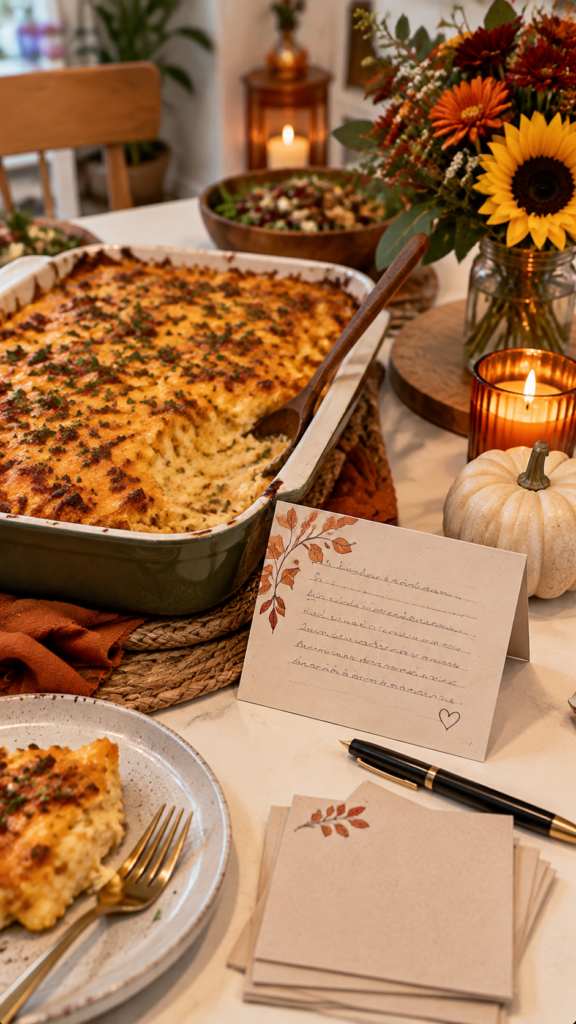
Give each dish a little more meaning by asking guests to bring something connected to a person, place, memory or tradition.
It could be a dessert they always had growing up, a dish they learned from a relative, a recipe from a place they once lived, or simply something they make whenever friends come over.
Then give each guest a small card to write the story behind their dish. Place the cards beside the food so people can read them while serving themselves, or let each person share the story before dinner.
This works especially well when not everyone at the table knows each other.
Instead of having to come up with an icebreaker, guests already have something specific to ask about: Who taught you to make this? What place is this recipe from? or Why did you choose this dish?
Keep the request simple, though. The story does not need to be sentimental or connected to Thanksgiving. The point is to give the food a personal connection and give the people around the table an easy reason to talk.
What to have: small recipe cards or blank cards, pens and simple card holders or stands for displaying them beside the dishes.
2. Host a “No Turkey Required” Friendsgiving
Friendsgiving does not have to be Thanksgiving dinner with a different guest list.
If nobody in the group particularly wants turkey, there is no reason to make it the centre of the meal simply because it is associated with the holiday.
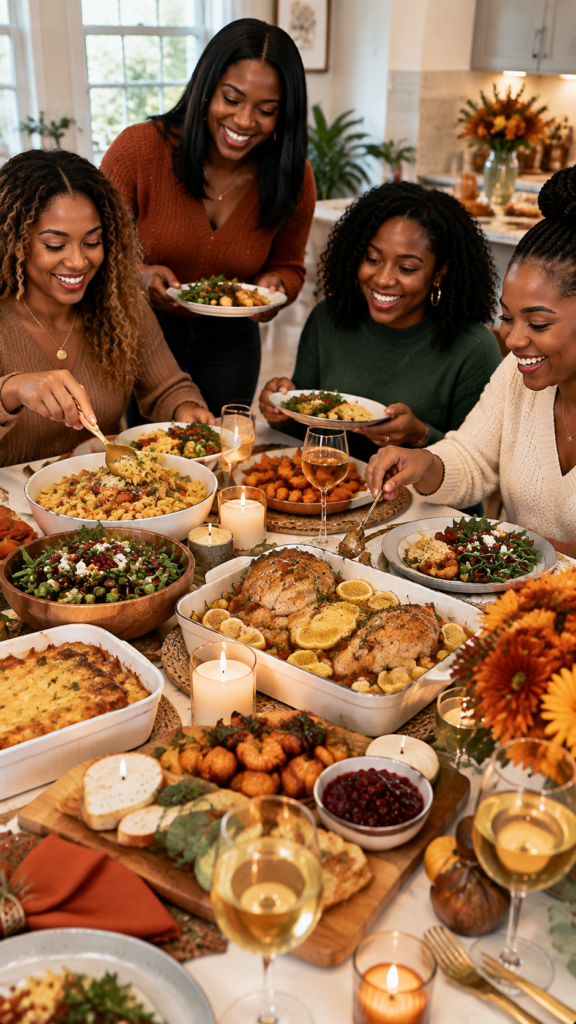
Choose one main dish that suits the people coming instead. It could be baked pasta, roast chicken, salmon, a vegetarian pie, tacos or a dish that has a personal or cultural connection to the group.
This can also make hosting easier. A large turkey takes planning, oven space and enough guests to make the leftovers worthwhile.
A different centrepiece may fit the size of your gathering and the cooking setup you already have much better.
The important part is to make the meal feel intentional. If the main dish is tacos, for example, build the rest of the menu around it rather than adding a traditional Thanksgiving spread just because it is expected.
Friendsgiving is a chance to decide what your group actually wants to eat, not to recreate a family menu out of obligation.
3. Turn the Potluck Into a Planned Menu
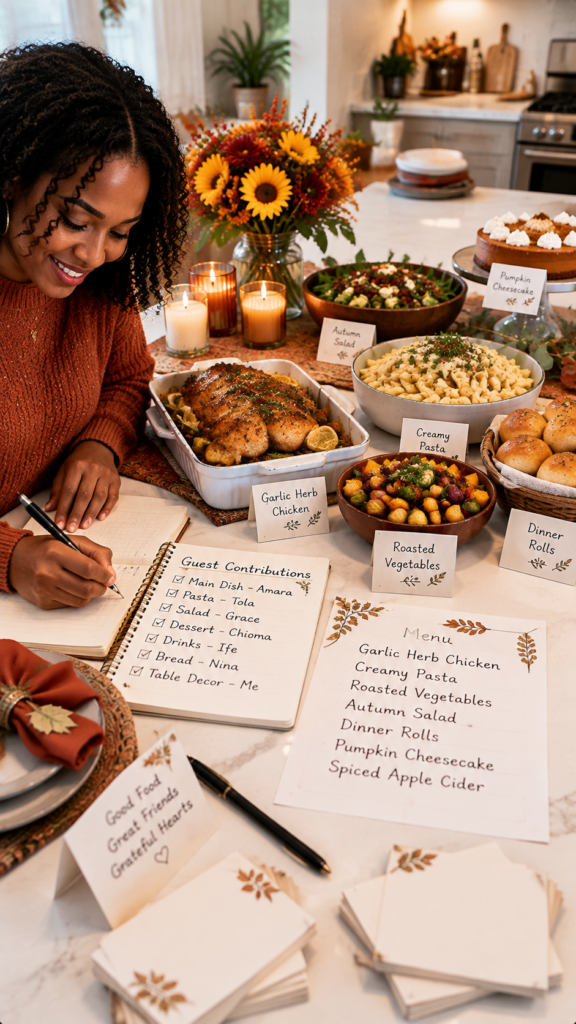
“Everyone bring something” sounds easy until six people arrive with desserts and nobody has brought enough food for the main meal.
Avoid that problem by assigning broad food categories before the party.
You might have one person bring the main dish, while others cover a substantial side, vegetable, starch, salad, bread, dessert and drinks.
And you do not need every category for a small gathering; the point is to create enough variety without leaving important parts of the meal to chance.
For a larger Friendsgiving, you can also ask guests to claim a category rather than a specific recipe. That gives them room to choose something they enjoy making while helping the host see what is still missing.
The host should keep responsibility for anything the meal cannot do without.
If nobody claims the main dish, for example, don’t assume someone will remember it at the last minute. The same applies to basics such as serving utensils, ice or enough drinks.
A simple shared list can make this much easier.
Guests can see what has already been claimed before choosing their contribution, which cuts down on duplicate dishes and leaves the host with a clearer picture of the meal.
Useful supplies: food labels or markers for identifying dishes, a clipboard or simple menu sheet for keeping track of contributions, and small menu cards if you want guests to know what is being served.
4. Make It a “Bring Your Tradition” Dinner
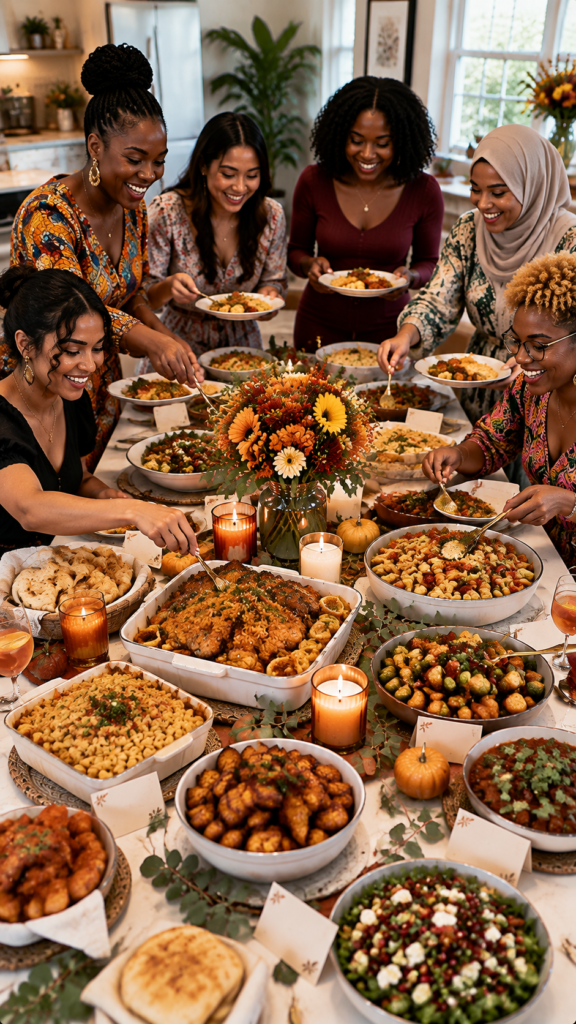
One way to make a Friendsgiving party feel more personal is to let everyone bring a dish that says something about where they come from or the people who influenced their cooking.
Ask guests to choose a family recipe, a dish associated with their region, something they grew up eating, or a food tradition they have adopted along the way.
It does not have to be a traditional Thanksgiving dish. A guest might bring a recipe their grandmother made, a favourite dish from their hometown, or something their family serves for another holiday.
This gives the meal more variety without turning it into a forced “international” theme. The interesting part is hearing why each dish made it onto the table.
For a simple touch, place a small card beside each dish with its name and a sentence or two about its connection to the person who brought it.
Guests can read the cards as they serve themselves, then ask questions naturally during dinner.
It also takes some pressure off the host. Instead of planning one menu that represents everyone, each guest gets to contribute a small part of the meal.
5. Create a Friendsgiving Grazing Dinner Instead of a Sit-Down Meal
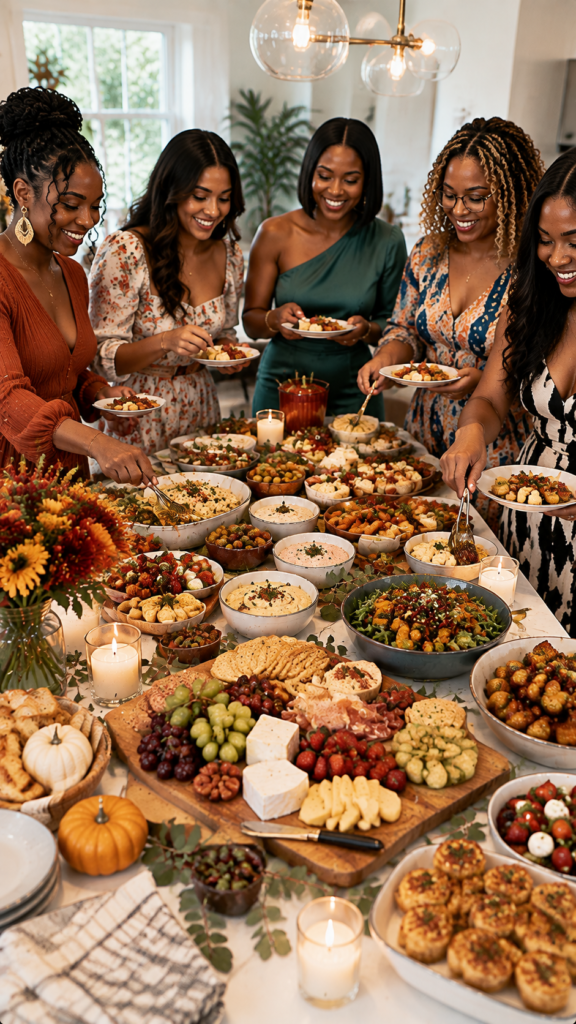
Not every Friendsgiving needs a formal dinner with everyone seated at the same table at the same time.
For a group that prefers to move around, talk and eat throughout the evening, a grazing-style Friendsgiving party can make more sense.
Build the food around items that are easy to pick up and serve in small portions. You could offer dips with bread or crackers, cut vegetables, fruit, cheese, small sandwiches, bite-size savoury foods and a selection of desserts.
The key is to choose foods that can comfortably sit out for serving and to keep perishable foods within safe temperature limits.
Don’t treat “grazing” as a reason to leave everything at room temperature all evening; foods that require refrigeration still need proper handling.
Set the food up in one area rather than spreading dishes throughout the room. This creates a natural place for people to gather without requiring everyone to sit down for a full meal.
It is particularly useful for Friendsgiving gatherings where people want a more relaxed party atmosphere, or where the space does not comfortably accommodate a large seated dinner.
Useful supplies: large serving trays, tiered stands, small appetizer plates, serving utensils and food picks.
6. Try a “Three-Course, Three-Person” Friendsgiving
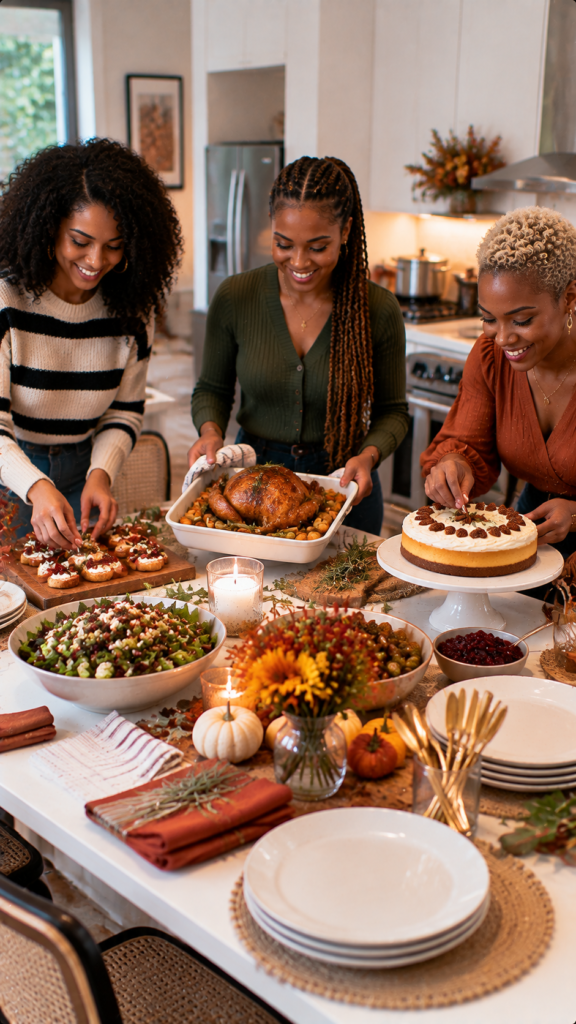
A potluck does not have to mean asking ten people to bring ten unrelated dishes.
For a smaller group, make the meal easier to coordinate by giving three people responsibility for the three main stages of the meal.
One person handles the starters, another takes care of the main course, and a third brings dessert. Everyone else can contribute drinks, a side dish or something needed for the table.
This works because each person has a clear responsibility without putting the entire meal on the host.
It also makes the menu easier to plan: the starter can complement the main dish, and the dessert can finish the meal without leaving everyone with several unrelated foods.
Before the Friendsgiving party, have the three people agree on what they are making.
That prevents a situation where the starter, main and dessert all require the same oven, competing for the same ingredients, or leave guests with far more food than the group can reasonably eat.
For a small gathering, this can be a better alternative to a large potluck because fewer people are cooking, the menu has some direction, and everyone still gets a meaningful way to contribute.
7. Give Guests Jobs Instead of More Food
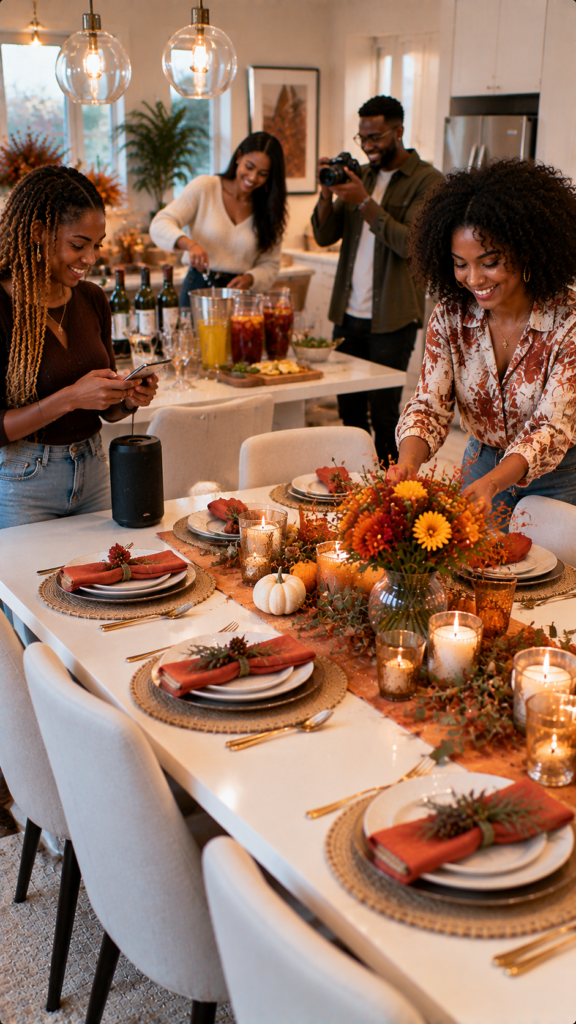
Not every guest needs to arrive carrying another casserole.
For some people, cooking may be inconvenient, especially when they are travelling, working late, have limited kitchen space, or simply are not confident in the kitchen.
You can still make them part of the Friendsgiving planning by giving them a useful job instead.
One person can take charge of the playlist, another can handle photos, while someone else sets the table or organises drinks.
A guest who arrives early can help with setup, and someone who needs to leave later can take responsibility for packing leftovers.
This also helps the host avoid doing every small task alone. A Friendsgiving works better when the work is shared, not just the food.
The jobs do not need to be formal assignments.
When sending the invitation, ask guests what they would rather contribute: food, supplies, time or a specific task.
Someone who does not want to cook may be perfectly happy to bring ice, manage the music or help clean up.
Make your next handmade gift more personal with ideas from Crafts to Make for Friends: Meaningful DIY Gift Ideas They’ll Actually Love.
8. Create One “Build Your Own” Food Station
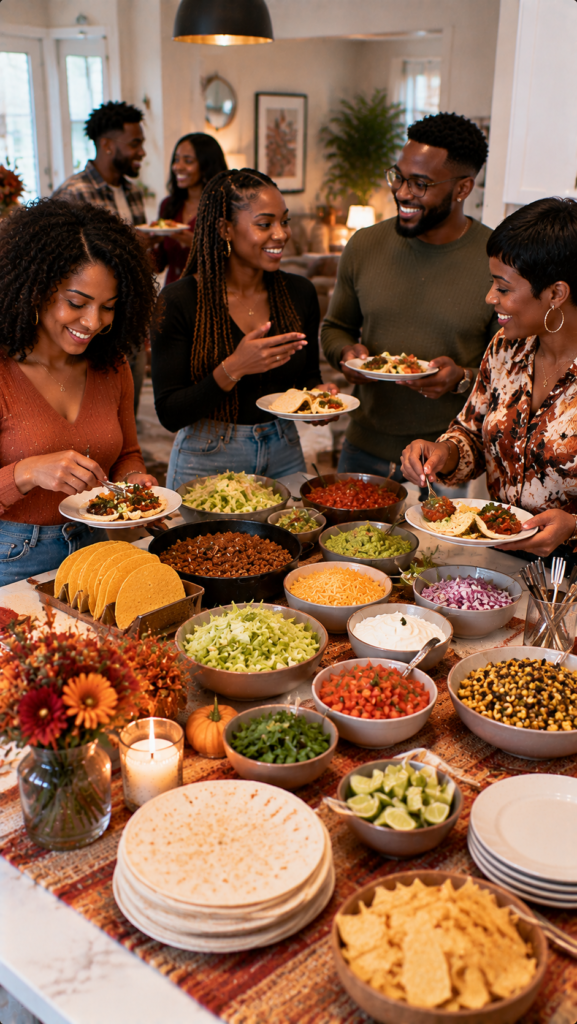
An interactive food station can give guests something to do while they eat, but you do not need to turn the entire meal into a DIY buffet.
Choose one food that works well with different toppings or combinations. A baked potato bar could have cheese, vegetables, herbs and other toppings.
A taco station could offer fillings, tortillas, salsa and toppings. For dessert, guests could add toppings to pie, ice cream or another simple sweet.
The advantage is choice without creating a complicated menu. The base food stays the same, while guests customise their portion according to what they like.
Keep the station manageable by preparing the ingredients in advance and providing the serving utensils guests need.
Cold toppings that need refrigeration should stay chilled rather than sitting out throughout the party.
One well-planned station is usually enough. When every course requires guests to assemble their own food, the host has more preparation to manage and the meal can start feeling like a buffet project rather than a party.
9. Host a Recipe Swap Alongside Dinner
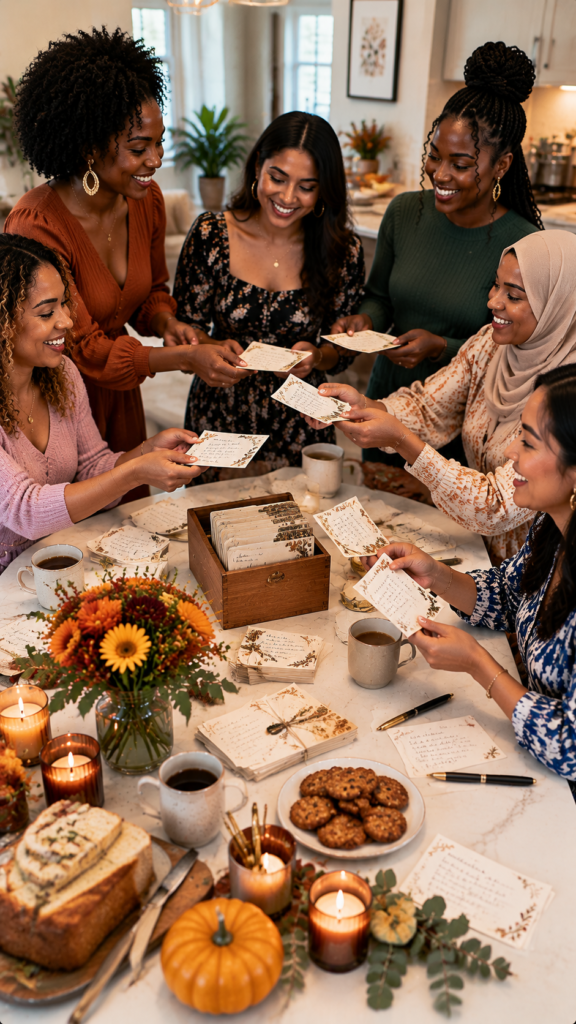
A recipe swap gives the evening something to take home besides leftovers.
Ask guests to bring a favourite recipe written or printed on a card. It does not have to be the dish they brought to dinner, and they do not have to cook it for the party.
After the meal, guests can exchange recipes or choose one that interests them.
This works particularly well when the group enjoys cooking because the exchange can continue after Friendsgiving.
Someone might leave with a recipe they heard about at dinner and later make it for their own family or another gathering.
For a group that wants to keep the tradition going, collect duplicate recipe cards in a small binder or recipe box. Over time, it can become a record of the dishes associated with your friend group.
Hosting essentials : recipe cards, a recipe box or binder, card sleeves and a ring for keeping loose recipe cards together.
10. Make the Table a Conversation Map
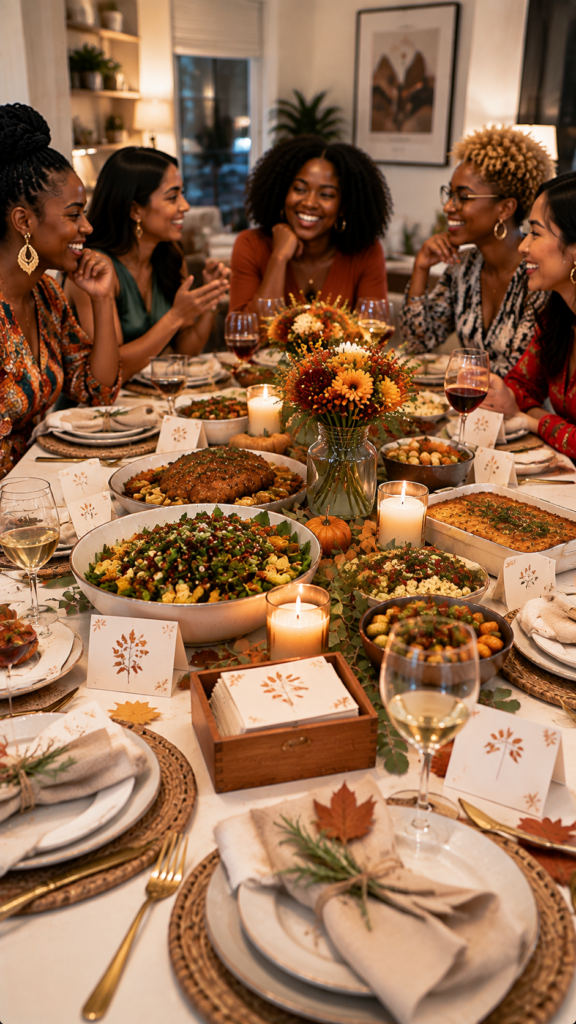
A long table does not automatically make everyone feel included. When guests come from different parts of your social circle, people who already know each other well can easily spend the entire meal talking among themselves.
A little thought about seating can help.
You could place newer friends beside people who are naturally good at keeping a conversation going, or seat guests with a shared interest near one another.
You can also separate two very close friends occasionally so that more people have a chance to interact.
This does not mean turning Friendsgiving into a formal dinner with strict seating rules.
Simple place cards are enough to give the arrangement some direction, particularly when you have a larger group.
The goal is not to control who talks to whom. It is to prevent a table full of people from becoming several separate conversations happening side by side.
Items worth having : simple place cards and small holders if you want the seating arrangement to be clear when guests arrive.
11. Set Up a “Tell Us How You Know the Host” Icebreaker
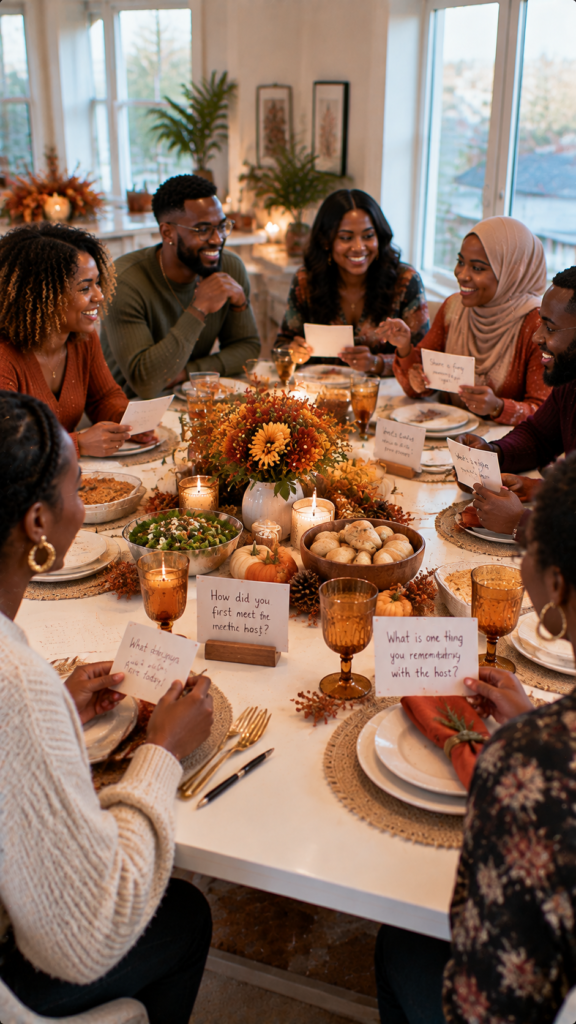
Friendsgiving can bring together people from completely different parts of the host’s life.
A college friend, coworker, neighbour and longtime family friend may all end up at the same table without knowing much about one another.
Instead of asking everyone to introduce themselves or answer a generic Thanksgiving question, give each person a small card with a specific prompt:
How did you first meet the host?
or
What is one thing you remember doing with the host?
Guests can read their answers aloud before dinner or leave the cards on the table for people to read and discuss.
The useful part is that the questions already give people something to talk about.
One answer can bring up a shared memory, introduce someone to a new part of the host’s life, or lead to a story involving several guests.
Keep the prompts specific and easy to answer. The goal is to get conversations moving, not put anyone on the spot with a question that requires a deeply personal response.
Items to have on hand: blank cards or conversation cards, pens and small holders if you want to display the responses.
12. Make the Party a Blind Taste Test
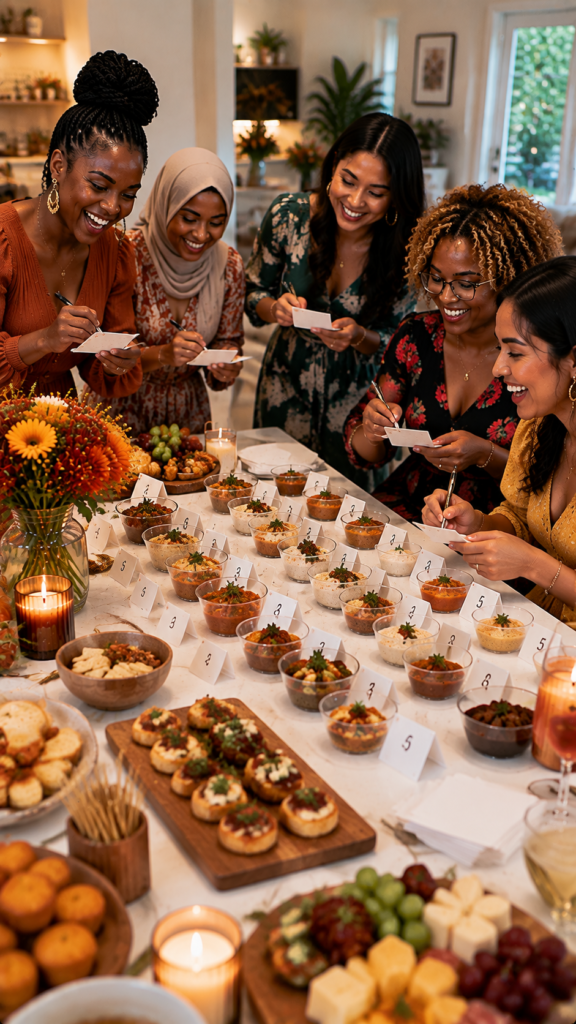
You can turn part of the food into an activity without preparing a separate party game.
Choose a few similar foods or drinks, serve them without revealing the brands or flavours, and let guests taste and rank them.
For example, you could compare different pies, apple ciders, sparkling drinks, snacks, sauces or hot chocolate toppings.
Give each sample a number rather than its name, then have guests record which one they prefer.
The trick is to keep the comparison manageable. Three or four samples are enough for a short activity; too many can make the tasting repetitive and leave you with more food than the group can reasonably finish.
It also helps to choose items that can be served safely at the appropriate temperature. Perishable foods should not simply be left out for the entire evening because they are part of a game.
Once everyone has voted, reveal what they tasted and see whether the group’s favourite matched the host’s prediction.
This works well for a Friendsgiving party because the activity uses food you can serve anyway.
You are giving guests something to do without buying a complicated game or adding another major activity to the schedule.
What you’ll need: small numbered cups or plates, tasting portions, pens and simple voting cards.
13. Create a “Guess Who Brought It?” Potluck Game
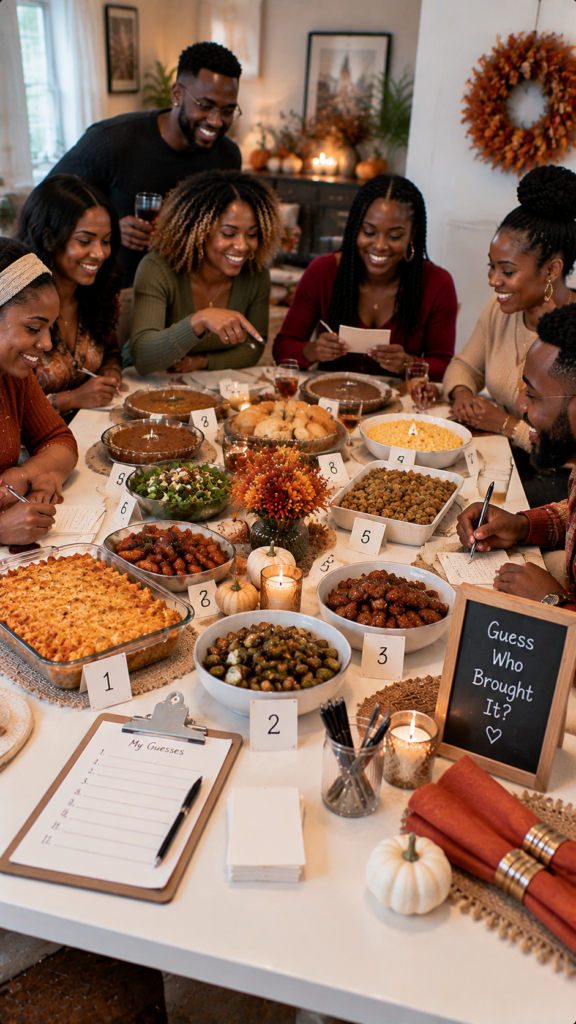
A potluck can create a small mystery of its own: everyone knows the dishes on the table, but does everyone know who made them?
Before guests arrive, assign each dish a number without putting the cook’s name beside it. During the meal, guests can look at the numbered list and write down who they think brought each dish.
After everyone has eaten, reveal the answers and see who identified the most dishes correctly.
This is particularly useful when the group includes people who do not know one another well.
Instead of asking guests to make conversation from nothing, the food gives them an easy topic: I thought you made the pasta, what did you put in it?
Don’t make the game too serious. The point is the guessing and the conversation, not proving who has the best cooking skills.
You can give the winner a small, inexpensive prize, or simply let getting the most correct answers be the reward.
For food that has a particularly strong smell, appearance or recognisable ingredient, the guessing can become surprisingly difficult, which is part of the fun.
Party essentials: numbered food cards, pens, voting slips and an optional small prize for the winner.
14. Let Guests Build the Friendsgiving Playlist
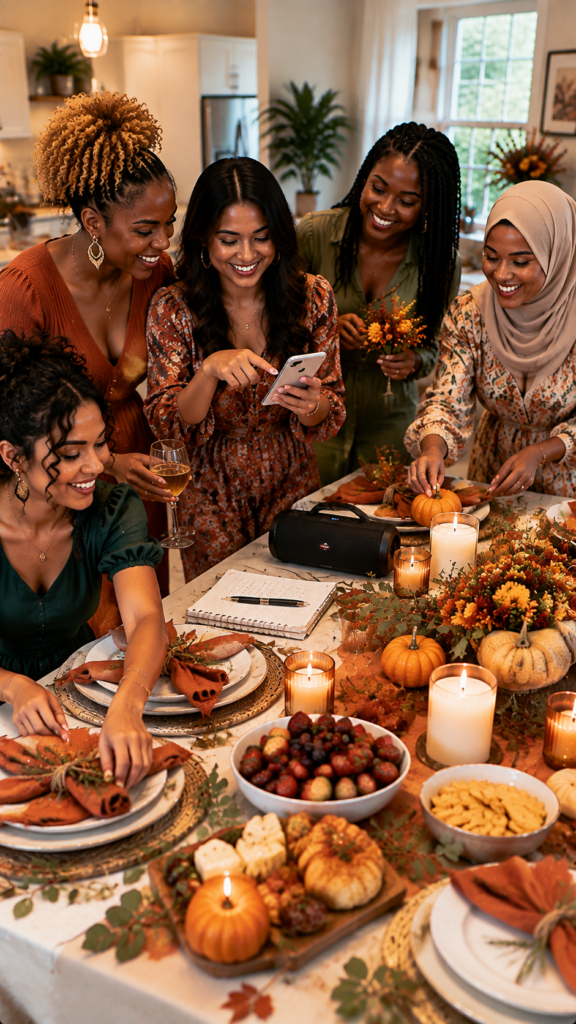
Music can quietly become a hosting problem when one person has to choose everything.
Their playlist might suit them perfectly while leaving half the room wondering when their kind of music is coming on.
Give each guest a small part of the playlist instead. Ask everyone to choose one song, then organise the selections around different parts of the evening: arrival, cooking, dinner and after dinner.
You don’t have to play every song immediately or give everyone complete control of the music. The host can arrange the selections so the volume and mood fit what is happening.
For a larger group, you could let guests vote on a few nominated songs rather than trying to fit everyone’s entire playlist into one evening.
The benefit is simple: the music becomes something the group contributes to, rather than another decision the host has to make alone. It can also give guests an easy conversation starter when they hear a song someone chose.
What to have on hand: a phone or music device, a reliable speaker and a prepared playlist so the music does not depend on someone’s phone battery throughout the evening.
Turn Halloween into a shared project with 25 Matching Halloween Costumes for Best Friends : Trending DIY Ideas You Can Make Together.
15. Turn Dessert Into Its Own Part of the Party
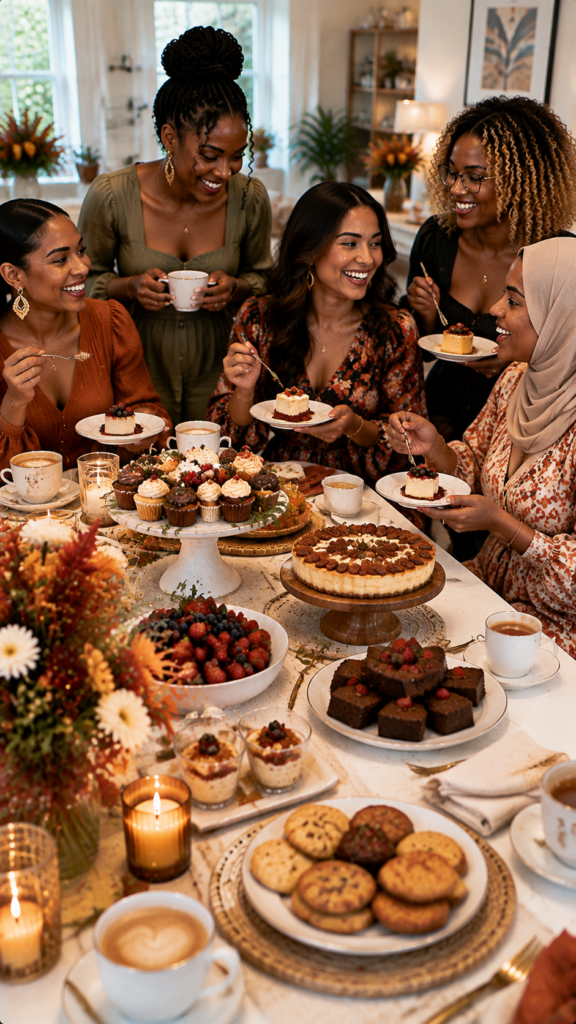
Dessert does not have to appear on the table five minutes after everyone finishes dinner. Give it its own moment and you can create a natural second phase of the evening.
A simple way to do this is a small pie tasting with coffee or tea. Instead of serving several full-size desserts, cut them into smaller portions so guests can try more than one.
You could do the same with cookies, brownies or other desserts that are easy to portion.
This approach also helps with a common hosting problem: making too many desserts for a group that is already full after dinner.
Smaller tasting portions let people sample different choices without committing to a large serving of each.
After dinner, clear the main dishes, bring out the desserts and move the coffee or tea to a separate area.
The physical change helps the gathering shift from dinner to after-dinner conversation without needing another formal activity.
Items to have on hand: small dessert plates, serving utensils, a cake or pie server, cups and a tray for carrying drinks.
16. Host a Friendsgiving Leftovers Exchange
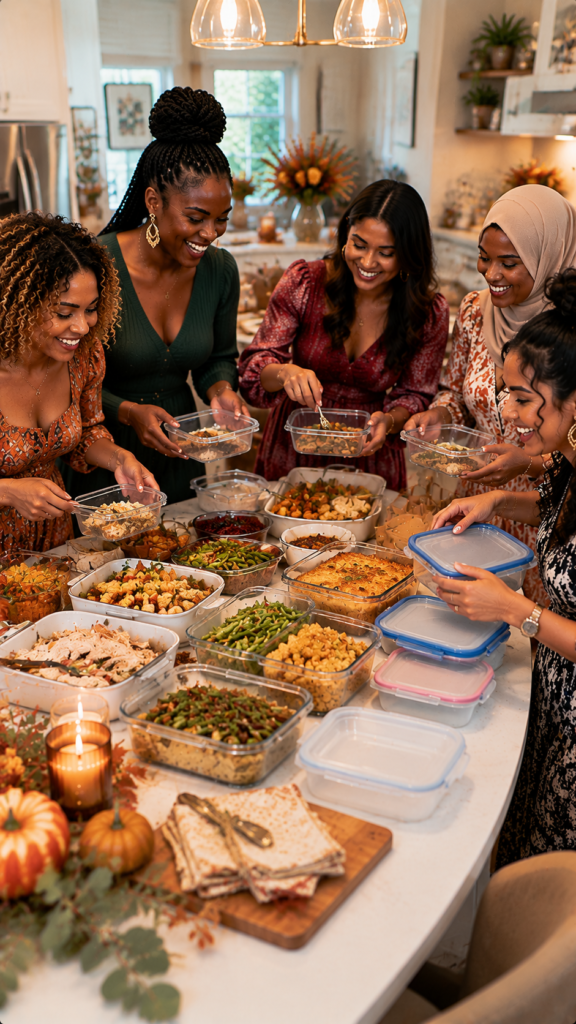
A successful Friendsgiving can leave the host with a refrigerator full of food.
Sending everyone home with a random container at the end of the night can also become confusing, especially when several dishes look similar.
Plan for leftovers before the party starts.
Ask guests to bring a reusable container if they are comfortable taking food home, or keep a supply of food-storage containers available.
After the meal, divide reasonable portions among guests instead of leaving every remaining dish with the host.
Label containers when necessary, particularly when foods contain ingredients that guests may need to know about.
There is also an important food-safety reason not to treat leftovers casually.
The USDA advises refrigerating perishable food within two hours of being served, or within one hour when the temperature is above 90°F (32°C).
Leftovers should also be stored promptly in suitable containers rather than being left on the table while guests continue talking.
So make the exchange part of the cleanup routine: pack food, label it, refrigerate what needs to be kept cold, and then move on to the rest of the evening.
This turns leftovers from a hosting burden into part of the Friendsgiving experience while helping prevent food from being handled or stored carelessly.
Hosting essentials: reusable food containers, labels, food-safe markers and storage bags.
17. Create a Friendsgiving After-Dinner Café
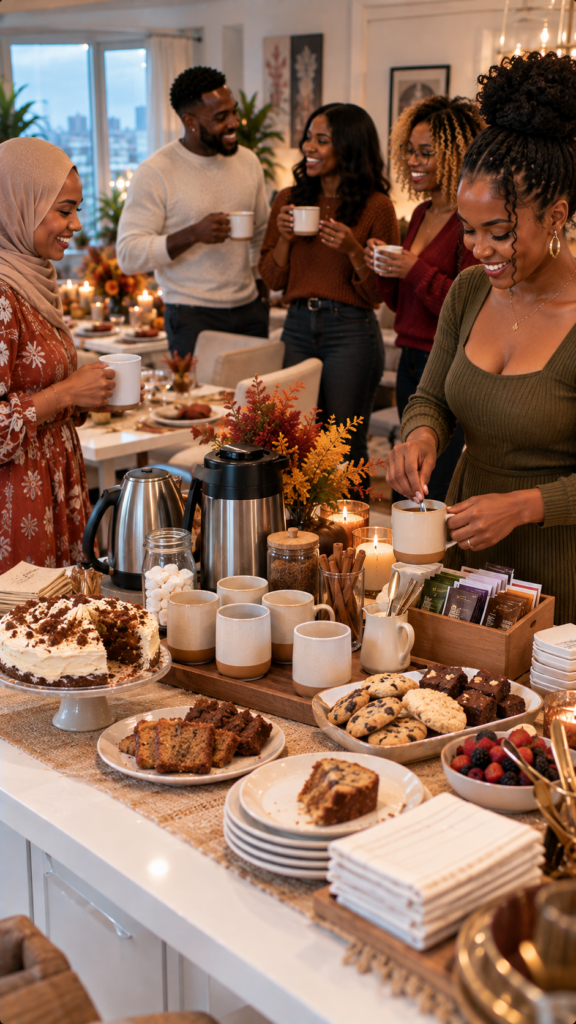
Once dinner is over, move the group away from the main dining area and create a small self-serve drinks and dessert spot.
You could offer coffee, tea, hot chocolate or cider alongside whatever dessert remains. Guests can help themselves while they continue talking rather than waiting for the host to serve another course.
This is especially useful when the dining table has become crowded with plates, serving dishes and empty glasses.
Clearing that space and giving drinks their own area makes the transition easier and gives guests somewhere else to gather.
You don’t need a dedicated coffee machine or elaborate beverage setup. A tray with mugs, a kettle or insulated carafe and a few drink options can do the job.
Keep hot drinks hot and use suitable containers for serving them safely. For a larger group, a self-serve setup also means the host does not have to keep getting up every few minutes to refill everyone’s cup.
Practical additions: mugs, a serving tray, an insulated carafe or beverage dispenser, and an electric kettle if you are preparing hot drinks.
18. Send Guests Home With Something They Can Eat
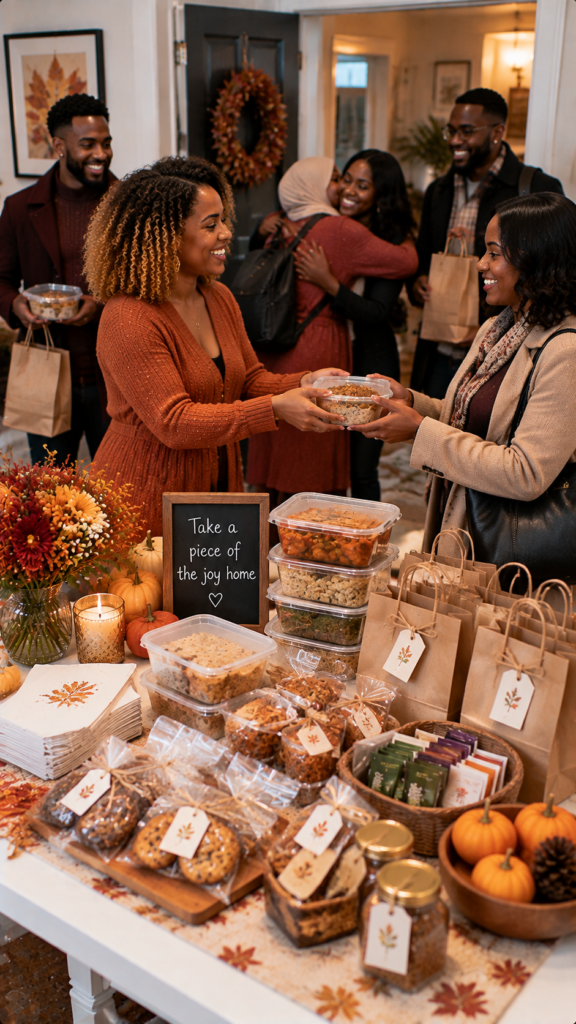
Party favours do not have to be another decorative item guests will eventually put in a drawer.
For Friendsgiving, an edible takeaway can make more sense because it connects directly to the meal.
You could send guests home with a few cookies, part of a dessert, homemade snack mix, tea, a small spice blend or another food that stores and travels well.
You can also use the leftovers exchange for this. Instead of creating a separate favour for everyone, portion some suitable food into containers and let guests take it home.
The important part is to choose something that is genuinely useful and easy to transport. A small amount is enough; guests do not need another full meal packed into their bags.
If you are giving homemade food, label it when ingredients or allergens may not be obvious. That small step is particularly helpful when you have guests who did not prepare the food themselves.
Items worth having: small food containers, paper bags, labels, ribbon or simple stickers if you want the takeaway to look finished without turning it into an elaborate party favour.
19. Make It a “Friendsgiving Photo Spot” Without Building a Booth

You don’t need a balloon wall, rented backdrop or a corner filled with props to get good Friendsgiving photos.
Choose one uncluttered spot with decent lighting and make it the place where guests can take pictures. A plain wall, tidy bookshelf or a well-lit area near a window can work.
Add one simple detail that connects it to the evening, such as flowers, a seasonal arrangement or the dinner table in the background.
A phone tripod can make group photos much easier because nobody has to keep asking one person to take every picture. A remote shutter or timer also lets the whole group get into the shot.
Think beyond one posed group photograph. Take a few pictures while people are cooking, serving food or talking.
Those candid photographs often capture more of the evening than having everyone pose repeatedly.
The goal is to create an easy Friendsgiving photo opportunity, not another setup that takes an hour to build and another hour to dismantle.
Items for the setup: a phone tripod, remote shutter, simple backdrop if the room needs one, and a few understated photo props.
20. Host Friendsgiving for People Who Can’t Travel Home
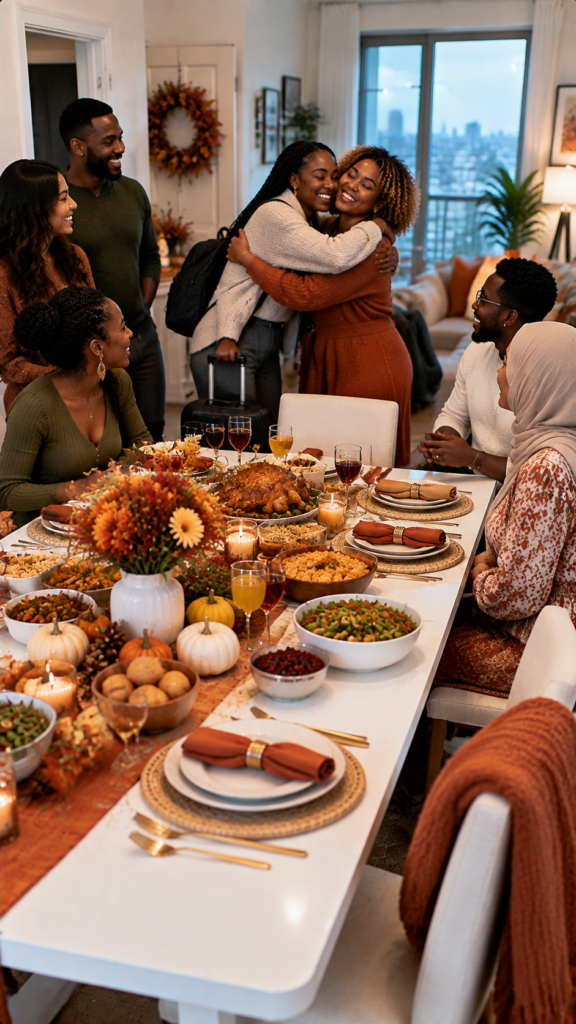
Friendsgiving can be particularly meaningful for people who will not be spending Thanksgiving with their families.
Someone may be studying or working away from home, living in another city, unable to travel, or simply choosing to spend the holiday with friends.
The important part is how you invite them.
Instead of a vague “Come over for Thanksgiving,” make the purpose clear: we’re having Friendsgiving, and we’d love you to b.e there That makes the invitation feel intentional rather than like an open seat that happened to be available.
You can also ask about practical things before the day arrives.
Does the guest have somewhere to stay if the gathering runs late? Do they have dietary restrictions? Are they comfortable bringing something, or would they rather simply come and enjoy the evening?
Don’t assume everyone who cannot travel wants to talk about being away from family, either. Give people room to enjoy the gathering without making their circumstances the focus of the night.
That small change in how you plan the event can make a Friendsgiving party feel welcoming rather than like a substitute gathering for people who had nowhere else to go.
21. Make a Small-Space Friendsgiving Work
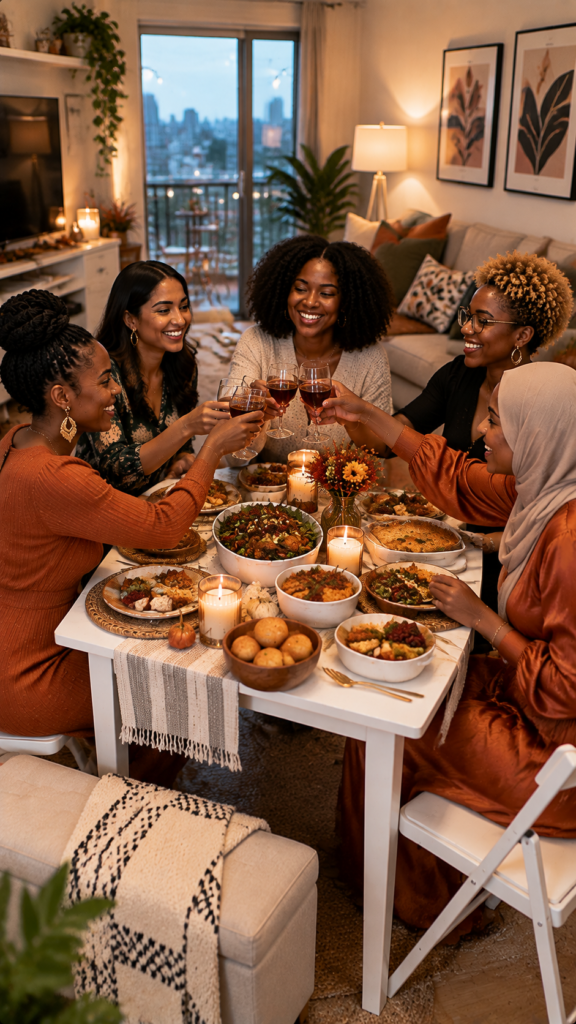
A Friendsgiving party does not require a dining room large enough to seat everyone around one table.
The bigger problem in a small home is usually traffic: people trying to serve themselves, refill drinks, find their coats and sit down in the same limited space.
Separate those functions where you can.
Keep the main food together in one area rather than placing serving dishes across every available surface.
Set drinks somewhere guests can reach without standing beside the food.
Keep coats and bags away from the eating and serving areas, and use folding or stackable seating when permanent chairs are limited.
You can also serve food in stages rather than putting everything out at once. Starters can come first, followed by the main meal and then dessert.
That reduces the number of dishes competing for table space at the same time.
For a very small room, guests do not all have to eat from a formal dining table. A combination of chairs, stools and a comfortable sitting area can work, provided guests have a stable place to put their food and drinks.
The aim is not to make a small home look like a banquet hall. It is to make the available space easy to move through.
Space-saving party supplies: folding chairs, stackable stools, a compact serving table, trays and storage containers for clearing dishes.
22. Have a “No Cooking Required” Friendsgiving
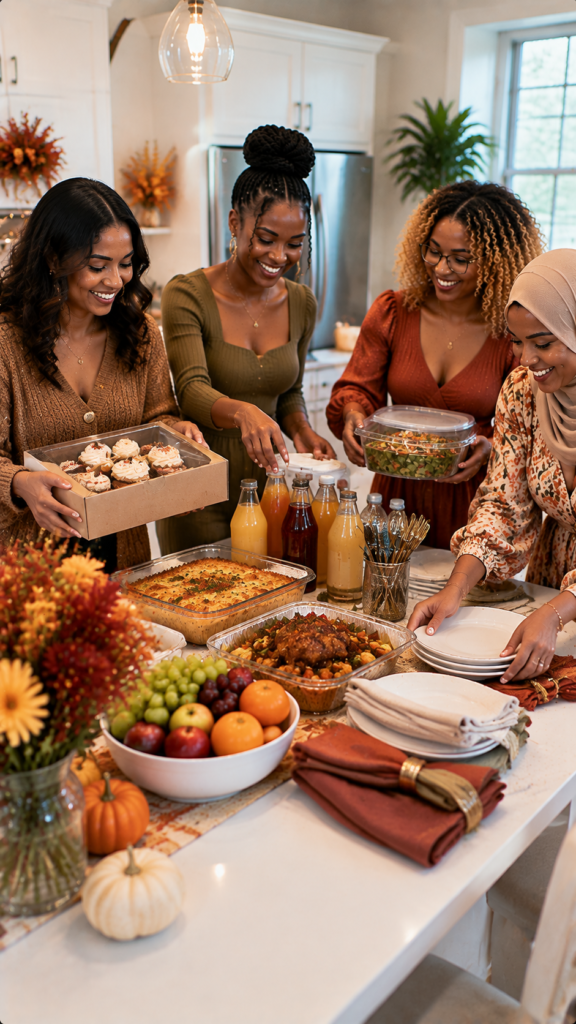
Not everyone who wants to attend a Friendsgiving wants to cook. Making homemade food a requirement can leave some guests feeling that they have nothing useful to contribute.
Remove that expectation.
One guest might bring bakery items, another can pick up a prepared main dish, someone else can bring drinks or fruit, while another contributes plates, napkins or serving supplies.
A guest who enjoys cooking can still make something from scratch, but nobody has to prove their contribution by spending hours in the kitchen.
The key is coordination, not homemade food. Tell guests what categories are still needed so three people don’t arrive with dessert while nobody has brought enough food for the main meal.
This can also make the gathering easier for people who are travelling, have limited kitchen access or are hosting other holiday commitments.
Friendsgiving is about sharing a meal with friends. There is no rule that says every item on the table has to have been cooked by one of the guests.
What to have on hand: a simple contribution list, serving dishes, utensils, napkins and containers for any food that guests may take home.
23. Turn Friendsgiving Into a Game Night With Food
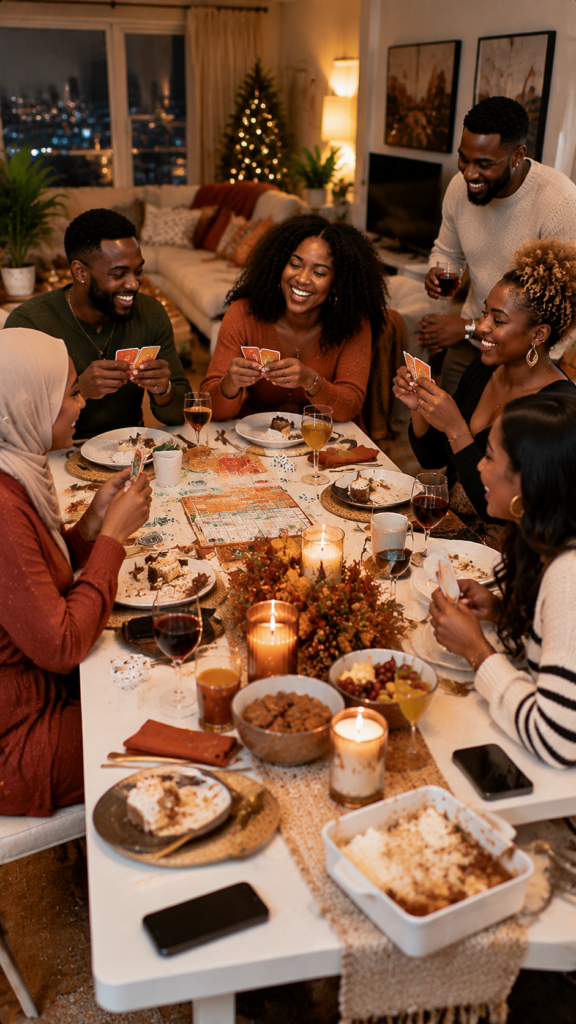
A game does not have to be something you bring out when everyone has finished eating and conversation starts to fade. Build the evening around it from the beginning.
For example, serve the meal first, play one main game, bring out dessert, then finish with a shorter game or activity.
This gives the evening a loose rhythm without making a schedule that guests have to follow minute by minute.
Choose the game according to the group. A game that works beautifully with six people may become slow or difficult with fifteen, while a large group may need something that allows several people to participate at once.
It is also worth considering how well everyone knows one another. A complicated strategy game may not be the best choice when half the guests have never met.
A quick party or card game with simple rules can make it easier for new people to join without having to learn a long rulebook.
That is the real advantage of making Friendsgiving a game night: the activity gives people something shared to focus on, which can take some pressure off conversation, particularly when you have a mixture of close friends and newer acquaintances.
Party essentials: one game suited to the group size, a second short game as a backup, score sheets if needed, and a small prize only if it adds to the fun rather than creating extra work.
24. End Friendsgiving With a “Take One, Leave One” Memory Table
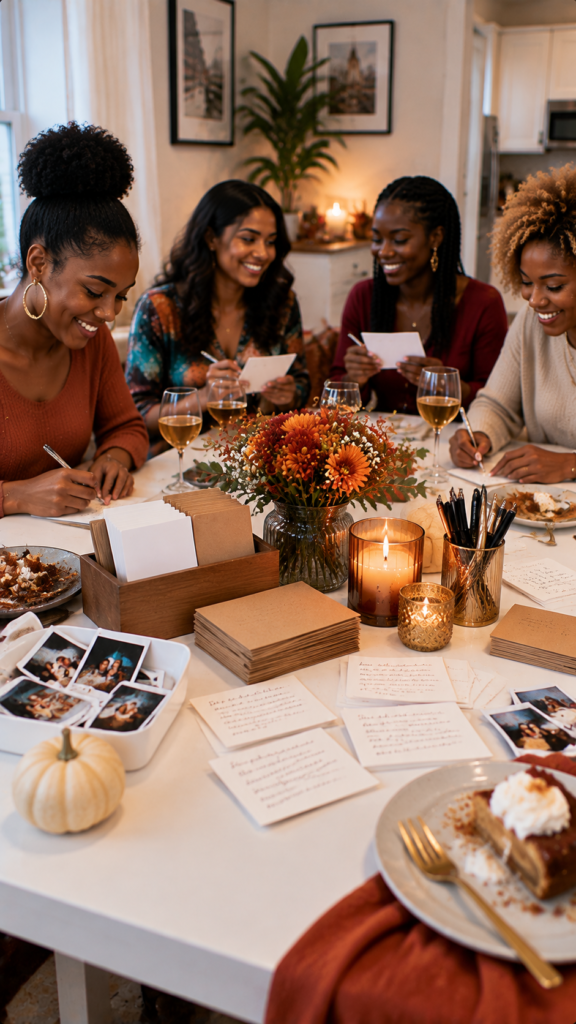
The end of a good Friendsgiving can be awkward. Everyone has eaten, conversations are winding down, and people start collecting their things without much of a closing moment.
Set up a small table with blank cards and pens before the party begins. Near the end of the evening, ask each guest to write down one favourite moment from the gathering, a funny thing that happened, or something they appreciated about the group.
Once everyone has finished, let each person choose a card written by someone else to take home.
This makes the activity more meaningful than a gratitude jar that stays in the host’s house.
Each guest leaves with a small reminder of the evening, and the cards do not have to sound serious or sentimental. A funny memory can be just as meaningful as a thoughtful message.
Keep the cards anonymous unless people want to sign them. That gives guests more freedom to write honestly and keeps the focus on the shared experience rather than on creating the “perfect” message.
25. Create Your Own Friendsgiving Tradition
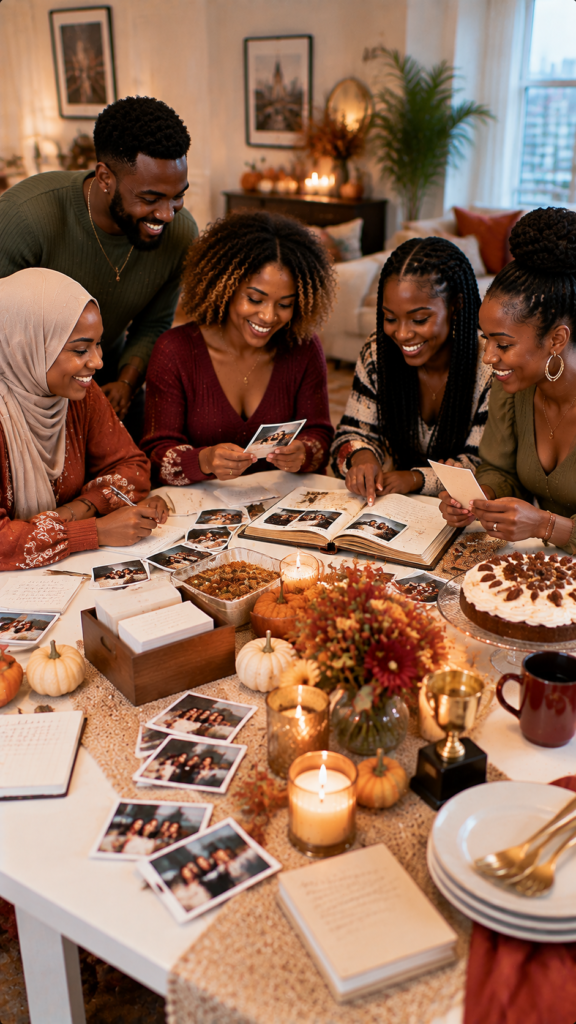
The easiest way to make Friendsgiving memorable from one year to the next is not to plan something completely different every time.
Pick one small element that your group enjoys and make it the part everyone expects when Friendsgiving comes around.
It could be a particular dessert that appears every year, a group photograph taken in the same spot, a recipe exchange, an annual playlist, a funny award, a favourite board game or a tradition of sending everyone home with leftovers.
You can also make the tradition something that changes slightly each year.
For example, everyone could bring one new dish to add to the menu, with the group deciding whether it deserves a place at next year’s gathering.
The tradition does not need to be elaborate or expensive. What matters is repetition. When the same small detail returns each year, it becomes part of your group’s history and gives everyone something to look forward to.
And that is where Friendsgiving can become more than another November meal: you are not simply repeating Thanksgiving traditions, you are giving your own group a chance to create one.
For a more reflective gathering, try the ideas in 15 Fall Church Craft Night Ideas for the Slow, Reflective Fall Your Heart Actually Needs.
How to Choose the Right Friendsgiving Idea for Your Group
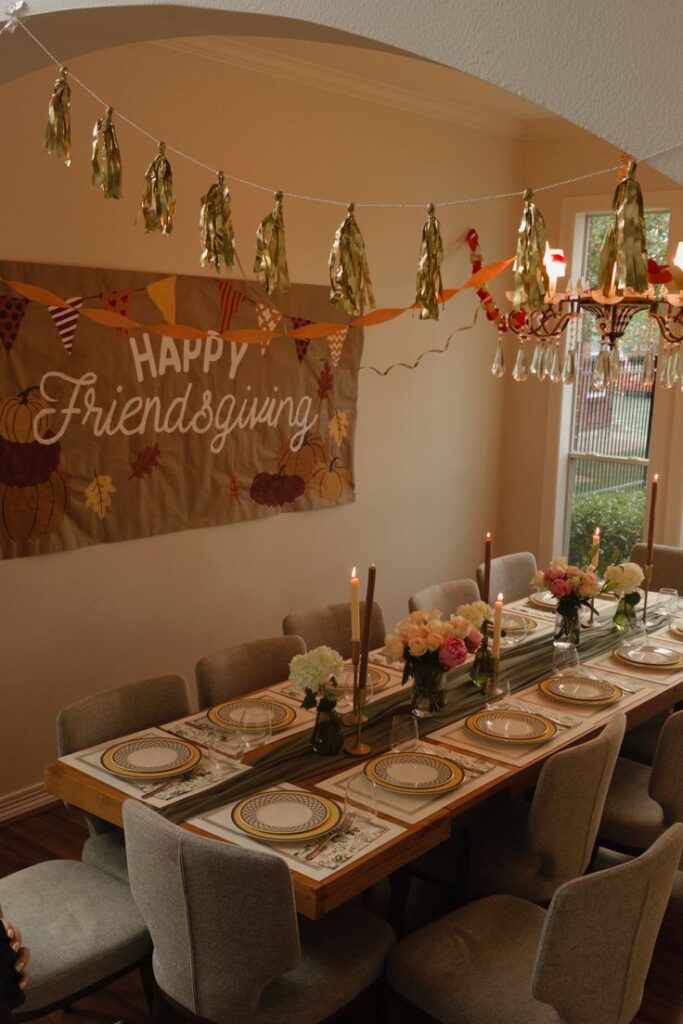
The number of guests affects more than how much food you need. It changes how easily people can talk, move around, eat and take part in activities.
Choose your Friendsgiving ideas around the size and flow of your group.
For 4–6 people, keep it personal
A small group can comfortably share one table, so conversation-based ideas work well. Try a recipe swap, blind taste test, conversation prompts or a simple group game.
You can also divide meal responsibilities more specifically, with different guests handling the main, sides, dessert or drinks.
7–12 people, add some structure
A larger group makes an unplanned potluck harder to manage. Assign broad food categories so you get a balanced menu instead of several versions of the same dish.
This is also a good size for one food station, simple place cards or a group activity that most guests can join without much explanation.
13 or more people, plan around movement
Large groups need space to move between food, drinks, seating and activities. Separate food and drink stations can reduce crowding, while multiple seating areas give people more room to settle and talk.
Choose flexible activities too. Music, casual tastings, photo opportunities and games that allow people to join in or step away tend to work better than activities that require everyone to participate at once.
What to Sort Out Before Guests Arrive
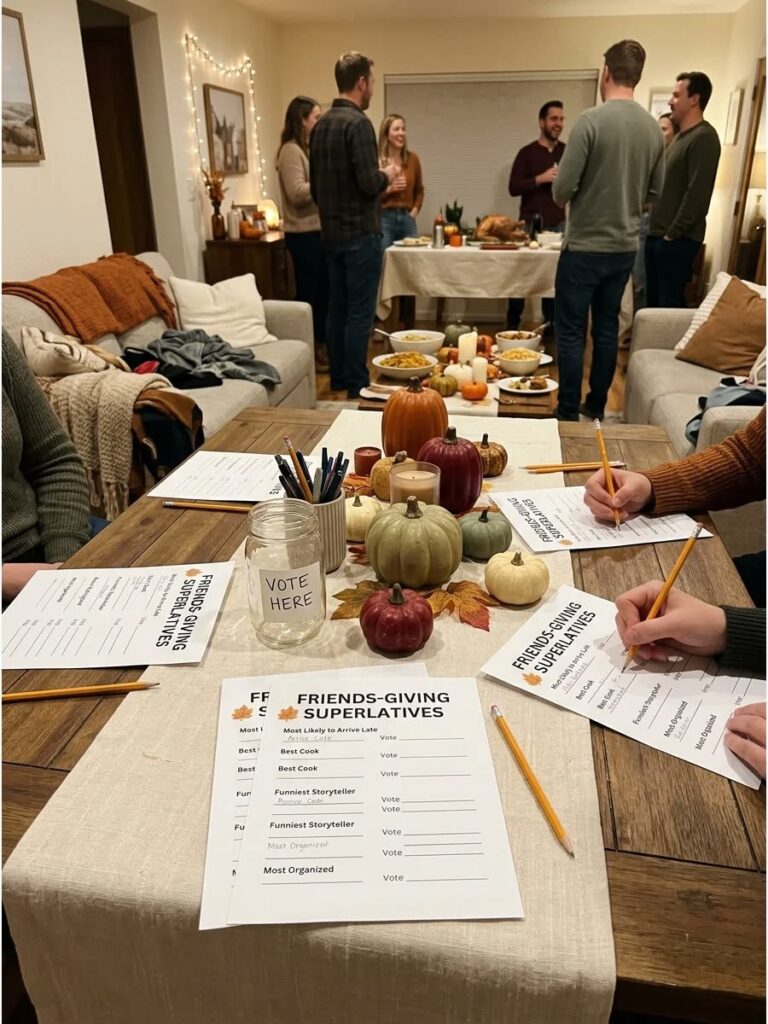
The problems at a Friendsgiving rarely start with the big things.
They are usually small gaps: nobody knows who brought the main dish, there is no serving spoon for the salad, two guests cannot eat the same dishes, or leftovers have nowhere to go.
Before your Friendsgiving party starts, sort out these details so you can spend less time fixing problems and more time enjoying the evening.
Food
Confirm who is bringing what before the day of the party. This helps you catch missing essentials, duplicate dishes or gaps in the menu.
Dietary needs
Ask about allergies and dietary restrictions before assigning dishes. It is much easier to plan suitable options in advance than discover them when dinner is already being served.
Serving
Check that every dish has an appropriate serving utensil. A full table is not much use if guests have to hunt for a spoon to serve the food.
Temperature
Plan where hot and cold foods will go before the meal begins.
Perishable food should not sit at room temperature for more than two hours, according to USDA food-safety guidance, so serve smaller portions when practical and refrigerate the rest promptly.
Seating
Know where people will actually sit. You do not need a formal seating chart, but make sure there are enough stable seats and places to put plates and drinks.
Leftovers
Have containers ready before dinner starts. That makes it easier to divide leftovers and send food home without leaving the host with a refrigerator full of unlabelled dishes.
Entertainment
Choose one main activity instead of planning something for every part of the evening.
A Friendsgiving does not have to be scheduled minute by minute; conversation and downtime are part of the night too.
Add a cosy hands-on activity to your next get-together with 20 Candle Making Night Ideas That Smell Better Than Anything on Etsy.
Conclusion
Friendsgiving does not need to look like a smaller version of Thanksgiving. You can shape the meal around the people actually sitting at the table.
Whether that means skipping turkey, sharing family recipes, keeping the food casual, or starting a tradition of your own, choose the ideas that fit your group rather than trying to make the evening perfect.
After all, the goal is simple: good food, good company and a Friendsgiving that feels like something you created together.
Pick a few ideas that suit your group, send the invite, and start planning a Friendsgiving you will be happy to make a tradition.