This post contains affiliate links. This means I may earn a small commission if you purchase through my links at no extra cost to you.
There comes a point in February when I think even the most enthusiastic craft group deserves a break from paper hearts.
These February craft ideas for nursing home residents take inspiration from music, fashion, traditional decorative arts and the little things people enjoy having around them.
I’ve included a few projects that might appeal to residents who aren’t usually interested in seasonal crafts.
Someone who loves music, for instance, might enjoy designing a vintage record sleeve far more than decorating another Valentine’s card.
And with spring not too far away, there’s room for a little gardening-inspired creativity towards the end of the month.
If you’re planning something specifically for February 14, our Valentine’s Day crafts for seniors in nursing homes already has plenty of ideas for that occasion. Here, I wanted to give the rest of February some attention.
What Makes February a Good Month to Try Something Different?
February is a relatively short month, so I wouldn’t feel obliged to fill every available afternoon with a different craft.
Instead, choose projects that introduce residents to different materials and techniques. You could spend one afternoon working with fabric and another experimenting with decorative painting.
I’ve also tried to select projects with distinctly different finished products. There’s something rather disappointing about planning four craft sessions only to discover that you’ve essentially made four versions of the same decoration.
Consider what residents actually enjoy before choosing from this list. Some may prefer practical projects, while others are quite happy experimenting with patterns and colors.
If you’re organizing a broader monthly program, you’ll find additional inspiration in these February activity calendar ideas for seniors in assisted living.
Make February Activity Planning Easier
Choosing a few good crafts is one part of planning February. There’s still music, games, conversation sessions and all those afternoons when you need something that doesn’t require much preparation.
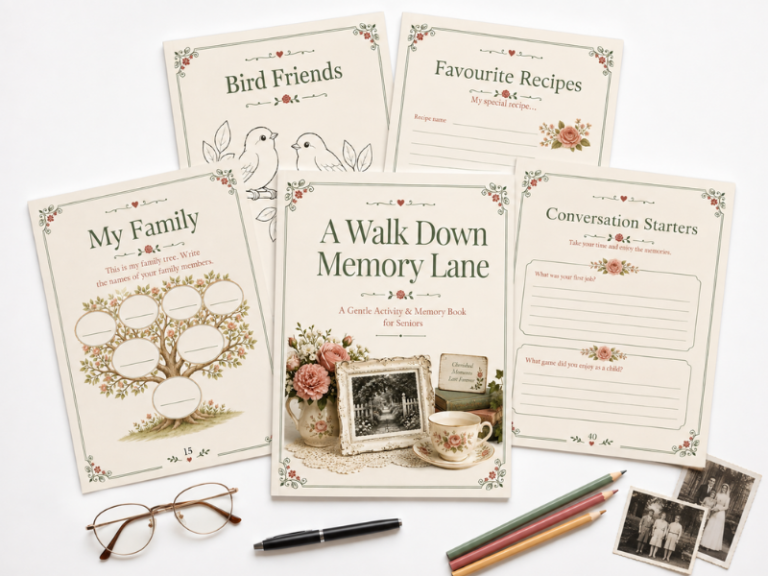
The Ready-to-Run February Activities for Seniors Bundle helps you bring those activities together into a manageable monthly program.
The bundle includes:
- Morning and afternoon activities.
- A suggested February activity calendar.
- Facilitator guidance for leading sessions.
- A blank calendar for your own arrangements.
- Practical activity planning templates.
- A reusable monthly senior activity tracker.
You can follow the suggested schedule or move activities around to accommodate appointments, special events and residents’ preferences.
10 Creative February Craft Ideas for Nursing Home Residents
1. Victorian-Inspired Decorative Fans
Have you ever noticed how attractive an old-fashioned folding fan can be, even when it’s simply resting on a dressing table?
I’d use that idea as inspiration for this first February craft. Soft floral patterns, muted pink, antique gold and cream work beautifully together without making the finished fan look overly decorative.
You don’t need to construct the folding mechanism from scratch. Starting with a plain assembled fan leaves residents more time to concentrate on the design.
You’ll need:
- Plain assembled paper or fabric fans.
- Floral-patterned decorative paper.
- Lightweight lace trim.
- Double-sided adhesive tape.
- Non-toxic paint markers.
- Large prepared decorative motifs.
How to make it:
- Open the fan carefully and place it on a flat surface.
- Select coordinating floral motifs.
- Arrange the designs before attaching them.
- Use prepared adhesive pieces to secure the decorations.
- Add a narrow lace border if desired.
- Check that the fan can still fold without damaging its decorations.
Keep the embellishments fairly flat. Otherwise, the fan may look lovely when open but refuse to close properly.
Adaptation tips:
- Secure the open fan on a non-slip mat for residents with limited hand strength.
- Prepare large floral shapes to avoid detailed cutting.
- Offer high-contrast patterns for residents with low vision.
- Present one decorative section at a time for residents who find multiple steps overwhelming.
Residents who prefer not to work with folding materials can decorate a rigid fan-shaped base instead.
2. Faux Stained-Glass Jewelry Trays
I’ve always liked the combination of deep blue, emerald green and amber in stained-glass-inspired designs. Those colors can work just as well on a small decorative tray as they do in a window.
For this project, there’s no need to handle actual glass or use traditional stained-glass equipment.
Instead, residents arrange translucent colored film over a lightweight, transparent tray to create a jewel-toned design.
You’ll need:
- Shatter-resistant transparent trays.
- Translucent adhesive craft film.
- Prepared geometric shapes.
- Thin decorative black adhesive strips.
- Soft smoothing cloths.
- A plain white design template.
How to make it:
- Place the transparent tray over a printed design template.
- Choose three or four complementary colors.
- Arrange the translucent film sections on the outer underside.
- Add dark adhesive strips between selected sections.
- Smooth the film carefully.
- Turn the tray over to reveal the completed design.
I’d avoid filling these trays with dozens of tiny shapes. A few larger sections will produce a cleaner design and make the project considerably easier to complete.
Adaptation tips:
- Lift adhesive backings before the session.
- Use larger geometric sections for residents with arthritis.
- Place a white sheet underneath the transparent tray to improve visibility.
- Allow residents to arrange loose pieces on a separate template before transferring them.
The finished tray can hold suitable personal items such as reading glasses or a watch.
These February craft ideas for nursing home residents are particularly useful when you want the finished project to have a purpose beyond seasonal decoration.
3. Vintage Record Sleeve Art
If you have residents who light up when an old favorite song comes on, this might be the craft I’d introduce first.
The idea is to design a record sleeve inspired by a favorite musical era. It could feature jazz, gospel, country music, classical performances or the rock-and-roll records someone remembers buying years ago.
You can even play some of the selected music while everyone works.
You’ll need:
- Square cardstock or lightweight mounting boards.
- Printed music-themed illustrations.
- Large alphabet stickers.
- Decorative paper.
- Non-toxic markers.
- Glue sticks or adhesive tabs.
How to make it:
- Invite each resident to choose a musical style or theme.
- Select a background color for the album sleeve.
- Arrange the illustrations or personal photographs.
- Create a title using printed or adhesive letters.
- Add the name of an imaginary artist or the resident’s own name.
- Display the completed sleeves together.
Now, I wouldn’t insist that everyone recreate a record they once owned. Someone might enjoy inventing an entirely new album cover.
You could have titles such as Sunday Morning Gospel, An Evening of Jazz or Songs for a Rainy Afternoon.
Adaptation tips:
- Offer prepared album titles for residents who struggle with handwriting.
- Use large, recognizable illustrations rather than small photographs.
- Provide only a few design choices at once.
- Let residents dictate their album titles if writing is difficult.
Keep music at a comfortable volume so residents can still hear instructions and conversations.
If music and old familiar interests appeal to your group, you might also enjoy these childhood-inspired group activities for seniors.
4. Sashiko-Inspired Fabric Art
If you’ve never considered introducing Japanese-inspired decorative stitching into your craft program, February might be a good opportunity.
Traditional sashiko embroidery is known for its repeated stitching patterns, often featuring white thread against indigo fabric.
For this project, I’d borrow the visual style without expecting residents to master traditional embroidery techniques.
You’ll need:
- Indigo or dark blue cotton fabric.
- White fabric markers.
- Large geometric stencils.
- Embroidery hoops or mounting boards.
- Optional prepared stitching cards.
- Optional blunt tapestry needles and thick thread for suitable participants.
How to make it:
- Select a large geometric pattern.
- Position the fabric on a stable surface.
- Trace or mark the design using a prepared template.
- Create short, evenly spaced white lines along the pattern.
- Repeat the design across the fabric.
- Mount the finished piece for display.
Residents who enjoy sewing may prefer a genuine stitched version. However, the fabric-marker alternative can produce an attractive design without requiring anyone to manage a needle.
Adaptation tips:
- Secure the fabric so residents do not need both hands to keep it flat.
- Use thick white fabric markers for easier gripping.
- Choose larger patterns with fewer intersections.
- Demonstrate one line of the pattern before introducing the next.
Assess individually whether needle-based work is suitable. There is no need for everyone to use the same technique.
What I particularly like about this addition to our February craft ideas for nursing home residents is that experienced needleworkers can enjoy a more challenging version without excluding beginners.
5. Handmade Decorative Bookends
A pair of decorative bookends is something you might overlook when planning crafts, simply because it doesn’t seem particularly seasonal.
But if someone keeps several books, magazines or devotional materials beside their chair, it’s quite a useful project.
I’d choose designs that resemble traditional library bookends rather than overly bright novelty shapes.
You’ll need:
- Stable, assembled wooden bookends.
- Non-toxic paint suitable for wood.
- Wide paintbrushes.
- Decorative architectural stencils.
- Large botanical motifs.
- Non-slip pads.
How to make it:
- Select a background color for each bookend.
- Paint the accessible wooden surfaces.
- Allow the first coat to dry.
- Add a contrasting decorative pattern.
- Finish with simple borders or initials.
- Have staff attach non-slip pads and check stability.
Cream with dark green detailing would give the bookends a traditional appearance. Alternatively, charcoal and pale gold could produce something more contemporary.
Don’t feel that both bookends need identical decorations. Matching colors may be enough to make them look like a pair.
Adaptation tips:
- Use preassembled bookends so no woodworking is necessary.
- Position each bookend securely at a comfortable height.
- Offer broad sponge brushes instead of narrow paintbrushes.
- Divide painting and decorating into separate sessions when fatigue is a concern.
Choose a bookend base designed to hold the intended books securely rather than improvising with unstable lightweight objects.
6. Painted Porcelain-Style Decorative Plates
You know those blue-and-white decorative plates that look attractive against almost any neutral wall?
That’s the appearance I’d aim for here, although we won’t be using actual porcelain or requiring residents to paint complicated floral designs.
A simple border and one central motif can already give a plate a finished appearance.
You’ll need:
- Lightweight decorative plate blanks.
- Suitable non-toxic blue paint.
- Large floral or botanical stencils.
- Wide brushes.
- Easy-grip paint markers.
- Stable display stands.
How to make it:
- Choose a simple design for the center of the plate.
- Secure the stencil over the surface.
- Apply paint using gentle dabbing movements.
- Remove the stencil carefully.
- Create a simple border around the outside.
- Allow the plate to dry completely.
You could work with several shades of blue or keep everything in one deep cobalt color.
I would leave some of the white surface visible rather than filling every available space. That contrast is part of what makes this style so appealing.
Adaptation tips:
- Provide large stencils with recognizable shapes.
- Secure the plate on a non-slip mat.
- Use a broad sponge applicator for residents who find brushes difficult to control.
- Offer dark blue paint against a bright background for improved contrast.
Keep the finished plates for decorative display unless the entire product and finishing method are specifically suitable for food contact.
7. Vintage Perfume Bottle Silhouette Artwork
This idea came from thinking about the beautiful shapes of traditional perfume bottles. Some have rounded shoulders, others have geometric glass designs, and the decorative stoppers can be quite distinctive.
Rather than decorating actual perfume bottles, which may involve fragile glass and lingering fragrances, you can turn those designs into silhouette artwork.
You’ll need:
- Sturdy background cardstock.
- Large perfume bottle silhouette templates.
- Metallic decorative paper.
- Black or navy cardstock.
- Decorative adhesive strips.
- Glue sticks.
- Lightweight frames.
How to make it:
- Choose a background color.
- Select two or three perfume bottle shapes.
- Arrange them at different heights.
- Add contrasting sections to suggest decorative glass.
- Attach the arranged shapes.
- Mount the finished artwork.
For a more dramatic design, try black silhouettes against pale gold. For something softer, blush pink and charcoal work well together.
You could also offer alternative silhouettes such as fountain pens, vintage clocks or decorative glassware for residents who prefer a different subject.
Adaptation tips:
- Prepare large silhouettes before the session.
- Use strong color contrast to distinguish individual components.
- Offer borders and decorative pieces with adhesive already attached.
- Let residents rearrange the composition before permanently securing anything.
This is one of the February craft ideas for nursing home residents that could fit particularly well into a fashion-themed or vintage design afternoon.
8. Art Deco-Inspired Clutch Purses
I wouldn’t introduce a complicated sewing project unless I knew the group actually enjoyed sewing.
However, there is quite a difference between making a purse from scratch and personalizing an assembled fabric clutch.
Art Deco-inspired designs give you plenty to work with: symmetrical patterns, fan-shaped motifs, contrasting colors and touches of metallic detail.
You’ll need:
- Plain assembled fabric clutch purses.
- Prepared geometric fabric motifs.
- Suitable fabric adhesive.
- Gold or silver fabric strips.
- Large decorative stencils.
- Fabric markers.
How to make it:
- Choose a color combination.
- Arrange the geometric fabric pieces across the clutch.
- Experiment with symmetrical or repeating patterns.
- Secure the chosen pieces using suitable fabric adhesive.
- Add a contrasting border if desired.
- Allow the adhesive to cure according to its instructions.
I’d keep the decorations flat, particularly if the purse will be used regularly. Raised embellishments are more likely to catch on clothing or other belongings.
Black and gold is a classic combination, although navy and silver or cream and burgundy would also work.
Adaptation tips:
- Use assembled purses with easy-to-operate closures.
- Prepare all fabric pieces beforehand.
- Insert a lightweight support inside the purse to create a firm working surface.
- Provide adhesive-backed decorations where suitable.
Residents who find arranging several pieces difficult can decorate the clutch with one large central motif.
The finished purses can be kept for personal use or given to someone chosen by their maker.
9. Handmade Decorative Drawer Liners
This may be the least obvious craft on the list, but I think it’s worth including.
Residents often have a bedside drawer filled with personal belongings. A decorative liner is a small way to personalize that space, particularly for someone who enjoys choosing patterns and organizing things.
There’s also no need to find somewhere on the wall for the finished project.
You’ll need:
- Heavy decorative paper or suitable fabric liner material.
- Prepared drawer measurements.
- Large printing stamps.
- Non-toxic ink or suitable paint.
- Pattern stencils.
- Protective table coverings.
How to make it:
- Measure the intended drawer beforehand.
- Prepare the liner material to fit.
- Choose a repeating decorative pattern.
- Stamp or stencil the design across the surface.
- Allow it to dry completely.
- Place the finished liner inside the drawer.
Choose materials that are suitable for the intended storage space and can be removed easily.
Now, you might be tempted to make these scented. I’d offer unscented liners as the standard option instead. Not everyone enjoys fragrance around their personal belongings.
Adaptation tips:
- Prepare correctly sized liner sheets before residents arrive.
- Provide stamps with large handles.
- Secure the paper so it cannot move while printing.
- Offer simple visual guides for positioning repeated patterns.
Residents with limited mobility can complete the decorative work at a comfortable table while someone else places the liner inside the drawer, with their permission.
If you’re looking for practical February craft ideas for nursing home residents, this is a refreshing alternative to making another item that needs a display shelf.
10. Early Spring Illustrated Seed Packet Collection
Towards the end of February, I like the idea of introducing something that gives residents a little connection to the coming spring.
Instead of planting seeds immediately, your group can create illustrated seed packet sleeves inspired by traditional gardening catalogs.
These can later be used to organize commercially packaged seeds for gardening activities.
You’ll need:
- Prepared paper envelopes or packet sleeves.
- Large botanical illustrations.
- Printed plant-name labels.
- Decorative cardstock.
- Glue sticks.
- Easy-grip markers.
- A storage box for the finished collection.
How to make it:
- Choose a flower, herb or vegetable to feature.
- Select a coordinating botanical illustration.
- Arrange the image on the packet sleeve.
- Add a large plant-name label.
- Decorate the remaining space with a simple border.
- Organize the finished sleeves into a gardening collection.
Keep the original seed packaging and instructions intact. The handmade sleeves are decorative organizers rather than replacements for important planting information.
I’d also let residents choose plants they genuinely like, rather than automatically assigning everyone a different flower.
Adaptation tips:
- Provide assembled envelopes.
- Use large illustrations that are easy to recognize.
- Print plant names in clear, high-contrast lettering.
- Offer a choice between two plant varieties at a time when helpful.
For residents who enjoy gardening but have limited mobility, selecting plants and designing their packet sleeves can be part of the preparation for future gardening sessions.
When the weather begins to change, continue with these March crafts for seniors in nursing homes.
How to Make February Craft Sessions Accessible and Enjoyable
You don’t necessarily need to find a completely different craft for every resident who requires assistance.
Often, the difficulty lies in one particular step. Perhaps the adhesive is difficult to peel, the brush is too narrow or the materials are positioned too far away.
Changing that step may be enough.
For Residents With Arthritis or Limited Hand Strength
Look at how much gripping, twisting or pinching each project requires.
- Replace thin tools with comfortable, thick-handled alternatives.
- Prepare adhesive backings.
- Secure materials on non-slip surfaces.
- Allow residents to rest their hands.
- Divide longer projects into smaller sessions.
For Residents With Low Vision
I would pay particular attention to the background underneath the materials.
A cream fabric piece may be easy to distinguish on a dark tray but almost disappear against a white tablecloth.
Use contrasting surfaces, uncluttered layouts, large patterns and appropriate lighting. Keep tools in consistent positions throughout the session.
For Residents Living With Dementia
Introduce the activity gradually. Instead of explaining six instructions at once, demonstrate the action the resident needs to complete next.
Familiar interests can help guide your choices. However, avoid turning music, gardening or vintage-themed projects into tests of someone’s memory.
The resident doesn’t need to remember the name of a singer to enjoy designing an album cover.
For Residents With Limited Mobility
Bring the materials closer rather than expecting residents to reach across a crowded table.
Portable trays, stable work surfaces and removable project bases can be useful for bedside activities as well as group sessions.
The important thing is to preserve the person’s ability to make decisions about their own project.
Give the Finished February Crafts Somewhere to Go
Before starting a craft session, I’d think about what might happen to the completed items afterward.
Not every project needs to go on a communal noticeboard.
The bookends could sit beside someone’s reading chair. The drawer liners can go into personal storage spaces, while the clutch purses might be given away or kept.
For the more artistic February craft ideas for nursing home residents, consider organizing a small vintage-themed exhibition featuring:
- Record sleeve artwork.
- Decorative fans.
- Porcelain-style plates.
- Sashiko-inspired fabric panels.
- Perfume bottle silhouette artwork.
You could arrange the pieces alongside suitable books, photographs or music-themed decorations.
Of course, ask residents whether they want their work displayed. Someone might be rather pleased with their artwork but still prefer to keep it in their own room.
Frequently Asked Questions About February Crafts for Nursing Home Residents
What are some easy February crafts for nursing home residents?
Decorative drawer liners, illustrated seed packet sleeves and vintage record artwork are manageable starting points. Prepare the cutting and adhesive materials before the session.
What crafts can seniors make in February besides Valentine’s crafts?
Try decorative fans, painted bookends, textile artwork, personalized purses or music-inspired designs. These projects offer variety without relying on Valentine’s Day themes.
What are good February crafts for seniors living with dementia?
Choose crafts with familiar materials, large components and a manageable sequence of actions. Record artwork and decorative printing can be simplified according to each resident’s abilities and interests.
What crafts can nursing home residents with arthritis enjoy?
Fabric printing, stencil painting and large-piece decorative arrangements can reduce the need for precise finger movements. Thick-handled tools and prepared materials may make these activities more comfortable.
What meaningful crafts can older adults make as gifts?
Decorative fans, clutch purses, jewelry trays and personalized bookends are attractive gift possibilities. Let residents decide whether they want to give away or keep their finished projects.
How can nursing homes organize inexpensive February craft sessions?
Start with supplies already available, including fabric remnants, cardstock, paint and suitable containers. Projects such as record sleeve art and decorative drawer liners do not necessarily require specialized craft kits.
How can I involve residents who don’t usually attend craft activities?
Choose a project connected to an interest they already have, such as music, fashion, reading or gardening. They may also prefer an individual session or a smaller group rather than a busy craft table.
Choose Something Your Residents Haven’t Tried Before
If I were deciding where to begin, I’d probably start with the vintage record sleeves.
There is plenty of room for different musical tastes, and the finished collection could become quite an interesting display.
But you’ll know your residents better than I do. Perhaps the fabric artwork will appeal to someone who used to sew, or the decorative bookends will catch the attention of someone who rarely joins the craft table.
Choose two or three of these February craft ideas for nursing home residents that feel right for your group. You can always save the others for a quieter afternoon.
And keep those illustrated seed packet sleeves somewhere accessible. March will be here before you know it.