This post contains affiliate links. This means I may earn a small commission if you purchase through my links at no extra cost to you.
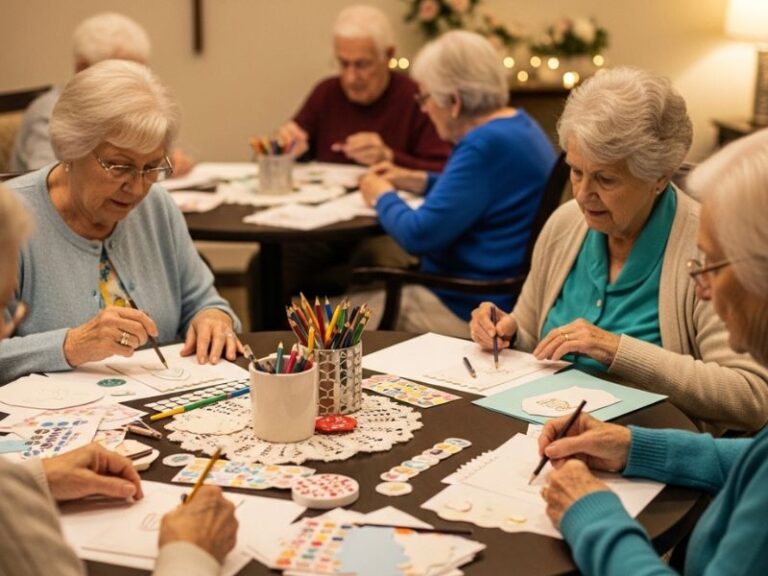
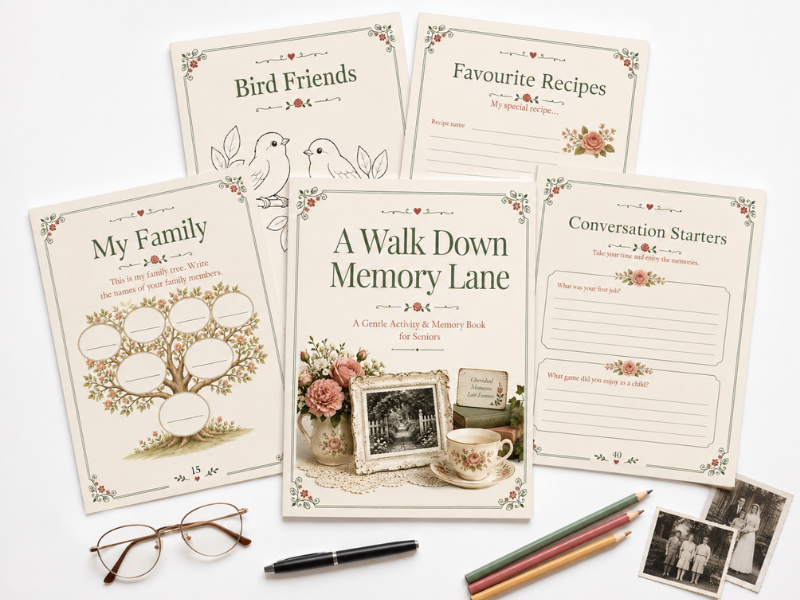
Every older person is carrying a lifetime of stories, and most of them have never been written down. This free Memory Book Activity for Seniors creates a gentle place for those stories to come out through familiar questions, simple puzzles, coloring, photographs, recipes and conversation.
It does not feel like a test. There are no scores, deadlines or wrong personal answers. A senior can complete one page, skip five, talk instead of writing, or return to the book whenever the mood feels right.
The printable works well for seniors at home, family visits, one-to-one home care, nursing homes and assisted living activity sessions.
What Is Inside This Memory Book Activity for Seniors?
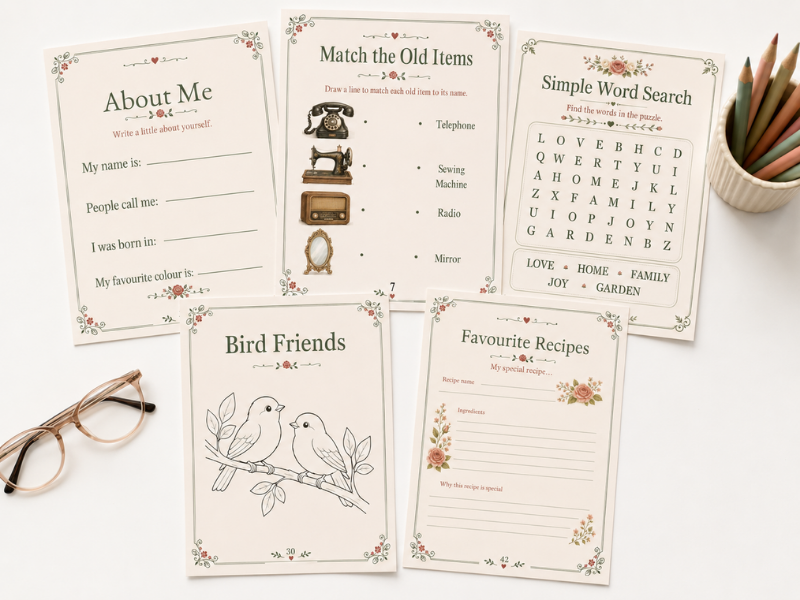
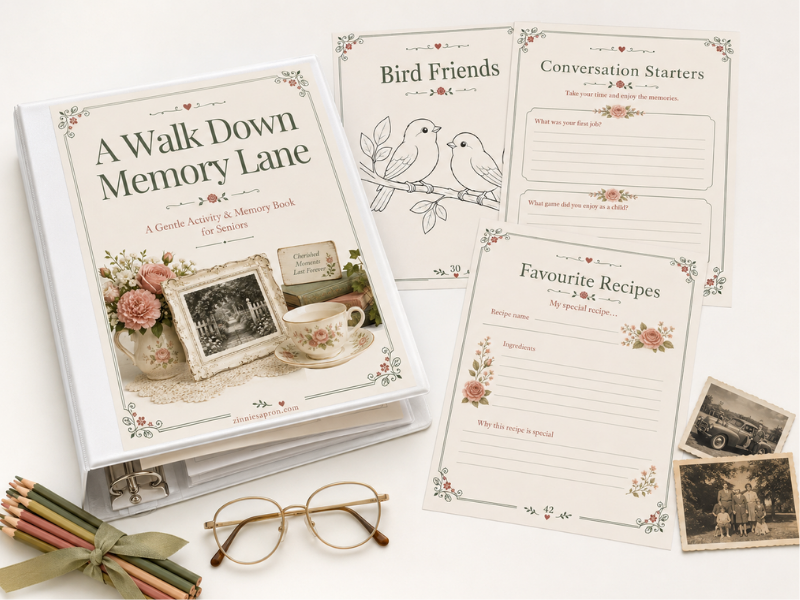
The printable contains 44 interior pages plus a decorative cover. It is formatted for standard US Letter paper, measuring 8.5 by 11 inches.
Inside the Memory Book Activity for Seniors, you will find:
- About Me and Things I Love pages
- Childhood, food, kitchen and music memories
- Celebration and family pages
- Familiar-object matching activities
- Sentence and saying completion
- Counting, patterns and a simple word search
- Seasons and animal matching
- Five calming coloring pages
- Gratitude, life advice and letter-writing prompts
- Space for photographs, recipes and family stories
- Conversation starters and an open My Story page
That variety matters. Some days a person may want to write about childhood. On another day, circling a favourite food or coloring a teacup may be enough.
Why This Is More Than a Workbook
The best part of this book is not whether every blank line gets filled. It is the moment a picture of an old radio brings back a song, or a recipe page leads to a story nobody in the family has heard before.
The National Institute on Aging encourages older adults to stay involved in enjoyable activities that feel personally meaningful.
This Memory Book Activity for Seniors gives that idea a simple structure without making the experience feel forced.
It can also become a keepsake. The completed family tree, favourite recipe, life advice and personal story pages may one day mean far more to the family than anyone expects while filling them in.
For another activity built around preserving stories, these memory jar craft ideas for seniors are a beautiful companion.
A Quick Look at the Four Main Sections
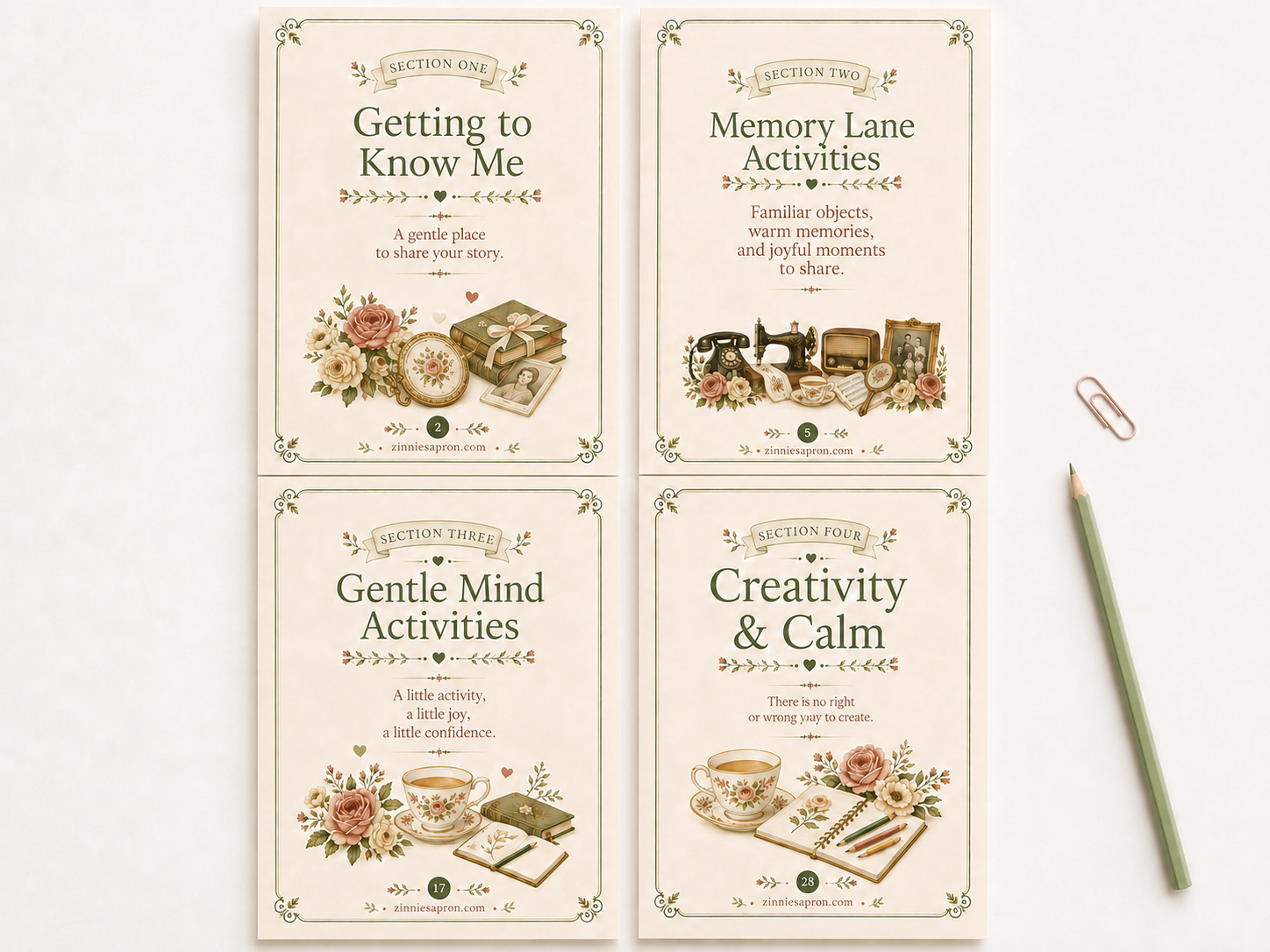
Getting to Know Me
The opening pages begin with comfortable questions: name, birthplace, favourite color, food, song, flower, place and happy moments.
These are easy starting points when a completely open journal page feels intimidating.
Memory Lane Activities
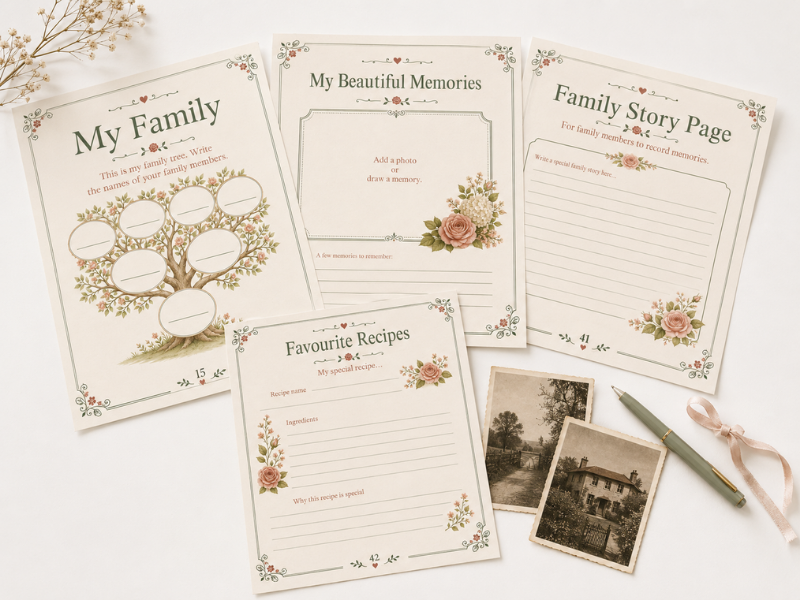
This section uses familiar objects, foods, sayings, music and celebrations. Seniors can match an old telephone or sewing machine to its name, finish “Home sweet…,” talk about who cooked their favourite meals, and add names to a family tree.
These pages make the Memory Book Activity for Seniors feel conversational.
A short written answer can easily become a longer spoken story, and that story does not need to fit neatly on the line.
Gentle Mind Activities
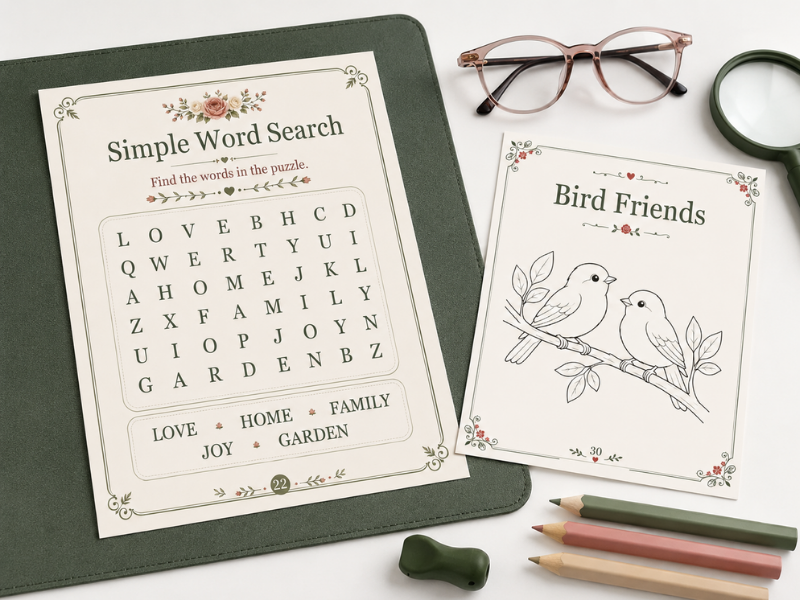
The book includes matching flowers, counting objects, completing patterns, a simple word search, identifying which item does not belong, matching seasons and animals, and finishing a picture.
These are gentle recreational activities, not a diagnostic tool. Nobody should feel watched, corrected or compared with another person.
Creativity and Calm
Five coloring pages feature garden flowers, birds, butterflies, a teacup and an autumn tree. There is also space to draw a dream garden, write a gratitude list, send kind words to someone special and record life advice.
The gratitude page pairs naturally with these gratitude journal activities for seniors. And if the Bird Friends coloring page becomes a favourite, try one of these relaxing bird crafts for seniors next.
The Pages Families Will Want to Keep
The final part of the Memory Book Activity for Seniors is where the book becomes personal.
There is space to add a photograph or draw a memory, answer conversation starters, preserve a family story, record a special recipe and write anything that belongs on the open My Story page.
The recipe does not need perfect measurements. “A little of this until it looks right” is still family history.
If writing is difficult, a family member or caregiver can record the answers exactly as they are spoken. Keep the person’s own phrases, humour and way of telling the story. Do not polish their voice out of their own memory book.
GET THE FREE PRINTABLE MEMORY BOOK
How to Use the Book Without Making It Feel Like Work
Offer One or Two Pages at a Time
Forty-four pages can feel like a lot when placed on the table all at once. Choose two pages and let the senior decide. The Memory Book Activity for Seniors is meant to be used slowly, not finished in one weekend.
Let Conversation Win
If “What was your first job?” leads to a twenty-minute story, stay with the story. The empty spaces on the next page will wait.
Help Without Taking Over
Read questions aloud, steady the paper or write down dictated answers. The Alzheimer’s Association recommends adapting activities, encouraging self-expression and avoiding criticism or correction in its guide to activities for people living with dementia.
If the person says, “I don’t remember,” accept it. Try another page or simply enjoy the quiet.
A Simple 30-Minute Memory Book Session
You do not need to plan a full afternoon around the book. A short, calm session is often more enjoyable than trying to complete several pages at once.
Begin with five minutes of settling in. Offer a drink, make sure the chair is comfortable and place two possible pages on the table.
Let the senior choose instead of announcing what they will be doing.
Spend the next ten minutes on one easy page. About Me, Favourite Foods, Finish the Saying or Match the Old Items are good choices because the instructions are clear and the responses can be brief.
Use another ten minutes for conversation. If an answer brings up a person, place or event, ask one gentle follow-up question.
“What do you remember most about that?” usually feels more natural than asking for exact dates or details.
Finish with five minutes of something light: add color to one flower, choose a photograph for a future page or decide which activity to try next time.
Stop while the experience still feels pleasant. The goal is for the person to want to open the book again.
Questions That Invite Memories Without Pressure
The wording around a prompt can completely change how it feels. “Do you remember your first job?” can sound like a memory test.
“What was your first job like?” assumes the story is welcome and gives the person room to share whatever comes first.
Try questions such as:
- What made that place feel like home?
- Who usually sat beside you at the table?
- What song could always get people dancing?
- Was that recipe made for ordinary days or special occasions?
- What advice would you give someone younger today?
Avoid rapid questions, correcting small details or asking “Are you sure?” The Memory Book Activity for Seniors should feel like an invitation to talk, not an interview someone can fail.
Using It in Nursing Homes and Home Care
For one-to-one care, choose a page connected to the person’s interests. Someone who loved cooking may enjoy Kitchen Memories and Favourite Recipes.
A music lover may have more to say on the Music Memories page than anywhere else in the book.
For small groups, use pages such as Favourite Foods, Finish the Saying, Celebrations or Seasons Match-Up. Invite conversation, but never require everyone to speak.
During family visits, the photograph, family story, recipe and life advice pages give relatives something meaningful to do together.
The completed pages can also inspire a resident display during National Assisted Living Week activities, with permission from each participant.
That is where the Memory Book Activity for Seniors works best: beside another person who is genuinely willing to listen.
Making the Pages Easier to Use
For Limited Grip or Arthritis
Use thick pencils, jumbo crayons, washable markers or soft foam pencil grips. Tape the page to the table and allow frequent breaks.
The Arthritis Foundation’s hand-craft guidance emphasizes choosing tools that reduce unnecessary gripping force.
For Low Vision
Print selected pages at a larger scale, use bright lighting and offer dark markers. Placing white paper on a dark mat may improve contrast.
The American Academy of Ophthalmology also recommends increased contrast among its low-vision strategies
For more tactile options, see these crafts for seniors with low vision.
For Seniors Living With Dementia
Begin with familiar pictures, foods, songs or objects. Offer one page at a time, reduce the number of choices and avoid correcting harmless details. Stop if the activity causes frustration.
The Memory Book Activity for Seniors is designed for gentle engagement and enjoyment. It is not intended to assess, diagnose or treat memory loss.
How to Print and Prepare the Book
- Download the PDF to your device.
- Select US Letter paper.
- Choose “Actual Size” or “Fit to Printable Area.”
- Print in color to keep the soft floral decoration.
- Use thicker paper for coloring pages if markers will be used.
- Place completed pages in a binder, presentation folder or clear page protectors.
You can print the complete Memory Book Activity for Seniors or select only the pages you need. Consider printing extra copies of the recipe, photograph and family-story pages.
Download the Free Memory Book Activity for Seniors
Begin with one page. Maybe it is a favourite song, a childhood meal, an old photograph or one piece of advice worth passing down.
The real value of this Memory Book Activity for Seniors is not a perfectly completed book. It is a story heard, a memory preserved or a quiet moment shared with someone who matters.
GET THE FREE PRINTABLE MEMORY BOOK
Grab Your Free Memory Keeper Cards
Before the stories fade, start asking the questions that matter.
The Memory Keeper Cards are a set of 46 free printable conversation starter cards designed to help you sit down with Mom, Dad, or someone you love and hear the stories they’ve never told you.
Just print them, cut them out, pick a card, and listen.
Each card has one thoughtful question organized into five categories — Childhood & Growing Up, Love & Family, Work & Life Lessons, Favorites & Fun, and Faith & Values.
There are even blank “Write Your Own” cards so you can personalize it for your family.
They’re simple. They’re meaningful. And they might just lead to the best conversation you’ve ever had.
Frequently Asked Questions
Is the Memory Book Activity for Seniors Free?
Yes. The complete printable can be downloaded without payment.
How Many Pages Are Included?
The Memory Book Activity for Seniors contains 44 interior pages plus its decorative cover.
Must Every Page Be Completed?
No. Choose only the pages that feel comfortable, relevant and enjoyable.
Can a Caregiver Write the Answers?
Absolutely. Write the answers as the senior shares them, keeping their own words and voice.
Can Nursing Homes Use the Printable?
Yes. It is intended for personal, home-care and single-facility activity use. The PDF may not be resold, redistributed or uploaded to another website.
Is It Suitable for Seniors With Dementia?
It may be suitable when carefully adapted to the individual. Use familiar pages, offer simple choices and stop if the activity feels tiring or frustrating.