This post contains affiliate links. This means I may earn a small commission if you purchase through my links at no extra cost to you.
Last year’s scarecrow didn’t survive the closet. These scarecrow crafts for seniors are made to come back every autumn, see which.
Every October, someone digs out a bin of last year’s fall decorations, and half of it goes straight in the trash.
The paper leaves have gone brittle, the construction-paper scarecrow that took an entire afternoon to make last year is now just a memory and a pile of crumbling scraps, so the whole thing gets built again from nothing, using the same few hours nobody really has to spare for something that should be fixed with ease instead og=f making from scratch .
That’s the quiet cost behind a lot of fall craft activities for seniors: not the making, but the remaking.
And it matters more than it looks like it should, because the making itself is doing real work.
Regular hands-on crafting helps maintain the fine motor skills, grip strength, and hand-eye coordination that naturally decline with age, which means a craft worth doing once is a craft worth doing again next year, not a one-time project headed for the bin.
The 10 scarecrow crafts below are built with that in mind.
Sturdier bases, materials that survive a year in storage, pieces that swap out instead of falling apart, so next October, the bin comes out, the scarecrow goes back together in minutes, and the only thing that needs remaking is the fun part.
Give everyday materials a second life with 20 Recycled Crafts for Seniors That Don’t Look Like Trash for budget-friendly projects with a creative twist.
Why Most Fall Crafts Don’t Survive Storage
Most fall crafts aren’t made to last past the season they’re created in, and that’s not an accident, it’s just what the usual materials do over time.
-
Paper, tissue, and unsealed cardboard don’t hold up in a bin
A year of sitting folded or stacked leaves them yellowed, brittle, or crushed flat. What looked crisp and bright in October often comes out of storage the following year looking faded and a little sad, even if nothing was done wrong.
-
Glued felt and fabric pieces work loose over time
Craft glue isn’t made for long-term storage, temperature swings in a closet, attic, or garage cause it to weaken, and pieces that seemed solid in November can be barely hanging on by the following fall.
-
Crafts without a sturdy base can’t really be set up twice
A lot of fall crafts are assembled flat or loosely put together, meant to be displayed once and admired for a few weeks, not taken apart, packed away, and reassembled a year later.
Without something solid holding the pieces together, “putting it back up” next year basically means starting over.
None of this comes down to the design of the craft, a scarecrow with a great face and a clever hat can still fall apart in storage if the materials underneath it were never made to survive a year off the shelf. That’s the standard the crafts on this list are held to.
Scarecrow Crafts for Seniors
Below are 10 ideas the senoir can craft and reuse next year
1. Terra Cotta Pot Scarecrow

Turn a small terra cotta pot upside down for the head, set it on a wooden dowel or paint stirrer wrapped in burlap for the body, and the base of this scarecrow is done, for good. That’s the part that never gets rebuilt.
Terra cotta doesn’t crack in the cold, doesn’t fade sitting in a sunny window, and doesn’t crush if something ends up stacked on it in a storage bin.
Almost nothing else used in fall crafts can say that. The only pieces that actually change from year to year are the face, the hat, and the scarf , small, cheap, quick to redo, while the pot and dowel go back into the closet exactly as sturdy as they came out.
Fabric glue is the detail that makes or breaks this one.
Regular craft glue holds for a season and then quietly lets go somewhere in storage; fabric glue is made to handle the temperature swings of an attic or garage, so the face is still attached when the bin gets opened again next October, instead of turning up loose at the bottom.
What you’ll need: a 4–6 inch terra cotta pot, a wooden dowel or paint stirrer, burlap fabric for wrapping, felt scraps for the face and hat, fabric glue, and raffia or twine for the scarf.
Keep the wrapped dowel and pot stored together as one piece, and put the face and accessories in their own labeled bag. Next fall, putting it back together takes five minutes, not another afternoon.
2. Mason Jar Scarecrow
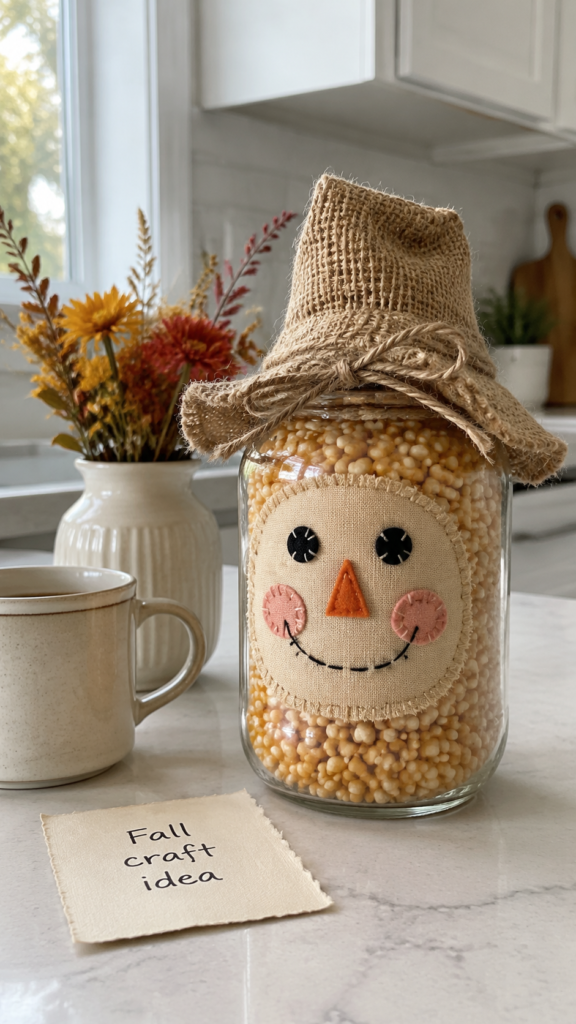
A pint-sized mason jar filled with dried corn kernels or candy corn becomes the base of this one, with a wired burlap hat lid and a painted or fabric face attached to the outside of the glass.
Unlike most scarecrow crafts for seniors that rely on stacked pieces held together with glue, this one is built around a single solid object that can’t come apart no matter how many times it’s packed and unpacked.
Glass doesn’t warp, doesn’t absorb moisture, and doesn’t weaken the way fabric-on-cardboard bases do after a year sealed in a bin.
The jar can be wiped clean, refilled with a new batch of corn each fall if it gets stale or dusty, and the face, the one part actually exposed to handling, can be done on a small fabric circle glued to the outside rather than painted directly on the glass, so it can be replaced without starting over on the whole piece.
There’s also a real, practical reason this one earns its place on the list: screwing a lid on and off, scooping kernels into a jar, and pressing fabric pieces into place all call on the kind of small, controlled hand movements that help keep grip strength and coordination from slipping, the same reason crafting shows up so often in occupational therapy for older adults.
What you’ll need: a wide-mouth pint mason jar, dried corn kernels or candy corn for filling, a small circle of burlap or felt for the hat brim, twine for tying, and a fabric circle with the face pre-drawn or embroidered, attached with fabric glue.
Store the filled jar as-is with the lid on tight, and keep the fabric face piece tucked inside an envelope taped to the jar’s underside, nothing to misplace, nothing to rebuild.
3. Wine Cork Scarecrow Family

A cluster of wine corks, glued end to end and dressed in tiny scraps of felt and fabric, makes a small standing scarecrow — or a whole family of them, lined up on a windowsill or mantel.
It’s one of the few scarecrow crafts for seniors built entirely from a material that’s already dense and weather-hardy, so there’s no worry about the base itself degrading in storage the way paper or cardboard would.
Cork doesn’t crush under weight, doesn’t absorb dampness the way cardboard does, and holds a pin or a small stitch far better than most craft materials, which means the little fabric hats, scarves, and arms actually stay attached year over year instead of needing to be re-glued every season.
A full family of them also solves a problem most single-scarecrow crafts don’t: it gives a group setting several small, low-stakes pieces to work on individually, rather than one shared project everyone has to take turns on.
Working with corks and small fabric scraps also asks for a real pincer grip and steady hand placement, gluing a two-inch scarf onto a cork body is a genuinely useful hand exercise, not just something to keep hands occupied.
What you’ll need: several wine corks, small fabric or felt scraps for hats and scarves, thin wire or pipe cleaners for arms, a fine-point marker for the face, and craft glue rated for wood and cork (not paper glue, which won’t hold on the cork’s surface).
Store the finished corks upright in a small box lined with tissue so they don’t roll or knock against each other, which is really the only thing that risks damaging them between seasons.
4. Wire-Wrapped Wool Scarecrow
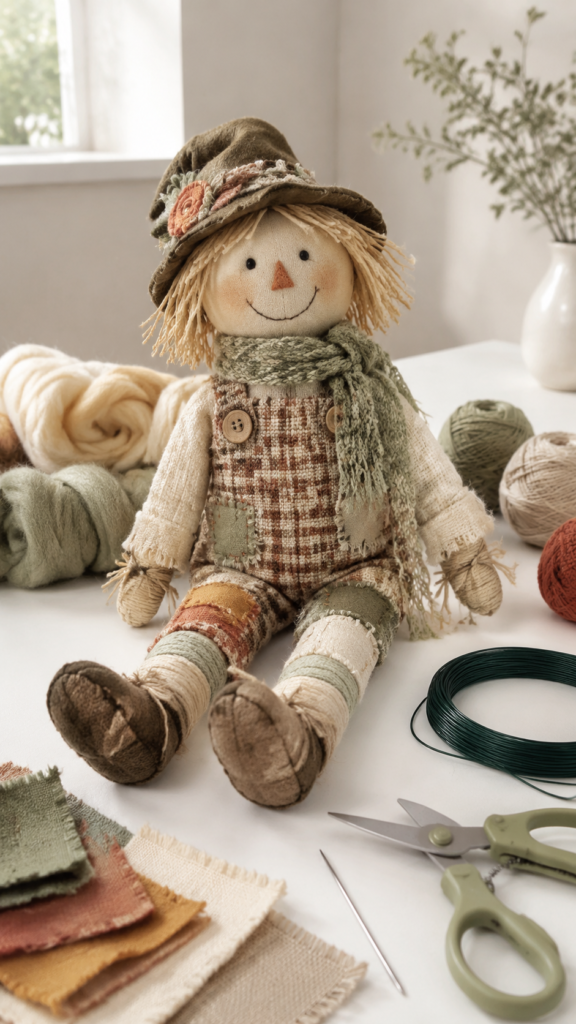
Bendable floral wire wrapped in wool roving or yarn forms the body of this scarecrow, which means the whole shape can be posed, bent, and reshaped every year instead of being fixed in one position forever.
It’s a different kind of durability than the pieces above, not just materials that survive storage, but a design flexible enough to look a little different each time it comes back out.
Wool doesn’t crumble, doesn’t yellow with age the way paper does, and holds its shape around the wire frame far better than tissue or crepe paper ever could.
Because the wire underneath is bendable, the scarecrow can be given new arm positions, a tilted head, or a different stance each fall, a small design choice that keeps a reused craft from feeling like the exact same object every October.
The wrapping itself is worth calling out directly: winding yarn or roving around a wire frame is a slow, repetitive motion that works the same small hand and finger muscles as knitting, without requiring anyone to actually know how to knit.
What you’ll need: floral wire (18–20 gauge holds shape well), wool roving or bulky yarn for wrapping, small fabric scraps for a hat and shirt, and a fine-point marker or small button eyes for the face.
Store it loosely coiled rather than folded flat, so the wire frame doesn’t develop a permanent crease that’s hard to bend back out the following year.
When Halloween activities need to feel comfortable and approachable, 20 Simple Halloween Crafts for Dementia Patients That Feel Festive Not Frightening offers gentle seasonal ideas.
5. Painted Rock Scarecrow
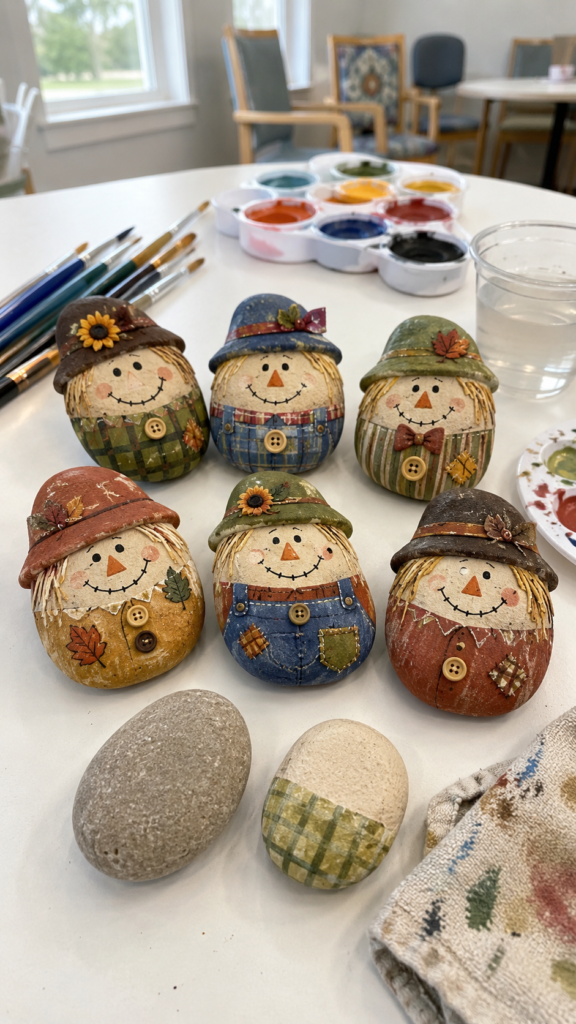
A cluster of smooth stones, painted to look like a scarecrow’s head, body, and hat, then stacked or glued together into one small standing figure.
Stone is about as close to indestructible as craft materials get, no cracking, no fading indoors, no risk from a bin getting knocked around in storage.
Acrylic paint is what actually needs attention here.
A cheap paint job will chip the first time the piece gets picked up and set back down, but a coat of clear sealant over the paint keeps the colors intact through repeated handling, which matters more for this craft than almost any other on the list since the whole point is picking it up and displaying it year after year.
Handling and turning smooth stones while painting fine details like a face or buttons calls for a steady, controlled grip, a good, low-pressure way to practice precision without anything breakable at stake if a hand slips.
What you’ll need: three to four smooth stones in graduating sizes, acrylic paint in fall colors, a fine-tip paintbrush for facial details, strong craft glue or E6000 adhesive to stack the stones, and a clear acrylic sealant spray.
Store the stacked figure as one solid piece wrapped in a soft cloth, since the only real risk to this craft is a hard drop, not time in storage.
6. Clothespin Scarecrow Ornaments
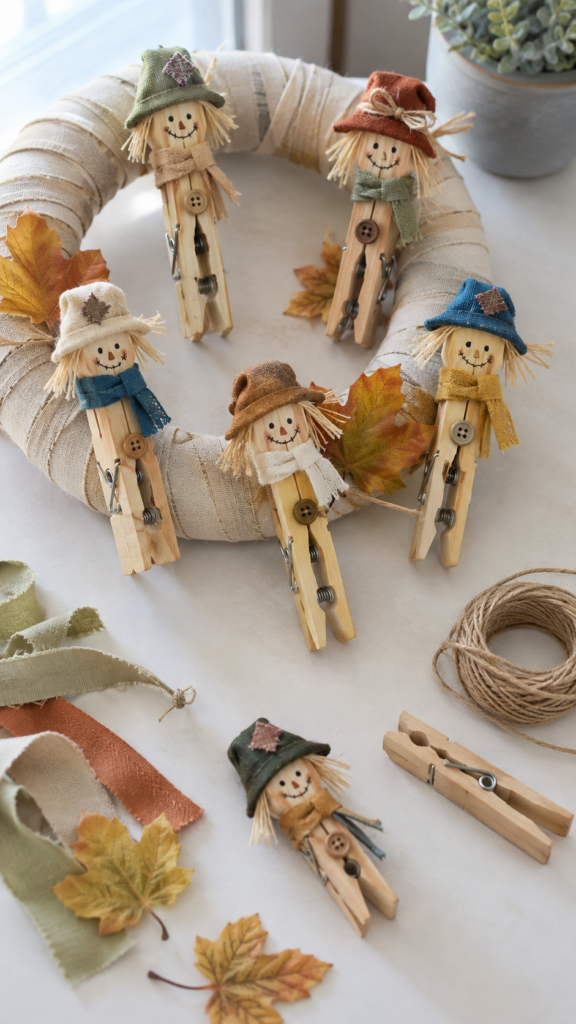
Wooden clothespins, painted and dressed in tiny scraps of flannel or burlap, become miniature scarecrow ornaments that clip onto a wreath, a branch display, or a string of twine hung across a mantel.
Wood holds up to storage the way paper never does, and clothespins in particular are built to survive years of clipping and unclipping without loosening.
Each one is small and quick to make, which makes this a good choice for a group setting where everyone finishes their own ornament rather than working on shared pieces, and because the clothespin itself does the “attaching” work, there’s no glue holding the ornament to its display spot, just a simple clip on and off.
The clip mechanism itself is a built-in hand exercise, squeezing a clothespin open works the same pinch grip used in everyday tasks like fastening buttons or picking up small objects, and repeating it across several ornaments adds up to real, gentle practice.
What you’ll need: wooden clothespins, acrylic paint, small scraps of flannel or burlap for clothing, thin twine for a hat brim, and a fine-point marker for the face.
Store the finished ornaments clipped onto a strip of cardboard or a length of ribbon, so they stay organized and untangled between seasons instead of loose in a bag.
Free Activity Book for Seniors
If you’re looking for a fun and meaningful way to keep seniors engaged, the Memory Lane Activity Book has 44 pages of gentle activities designed to spark joy, stimulate memory, and fill an afternoon with purpose.
From simple word games to nostalgic prompts that bring back favorite memories it’s the kind of resource that works whether you’re a caregiver, an adult child, or running a group activity at church or a care facility.
Download your free Memory Lane Activity Book here.
7. Fabric-Wrapped Embroidery Hoop Scarecrow Face

An embroidery hoop, wrapped in burlap and finished with a felt scarecrow face stitched or glued to the front, makes a simple wall-hanging piece rather than a standing figure.
The hoop’s wood and metal frame doesn’t warp or lose tension in storage the way a flat paper wreath backing would, so the shape holds year after year without needing to be reformed.
This is one of the few projects on the list built specifically for wall or door display rather than a tabletop, which matters for anyone working with residents who have limited table space or who display finished crafts in a hallway or common area instead of on a surface.
Stretching the burlap taut across the hoop and securing it evenly takes a controlled, two-handed motion, and stitching or gluing on the smaller felt features afterward adds a second, finer layer of hand coordination on top of that.
What you’ll need: a wooden embroidery hoop, a square of burlap larger than the hoop, felt scraps for the face, a hot glue gun or fabric glue, and a small loop of twine for hanging.
Store it flat, hoop and all, in a shallow box so the fabric doesn’t develop creases that are hard to smooth back out.
8. Popsicle Stick Scarecrow Plant Stake

Wide craft sticks, glued into a simple ladder shape and topped with a painted or fabric scarecrow face, become a small stake that pushes into the soil of a potted plant or garden bed.
Wood holds up outdoors and in storage alike, and because this one is meant to be planted rather than displayed on a shelf, it’s built to handle a bit more wear than an indoor-only piece.
This is a good option for anyone who still keeps a small potted plant or garden bed going, since it gives a finished craft an actual job to do instead of sitting in a box for eleven months of the year, reused every autumn not just by being stored, but by being replanted.
Gluing and aligning several sticks into an even ladder shape takes some patience and steady hand placement, and painting the small face afterward adds a finer motor task on top of the larger assembly work.
What you’ll need: wide wooden craft sticks, wood glue, acrylic paint or fabric scraps for the face and hat, and a clear outdoor sealant if the stake will spend time outside.
Store it standing upright in a small container or jar rather than lying flat, so the glued joints aren’t put under pressure while it’s packed away.
9. Buttoned Burlap Sack Scarecrow

A small burlap sack, stuffed loosely with fiberfill or fabric scraps and cinched at the top with twine, forms the head and body of this scarecrow, with mismatched buttons sewn on for the face and shirt front.
Among scarecrow crafts for seniors, this one holds up especially well because burlap is naturally sturdy and resists the kind of fading, tearing, or crushing that thinner fabrics run into after a year folded in a bin.
Loosely stuffed burlap also keeps its shape without a rigid frame underneath, so there’s nothing inside that can snap, bend out of place, or need to be reset before it goes back on display.
Sewing buttons onto burlap does ask for a bit more hand strength than gluing, since the fabric is thicker than most craft materials, but that resistance is exactly what makes the sewing motion a useful, low-key hand exercise, not just busywork.
Sturdy button-and-thread construction also means this scarecrow can be picked up, moved around, and handled far more than a glued piece could tolerate, which matters for anyone who likes rearranging a fall display through the season rather than setting it once and leaving it untouched.
What you’ll need: a small burlap sack or a rectangle of burlap sewn into one, fiberfill or fabric scraps for stuffing, twine for cinching, assorted buttons, and a needle with a large eye and thick thread for easier handling.
Store it stuffed and assembled as one piece in a breathable cloth bag rather than plastic, so the burlap doesn’t trap moisture over the months in storage.
10. Felt Finger Puppet Scarecrow

Two pieces of felt, cut in a simple scarecrow shape and sewn or glued together along the edges with an opening at the bottom, make a small finger puppet rather than a standing decoration.
Unlike most scarecrow crafts for seniors built for a shelf or table, this one is made to be picked up and handled directly, which makes it a good option for anyone who enjoys a craft with a hands-on, playful use afterward rather than one that’s just set down and looked at.
Felt is dense enough to hold its shape without stiffening or drying out the way thinner fabric does, and it doesn’t fray at the cut edges the way woven fabric would, so the puppet’s outline stays clean through repeated use and storage.
Slipping it on and off a finger also gives it a bit of built-in wear-testing every time it’s used, and felt simply tolerates that kind of regular handling better than paper or cardboard ever could.
Cutting the felt pieces to match, then sewing or gluing the edges together neatly, calls for a fair amount of hand-eye coordination and precision, a bit more demanding than some of the simpler crafts on this list, which makes it a good pick for anyone who wants a slightly bigger challenge.
What you’ll need: two matching pieces of felt in a scarecrow shape, a needle and thread or fabric glue for the edges, small felt scraps for the face and hat, and fabric glue for the finer facial details.
Store it flat inside a small envelope or pouch so the felt doesn’t crease or lose its shape between one autumn and the next.
What Actually Makes a Craft Reusable

A craft doesn’t earn a second season just because it looked good the first time around.
What actually decides whether it survives storage comes down to a few things most people never think to check before they start building: a strong base that can be packed, unpacked, and handled without bending or crushing out of shape;
materials that don’t fade, crumble, or absorb moisture the way paper and unsealed cardboard do; and construction that holds together through repeated handling, not just a single afternoon of display.
That’s the real standard behind every scarecrow craft for seniors on this list, not how impressive it looks on day one, but whether it still looks that way when it comes back out a year later.
There’s a second reason this matters beyond convenience.
Regular, hands-on craft work is one of the more effective ways to help maintain fine motor skills, grip strength, and hand-eye coordination as those things naturally decline with age, but that benefit only keeps paying off if the activity actually gets repeated.
A craft that has to be rebuilt from nothing every October is a craft that’s easy to skip when time or energy runs short.
A craft that’s already mostly done, just waiting to be pulled back out and redecorated, is one that’s far more likely to happen again, which means the durability isn’t just about saving materials, it’s about making sure the activity itself keeps showing up year after year.
Keep the seasonal creativity going with 21 Easy Senior Summer Crafts That Are Relaxing, Creative and Seasonal, especially when planning activities across different seasons.
Storing Them So They Actually Last Until Next Fall
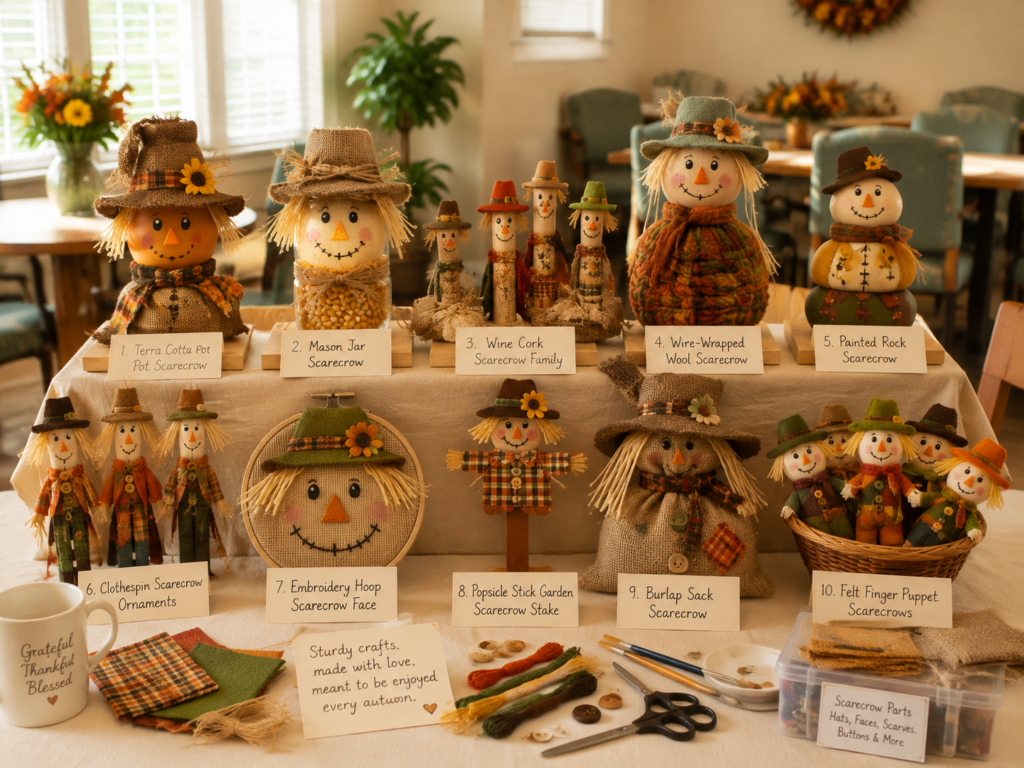
The craft itself is only half the job. How it gets packed away is what decides whether next October is a five-minute setup or another full afternoon of rebuilding from scratch.
✅ Keep fabric pieces loose, not folded
Burlap, felt, and wool hold their shape far better when they’re rolled or laid flat than when they’re folded tight for months. A hard crease pressed into fabric over a year in storage doesn’t always smooth back out, even with steam or ironing.
✅ Store small accessories separately, in their own labeled bag
Hats, scarves, buttons, and faces are the pieces most likely to go missing between seasons, not because they break, but because they end up loose at the bottom of a bin instead of attached to anything.
A small labeled pouch taped to the base, or kept alongside it, means nothing has to be hunted down or remade next fall.
✅ Avoid plastic bins for anything with natural fiber in it. Burlap and wool can trap moisture in a sealed plastic container, which leads to mustiness or mildew over a humid summer.
A breathable fabric bag or a cardboard box with some airflow keeps natural materials in better shape than an airtight tub does.
✅ Store upright pieces standing up, not stacked flat
Anything built around a dowel, wire frame, or stacked base, like the terra cotta pot or wire-wrapped wool scarecrows, holds its shape better standing in a box than lying on its side under other decorations.
Weight pressing down on a shaped piece is usually what causes the bent wire or crushed base that forces a rebuild the following year.
✅ Take one photo before it goes back in the box
A quick picture of the finished piece removes all the guesswork the following October, no trying to remember which button went where or how the scarf was tied.
It turns reassembly into matching a photo instead of reconstructing it from memory.
Know That
The real win here isn’t the ten projects themselves, it’s opening that bin next fall and finding something worth setting back up instead of something worth throwing out.
That’s what separates good scarecrow crafts for seniors from the kind that quietly become a once-a-year rebuild.
Pick one to start with this season. Build it well, store it right, and let next October be about redecorating a familiar piece, not starting over from an empty table.
Made one of these already? Share which one held up best for you, and what you’d tell someone trying it for the first time.