This post contains affiliate links. This means I may earn a small commission if you purchase through my links at no extra cost to you.
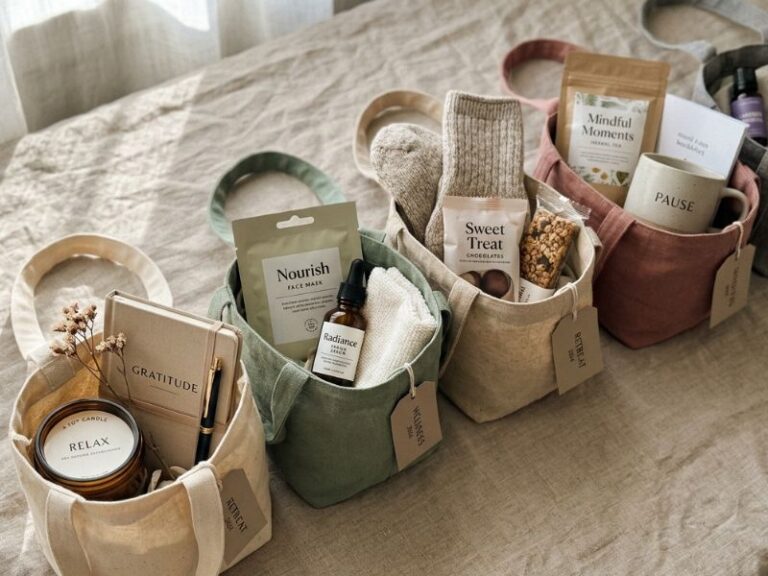
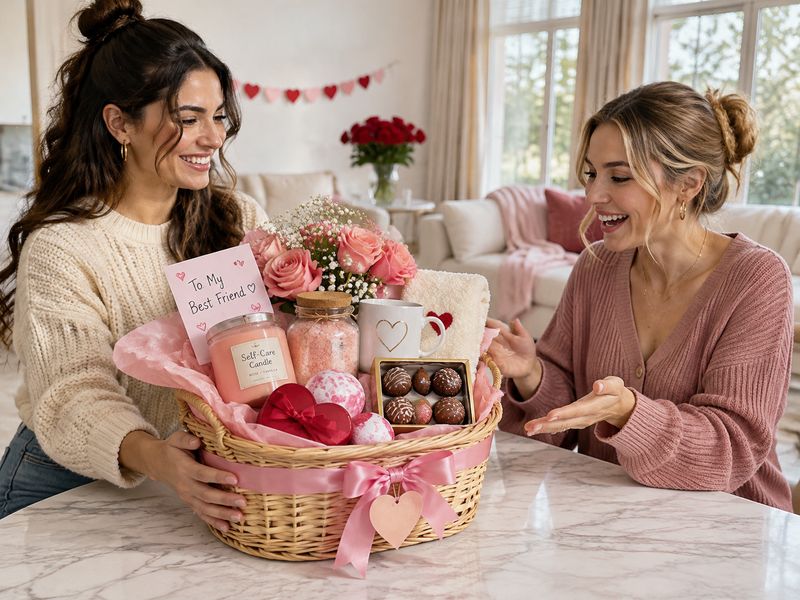
She may not need another box of chocolates; these DIY Valentine gift baskets for your best friend turn her favourite interests into thoughtful surprises.
Your best friend probably has a few things you could recognise without asking: the snack she always reaches for, the drink she orders, the hobby she keeps making time for or the little item she is always borrowing.
Those details can tell you more about what to give her for Valentine’s Day than a shelf full of ready-made gift sets.
A DIY gift basket gives you the chance to bring some of those details together. It could hold supplies for a hobby she enjoys, useful things for her daily routine or a few items connected to a memory you share.
The aim is not to make the biggest basket, but to put together one that feels like it could only have been chosen for her.
These 15 DIY Valentine gift baskets for your best friend offer different ways to do that, with practical ideas for what to include and how to make each collection thoughtful without filling it with things she may never use.
Putting together a Christmas surprise for your husband doesn’t have to cost a fortune. 25 DIY Christmas Gift Baskets for Husband on a Budget That Don’t Feel Cheap shares thoughtful ways to make a gift basket without overspending.
When Did Giving Valentine’s Gifts to Friends Become a Thing?
Valentine’s Day has a longer history of friendship and gift-giving than its modern romantic image might suggest.
By the middle of the 18th century in Britain, friends and family members were among those exchanging small tokens of affection and handwritten notes on Valentine’s Day. These gestures were not limited to romantic partners.
The tradition continued into the Victorian era, when people exchanged handmade and printed Valentine cards. Some carried romantic messages, while others expressed friendship or used humour.
The Victoria and Albert Museum’s collection even includes examples of cards known as vinegar valentines, which were exchanged as jokes or insults rather than declarations of love.
In more recent times, the celebration of female friendship gained another recognisable name: Galentine’s Day.
The occasion was introduced in a 2010 episode of the television sitcom Parks and Recreation, in which Leslie Knope gathered her female friends for breakfast and gave them personalised handmade presents.
The fictional celebration later became a real-world tradition, commonly observed on February 13.
So, giving a friend something thoughtful for Valentine’s Day is not an entirely new idea. It is part of a much longer tradition of using the occasion to express affection beyond romantic relationships.
The DIY Valentine Gift Baskets for Your Best Friend
1. The Recipe Experiment Basket for a Friend Who Loves Trying New Meals
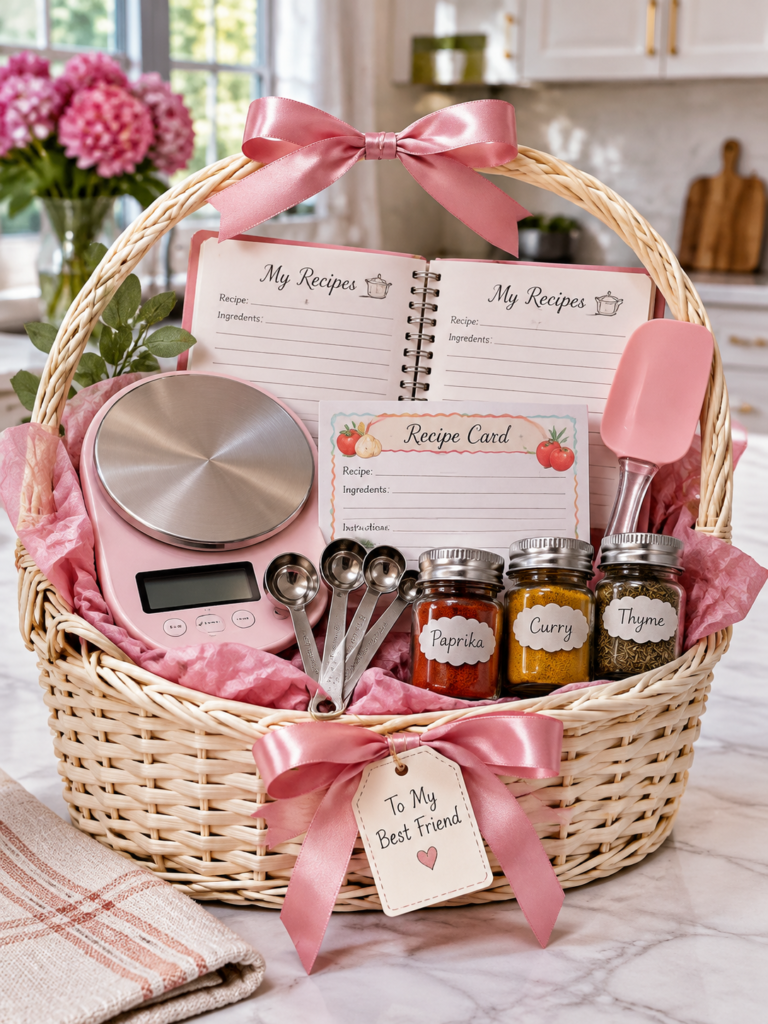
Some people follow recipes exactly; others enjoy changing a seasoning, testing a different ingredient or adjusting a recipe until it suits their taste.
This basket is for the friend who enjoys that process and likes keeping track of meals worth making again.
What to include:
- A recipe testing notebook: Choose one with enough room to record the recipe source, ingredient quantities, preparation steps, cooking time, number of servings and personal notes. A recipe journal with sections for ratings and adjustments can make it easier for her to remember what worked and what she would change next time.
- A digital kitchen scale: This is especially useful when she experiments with baking recipes. Weighing ingredients in grams or ounces gives more consistent measurements than relying on loosely filled cups. A compact digital kitchen scale with both gram and ounce settings would be a practical choice.
- A complete set of measuring spoons: These are useful for measuring small quantities of baking powder, salt, vanilla extract and seasonings. Stainless-steel measuring spoons with clearly marked measurements are worth considering because they complement the kitchen scale rather than duplicate its purpose.
- A flexible silicone spatula: Choose a food-grade spatula with a stated heat-resistance rating. It can help scrape mixtures from bowls, fold ingredients together and transfer batters or sauces without leaving much behind.
- A small selection of familiar seasonings: Choose two or three spices or blends she already enjoys using. Check the ingredients and best-before dates rather than buying a random assortment she may never use.
- One recipe to experiment with: Print a recipe that suits her interests, perhaps a dish she has mentioned wanting to try. Include space on the page for her to record any changes she makes.
For a friend who regularly cooks meat or poultry, an instant-read food thermometer is another useful addition.
It helps check whether food has reached a safe internal temperature instead of relying on colour or appearance. Choose one with a clear digital display and a temperature range suited to everyday cooking.
Make the basket more personal: Write a small note on the recipe notebook’s first page, such as “Recipes worth keeping, experiments worth repeating, and a few kitchen surprises along the way.” You could also include the name of a meal you both enjoy as the first recipe to test.
2. The Windowsill Herb-Growing Basket for a Friend Who Loves Fresh Ingredients
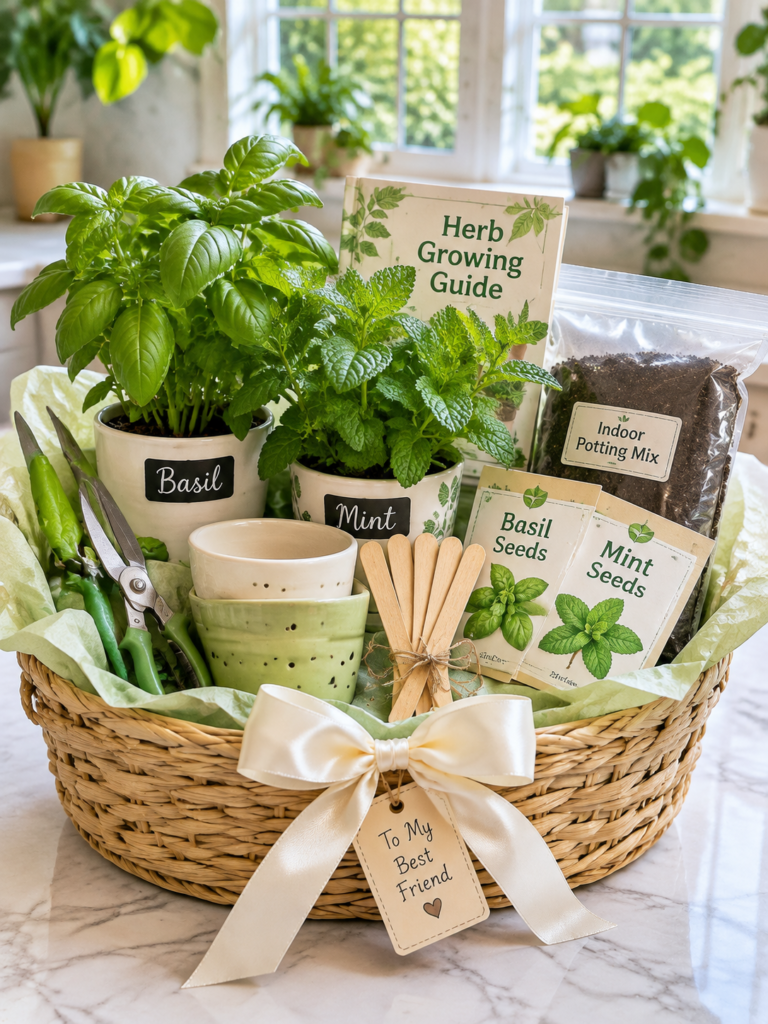
A friend who enjoys cooking may appreciate having fresh herbs within reach rather than buying a whole bunch for one recipe and leaving the rest unused.
This basket gives her a starting point for growing a few herbs at home, even without a garden.
What to include:
- A small herb starter plant or seed packets: Basil, parsley, chives and mint are possible indoor choices. A young potted plant is a good option when she wants something to care for immediately, while seed packets allow her to experience the growing process from the beginning. Basil, parsley and cilantro can be started indoors from seed, but germination and harvesting take time.
- A planter with drainage holes: Choose a pot that suits the selected herb’s size rather than an oversized decorative container. A small terracotta or plastic planter can work, provided excess water can escape.
- Indoor potting mix: Include a potting mix suitable for containers. Ordinary garden soil is not the best choice for a small indoor pot because it can become compacted and drain poorly.
- Plant labels: Add reusable labels so she can identify each herb and record its planting date. This is particularly useful when growing different varieties.
- Small pruning scissors: A compact pair of clean, sharp herb scissors makes harvesting small amounts easier. She should avoid removing too much foliage from a young plant at once.
- A simple growing guide: Include the light, watering and harvesting requirements for the particular herb in the basket.
One growing detail worth explaining: A windowsill does not automatically provide enough light for every herb.
The University of Maryland Extension recommends at least five hours of sunlight for many indoor herbs, while Iowa State University Extension notes that light is often the main limitation and that many herbs need around eight hours of direct light.
Requirements vary by plant and growing conditions. A bright window may be sufficient, but supplemental grow lighting may be necessary in a dim room. Containers also need drainage, and most herbs should not be left sitting in water.
For the basket, a small indoor herb-growing kit with separate pots, plant labels and a drainage tray can make a useful addition, especially when the recipient is starting from scratch.
Keep the selection manageable: two or three herbs she regularly uses are more practical than a large collection she may not have space or light to grow.
Choosing something meaningful for your partner is easier when you consider his interests and personality. Valentine’s Gifts for Your Boyfriend That Feel Personal, Thoughtful and True to Him offers more gift inspiration.
3. The Watercolour Practice Basket for a Friend Who Wants to Try Painting
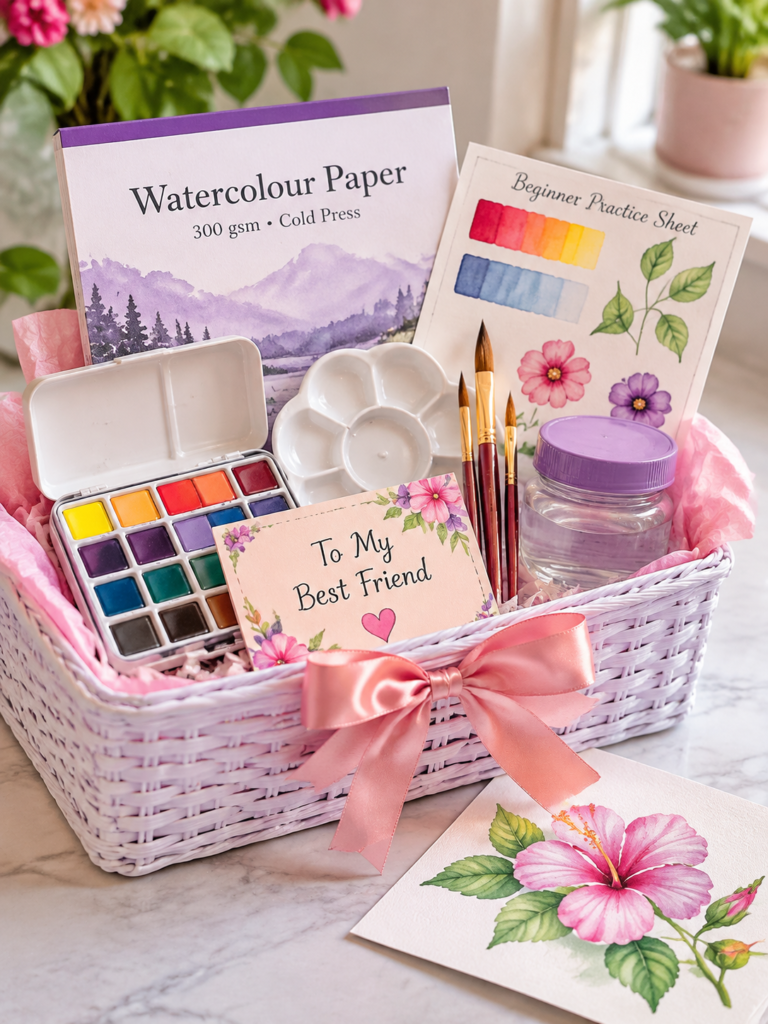
Someone who has been interested in painting but has never known which supplies to buy may appreciate a small starter collection.
The aim is to give her enough materials to practise simple washes, colour mixing and basic shapes without overwhelming her with professional equipment.
What to include:
- A beginner watercolour paint set: Choose a compact set with a selection of basic colours. A small palette is enough to practise mixing new shades without buying a large collection of individual paints.
- Watercolour paper: This is one of the most important items in the basket. Ordinary printer paper is not designed for repeated wet washes and can buckle or become damaged. A 140 lb (300 gsm) cold-press watercolour pad is a useful starting point for general practice because it has more body than lightweight paper and a textured surface suitable for different brush techniques.
- Two or three round brushes: A small round brush for details and a medium round brush for filling shapes and making broader strokes give a beginner room to practise different marks. Synthetic brushes are a practical starting choice.
- A mixing palette: Choose a palette with separate wells for keeping colours apart and a larger area for mixing. A simple plastic palette is sufficient for practice.
- A water container: A stable, easy-to-clean container is useful for rinsing brushes between colours. A two-section container can help keep cleaner water available.
- A beginner practice sheet: Include a printed sheet with basic exercises such as colour gradients, circles, leaves and simple flowers. These give her something specific to practise before attempting a complete painting.
What to know about watercolour paper: Paper weight and surface texture affect how it handles water and paint. Lightweight paper is more likely to buckle during wet painting, while heavier paper generally holds its shape better.
Cold-press paper has a noticeable texture and is versatile for beginners; hot-press paper is smoother and is often chosen for fine details and precise lines.
A 140 lb (300 gsm) pad is a sensible general-purpose option, although very wet techniques can still cause some buckling.
A beginner watercolour set paired with a good-quality 300 gsm cold-press paper pad is a more useful purchase than an expensive paint collection paired with unsuitable paper.
Add a small mixing palette and synthetic brush set so she can begin practising as soon as she opens the basket.
4. The Home-Baking Basket for a Friend Who Loves Making Cakes and Pastries
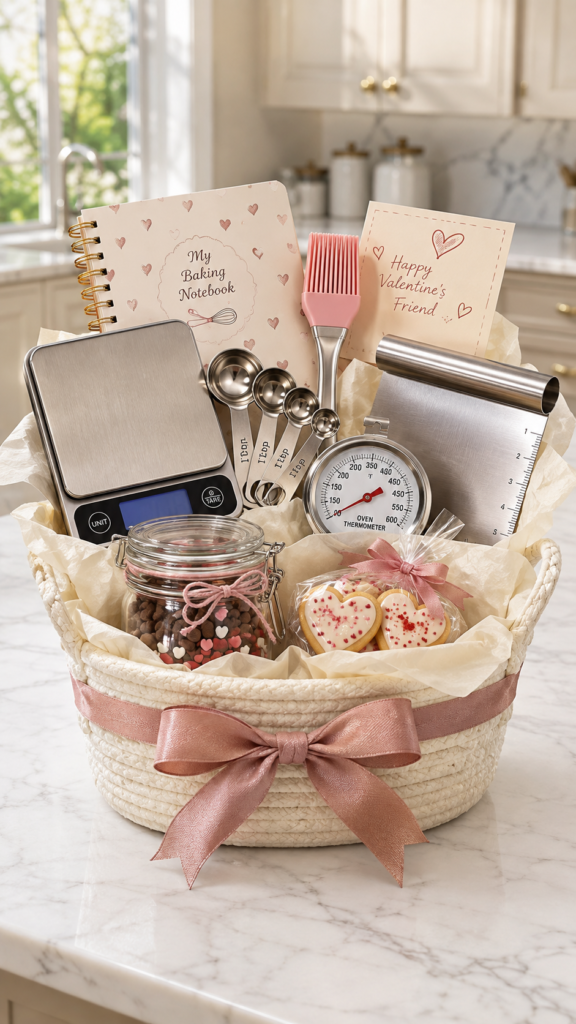
For a friend who enjoys baking, a basket of carefully selected measuring and preparation tools can be more useful than another collection of decorative kitchen accessories.
Focus on equipment that helps her measure ingredients, prepare mixtures and keep track of recipes.
What to include:
- A digital kitchen scale: Choose one that measures in grams and ounces. This is particularly useful for baking because weighing ingredients gives more consistent results than relying on cups that may be filled differently. A compact scale with a tare function lets her reset the measurement when adding another ingredient to the same bowl.
- Measuring spoons: A stainless-steel set with clearly marked measurements is useful for smaller quantities of baking powder, salt, vanilla extract and other ingredients.
- An oven thermometer: This can help her check the temperature inside the oven rather than relying entirely on the temperature displayed on the appliance. A model designed to remain in the oven during baking is a practical choice.
- A silicone pastry brush: This is useful for applying egg wash, melted butter or other coatings to pastry and baked goods. Choose one that is heat-resistant and easy to clean.
- A bench scraper: A stainless-steel bench scraper can help divide dough, lift chopped ingredients and clean flour or dough residue from a suitable work surface.
- A baking notebook: Choose one with room to record ingredient quantities, oven settings, baking times and changes made to a recipe. This helps her compare results when testing a recipe more than once.
Why the oven thermometer matters: Oven settings do not always tell the whole story about the temperature inside the appliance.
A separate oven thermometer can help identify noticeable differences between the selected setting and the temperature shown by the thermometer.
However, an ordinary oven thermometer is not a laboratory calibration instrument, so it should be treated as a practical checking tool rather than a guarantee of exact temperature.
A useful combination is a digital kitchen scale, a set of measuring spoons and an oven thermometer.
These products address different parts of baking: ingredient measurement, small-quantity measurement and oven temperature checking. Avoid adding baking tins without checking which sizes she already owns.
5. The Dog-Walking Basket for a Friend Who Takes Her Dog Everywhere
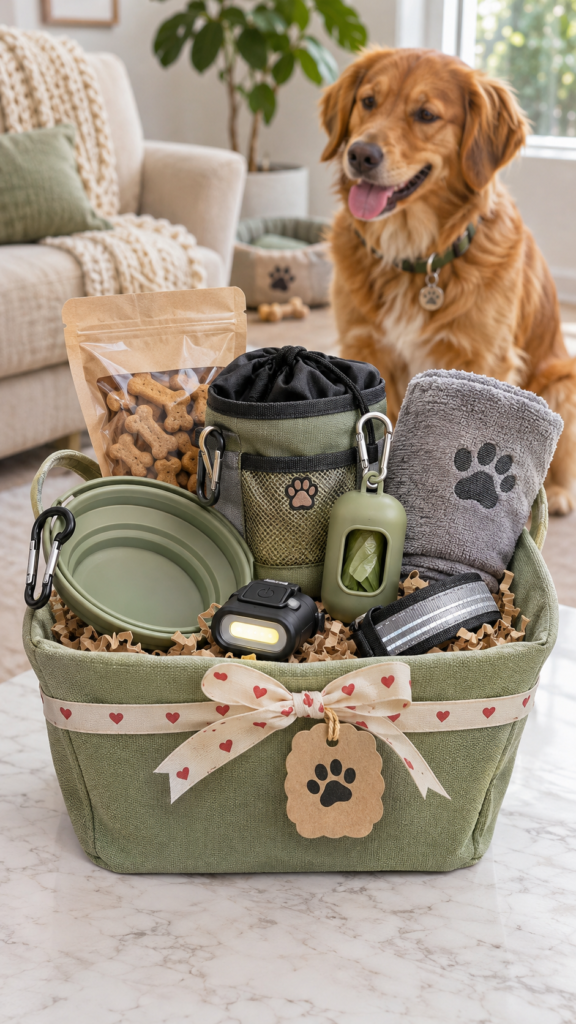
Daily dog walks involve more than a lead and a few treats. There are small essentials for carrying water, cleaning up after the dog and staying visible during walks in low light.
This basket brings those items together for a friend whose dog is part of her everyday routine.
What to include:
- A treat pouch: Choose one that attaches securely to a belt or waistband and opens easily. It is useful for carrying small rewards during walks or training sessions.
- A waste-bag dispenser: A clip-on dispenser that attaches to the lead or walking bag makes it easier to carry waste bags without keeping a loose roll in a pocket.
- A collapsible water bowl: This is useful for offering the dog water during longer walks or outings. Choose a washable, non-toxic bowl that folds down for storage.
- Reflective walking accessories: A reflective collar, lead attachment or dog walking vest can make the dog more visible when light is low. Check that the accessory fits properly and does not restrict movement.
- A clip-on walking light: This provides an additional light source for evening walks. Choose one that attaches securely and is suitable for outdoor use.
- A small washable towel: This can help remove mud and dirt from the dog’s paws before the pet enters the house or car.
An important visibility detail: Reflective materials work by reflecting light from an external source, such as vehicle headlights.
They do not produce light themselves. A small clip-on light can therefore be a useful companion for walks in darker conditions.
The RSPCA also recommends reflective accessories to help dogs remain visible during walks in the dark.
Choose treats with the particular dog’s size, dietary requirements and known sensitivities in mind. Avoid putting unfamiliar food into the basket simply because the packaging looks attractive.
A washable treat pouch and collapsible water bowl are practical purchases that can be used repeatedly rather than disposable extras.
6. The Car-Organisation Basket for a Friend Who Drives Often
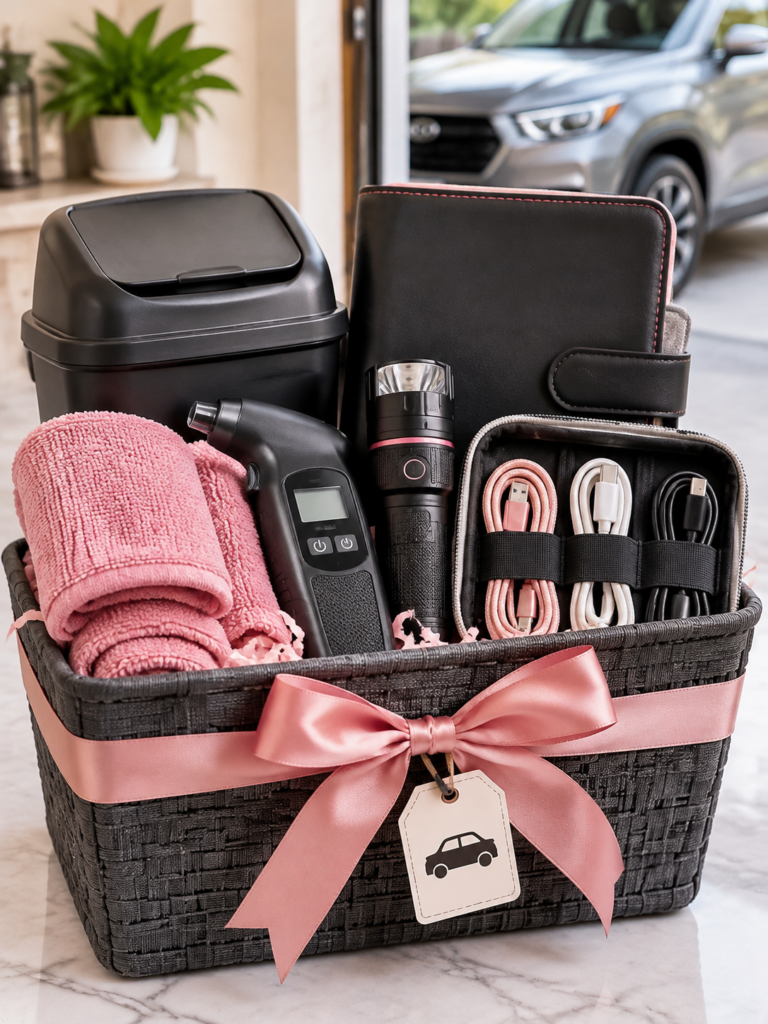
A friend who spends a lot of time driving may appreciate a collection of small items that help keep her vehicle tidy and make routine checks easier.
Instead of filling the basket with decorative car accessories, focus on products that have a clear use.
What to include:
- A compact car rubbish bin: Choose one with a secure closure and a fastening system that suits her vehicle. Check the dimensions so it does not obstruct the driver’s legroom or access to controls.
- A microfiber cleaning cloth: A clean, soft microfiber cloth is useful for wiping suitable interior surfaces and removing dust. It should be kept separate from cloths used on dirtier surfaces to reduce the risk of scratching.
- A tyre pressure gauge: A portable digital or dial gauge allows her to check tyre pressure at home or before a journey. Choose one with a readable display and a measurement range suitable for her vehicle.
- A compact torch: This can be useful when checking the boot or looking for something inside the car in low light. A rechargeable model with a secure charging arrangement is worth considering.
- A car document organiser: Choose a slim folder for vehicle paperwork that she is required or advised to carry in her location. It should be stored securely rather than left in plain view.
- A cable organiser: A small organiser keeps charging cables from becoming tangled around the centre console or other storage areas.
The tyre-pressure detail readers should know: The correct inflation pressure is specified by the vehicle manufacturer, usually on a tyre information placard or in the owner’s manual. It is not necessarily the maximum pressure printed on the tyre sidewall.
Tyre pressure should generally be checked when the tyres are cold, following the vehicle manufacturer’s instructions.
A digital tyre pressure gauge and a compact cable organiser are useful additions for someone who drives regularly.
Check the vehicle’s charging connections before purchasing a cable organiser that includes built-in charging leads.
The basket should also leave room for the driver to keep essential safety equipment separately, according to local road regulations.
Small gestures can make elderly neighbours feel remembered during the holidays. 10 DIY Thanksgiving Gift Baskets for Elderly Neighbors That Make Them Feel Remembered and Loved has thoughtful ideas for putting together a seasonal gift.
7. The Photo-Printing and Memory-Keeping Basket for a Friend Who Loves Photographs
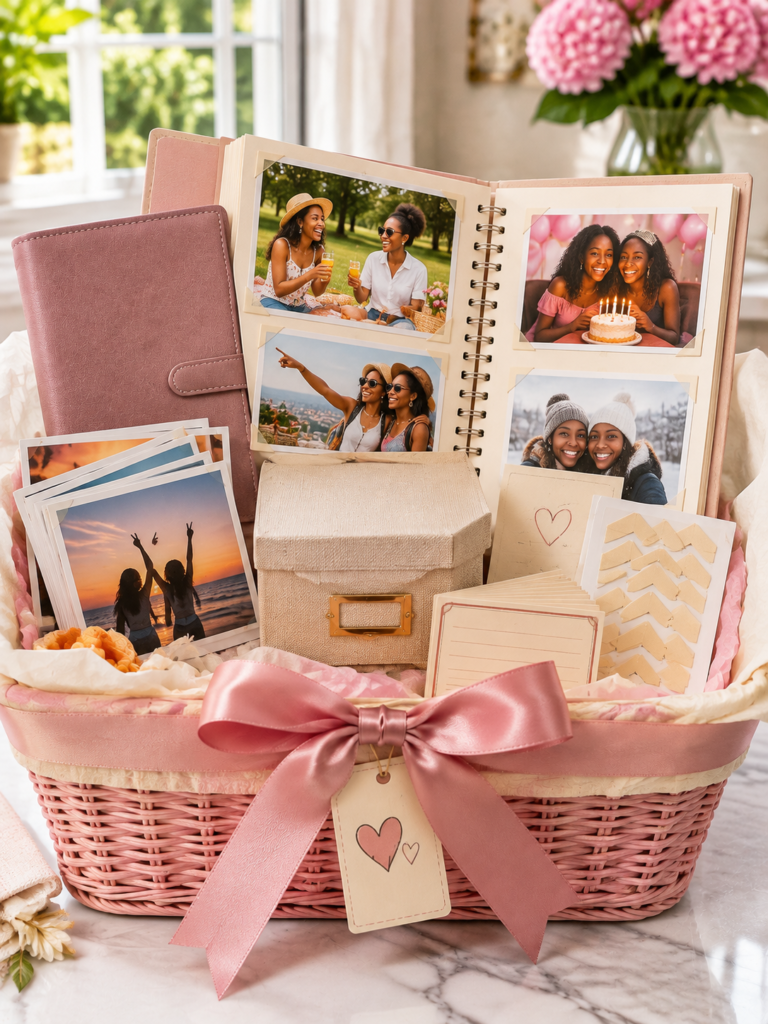
Many photographs stay on phones and computers without ever becoming part of an album.
This basket gives a friend who enjoys keeping memories a way to select, print and organise photographs from trips, celebrations and everyday moments.
What to include:
- A small photo album: Choose an album with sleeves or pages that suit the size of the photographs she intends to print. A simple album with room for captions can make it easier to record the people, places and dates behind the pictures.
- A selection of printed photographs: Choose photographs from shared outings, family celebrations or moments that are meaningful to her. Make sure you have permission to include pictures of other people, particularly where children are involved.
- Photo corners: These allow photographs to be held in place without applying adhesive directly to the image. Look for photo-safe paper or plastic corners from a reputable supplier.
- A photo storage box: A suitable box gives her somewhere to keep additional prints, duplicates and photographs she has not yet placed in the album.
- Caption cards: Include small cards where she can write dates, locations, names and short notes about the photographs. This keeps the written details beside the photographs without marking the image itself.
- A handwritten memory note: Choose one photograph and write a short message about the occasion or why that moment matters to your friendship.
Protecting the photographs: The Library of Congress advises against using ordinary glue, self-adhesive tape, sticky notes or other adhesives directly on photographs. It recommends suitable protective enclosures and photo-safe storage materials.
The National Archives also recommends photo corners made from appropriate materials as an alternative to adhesive mounting.
A small album with photo sleeves is a convenient option for someone who wants to arrange pictures without attaching them individually.
For a more traditional scrapbook, choose photo corners and caption cards rather than sticking valuable or irreplaceable prints directly onto decorative pages.
A portable photo printer can also be considered when she regularly prints pictures from her phone, but check its paper and cartridge compatibility before buying.
8. The Sewing Repair Kit Basket for a Friend Who Likes Mending Her Clothes
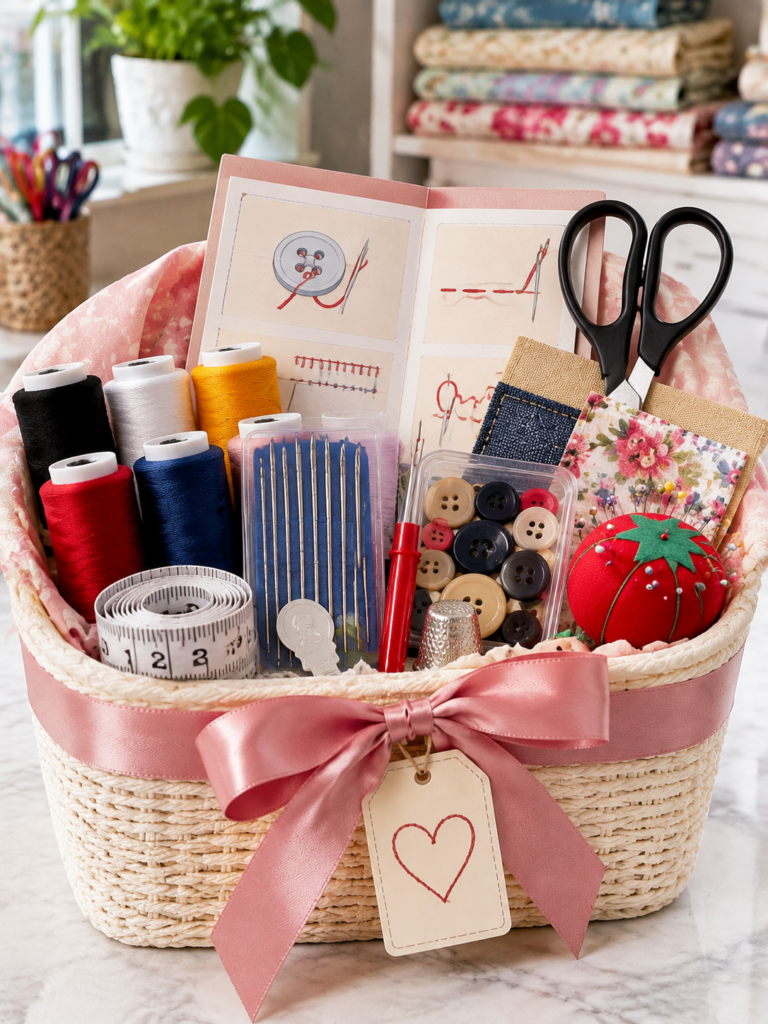
That favourite dress with a loose button or the trousers with a small tear do not always need to be thrown away or taken to a tailor. Sometimes, a few basic sewing supplies are all that is needed to put things right.
This basket is suited to a friend who enjoys looking after her clothes and prefers to handle simple repairs herself.
What to include:
- Hand-sewing needles: Choose different sizes for working with lightweight fabrics, denim and other materials she commonly wears.
- Sewing threads: Include everyday colours such as black, white, navy and a few shades that match her wardrobe. All-purpose polyester thread is suitable for many routine clothing repairs.
- A seam ripper: This comes in handy when she needs to remove unwanted stitches, correct a sewing mistake or open a seam before repairing it.
- Fabric scissors: Pick a sharp, comfortable pair made for cutting fabric. Ordinary paper scissors may not cut cloth as cleanly.
- A measuring tape: She can use it to check hem lengths, measure damaged sections and keep alterations even.
- A needle threader and thimble: These small accessories can make hand sewing more comfortable, particularly when threading fine needles or pushing a needle through thicker fabric.
- Spare buttons and fabric patches: Choose a few common button sizes and small patches that suit the clothes she usually repairs.
- A pin cushion or sewing organiser: These help keep needles, pins, threads and other small supplies in one place.
Keeping the kit practical: Focus on everyday mending rather than filling the basket with specialised sewing equipment. Check what she already owns so you do not buy duplicate tools she rarely uses.
A compact sewing organiser with separate compartments is worth considering, especially when she likes to keep her supplies in a drawer or take them along when travelling.
You could also include a small guide showing how to replace a button, close an open seam and repair a minor tear by hand.
9. The Balcony Gardening Basket for a Friend With Limited Outdoor Space
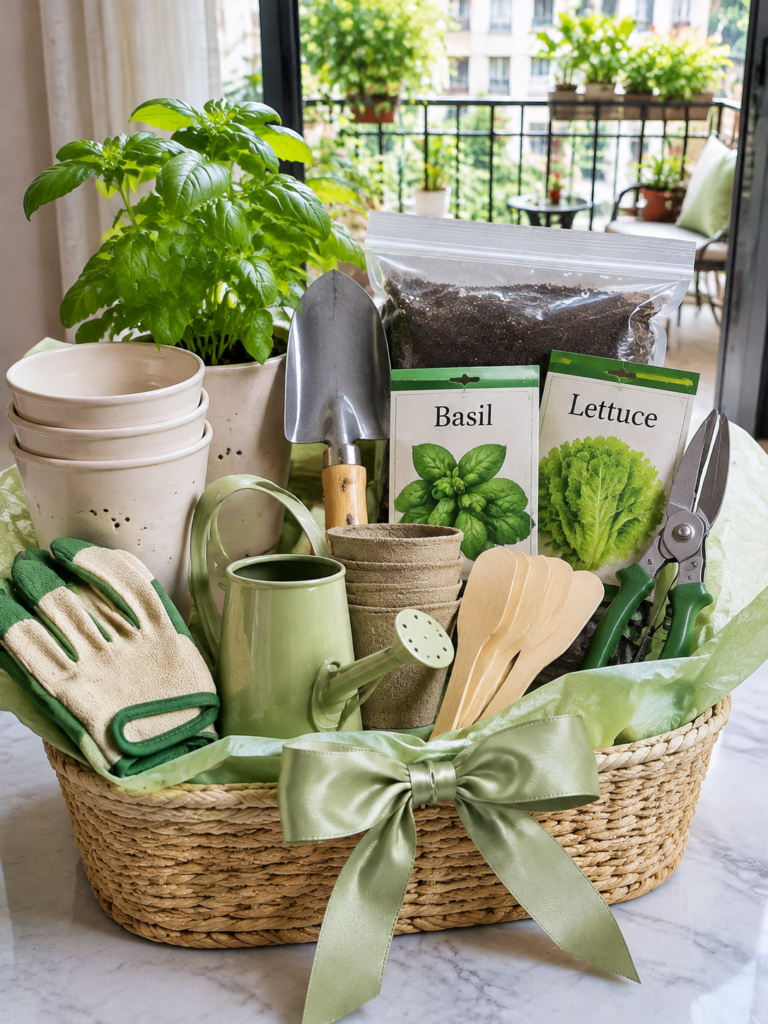
Fresh herbs growing near the kitchen door or a few tomato plants in pots can make a small balcony more useful.
Having limited outdoor space does not necessarily mean giving up the pleasure of growing something.
This basket is for a friend who wants to start container gardening but needs supplies that will fit comfortably into the space she has.
What to include:
- Lightweight planters: Look for containers with drainage holes. Their size should suit the plants she wants to grow and the amount of room available on the balcony.
- Container potting mix: Choose a growing medium made for pots. Ordinary garden soil can be heavy in containers and may not provide suitable drainage.
- Herb or vegetable seeds: Basil, parsley, lettuce and compact tomato varieties are possible choices. Check their growing requirements and whether they suit her local climate before selecting the packets.
- A hand trowel: This is useful for filling containers, moving potting mix and transplanting young plants.
- A watering can: Choose a small one with a narrow spout so she can water individual pots without flooding the balcony.
- Plant labels and a waterproof marker: These will help her identify the different varieties, especially when several herbs or vegetables are growing together.
- Gardening gloves: Pick a comfortable pair for handling potting mix and carrying out light planting tasks.
- Pruning scissors: These are useful for harvesting herbs and trimming small damaged or unwanted stems.
Making the most of balcony space: Sunlight should guide the choice of plants. Check how many hours of direct sun reach the balcony before buying seeds or young plants. Some vegetables need several hours of sunlight, while certain leafy crops and herbs can manage with less.
Drainage is equally important. Water needs to escape through the bottom of the container rather than collect around the roots. University extension guidance on container gardening also recommends using suitable potting mix instead of ordinary garden soil.
Vertical planters and railing boxes can help when floor space is limited. Check that any hanging or railing planter is securely fitted and that the balcony can safely support the weight of the containers, growing medium and water.
Welcoming someone into a new neighbourhood can start with a simple, useful gift. 15 DIY Housewarming Gift Baskets for New Neighbors That Make a New Home Feel Like Home from Day One shares ideas for making new neighbours feel welcome.
10. The Natural Dye Experiment Basket for a Friend Interested in Textile Crafts
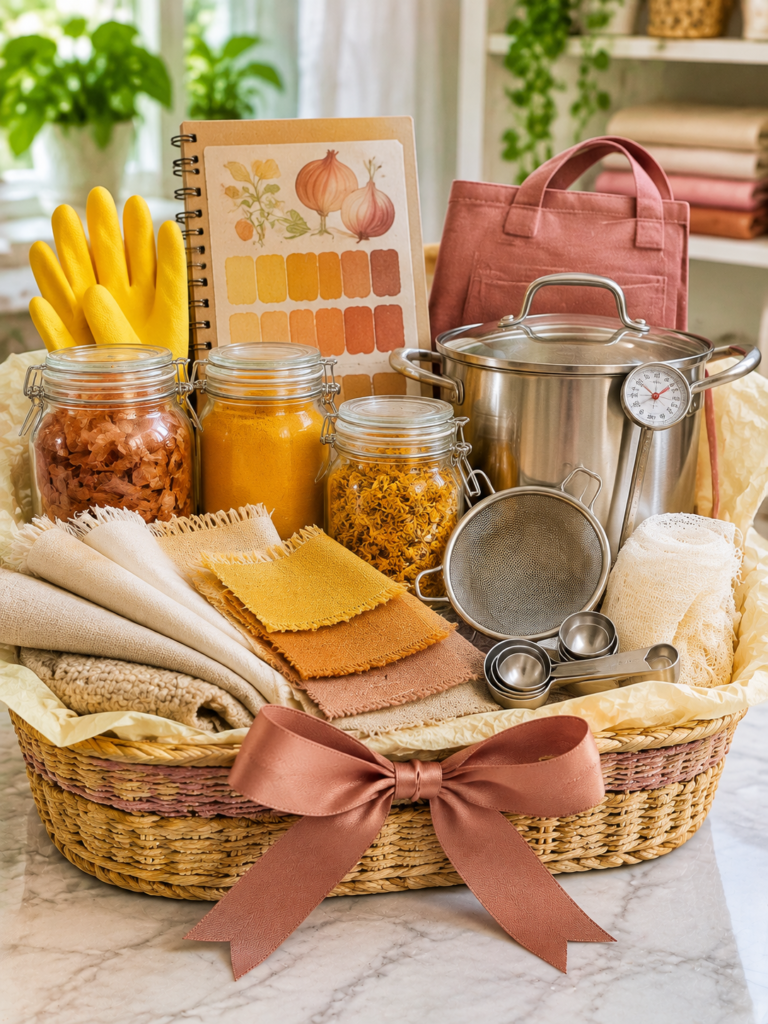
Onion skins, flowers and other plant materials can produce colours that are quite different from the dyes sold in craft shops.
For someone who enjoys working with fabric and yarn, experimenting with these materials can be an interesting way to try a new textile technique.
This basket gives her some of the basic supplies to begin exploring natural dyeing on small fabric samples before moving on to larger projects.
What to include:
- Natural dye materials: Dried onion skins, turmeric and dried marigold flowers are possible starting materials for small experiments. Each produces different results depending on the preparation method and fabric.
- Natural-fibre fabric samples: Include undyed cotton, linen, wool or silk samples so she can compare how different fibres take up colour.
- A dyeing notebook: She can record the plant material, fabric type, quantities, preparation method and time used for each experiment.
- A dedicated dyeing pot: Choose one that will be used only for craft dyeing, not for preparing meals.
- A fine strainer or cheesecloth: These help remove plant pieces from the dye liquid before the fabric goes in.
- Measuring spoons and a thermometer: These are useful for following recipes and recording the quantities and temperatures used.
- Rubber gloves and a protective apron: Include these to help protect her hands and clothes during the dyeing process.
- Fabric labels: Small tags will make it easier to identify and compare the samples after they have dried.
Understanding natural dye methods: Results can vary considerably. The same plant material may produce different shades on cotton, wool or silk, and the final colour can also depend on preparation and dyeing conditions.
Testing a small piece of fabric first is a sensible way to avoid wasting material.
Some natural dye recipes use mordants to help colour attach to fibres. Their suitability and handling instructions depend on the particular substance, so choose a beginner recipe with clear safety guidance.
Natural materials should not automatically be assumed to be harmless.
A beginner’s natural-dyeing guide is a useful addition, particularly one that explains which fibres and plant materials work together and identifies any mordants or precautions required.
11. The Indoor Seed-Starting Basket for a Friend Preparing a Small Vegetable Garden
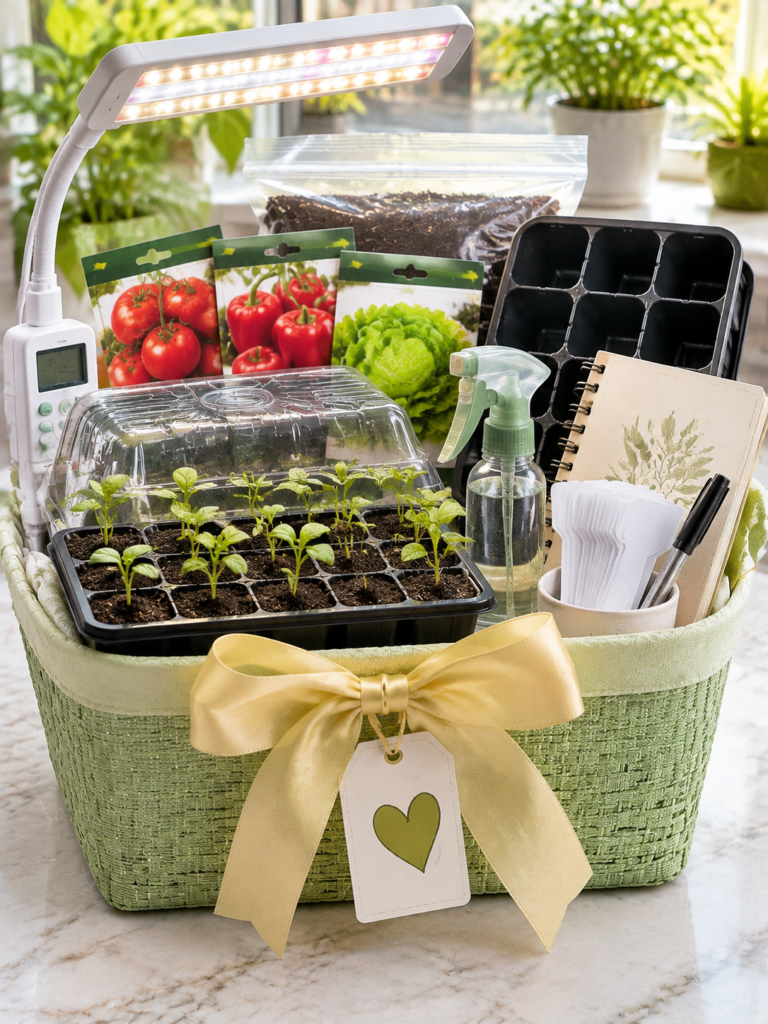
Vegetable gardening often begins before the plants reach their final growing space.
Seeds can be started in small trays indoors, giving them time to germinate and develop into seedlings before they are moved into an outdoor garden or suitable containers.
This basket is a thoughtful option for a friend preparing a small vegetable garden who wants to raise some of her plants from seed.
What to include:
- Seed-starting trays: Choose trays with individual cells so she can keep different vegetable varieties organised and separate while they germinate.
- Vegetable seed packets: Consider tomatoes, peppers, lettuce or cabbage, depending on her local climate, growing season and available garden space.
- Seed-starting mix: Look for a light growing medium suitable for germinating seeds. Heavy garden soil is not ideal for filling small seed trays.
- Plant labels: These will help her identify each variety and remember which seeds were planted in each tray.
- A waterproof marker: Choose one that will remain readable when the labels come into contact with water.
- A spray bottle or small watering can: Gentle watering helps moisten the growing medium without disturbing newly planted seeds.
- A humidity cover: A clear cover can help retain moisture during germination, but it should be removed once seedlings emerge.
- A seed-starting journal: She can record sowing dates, germination, watering and when each variety is ready for transplanting.
- A grow light and timer: These can help provide sufficient light when a sunny window is not available.
Helping young seedlings grow well: Different vegetables have different requirements, so the instructions on each seed packet should guide planting depth, temperature and germination time. Keep the growing medium moist without leaving the trays waterlogged, and make sure the containers have drainage holes.
Light becomes particularly important once the seedlings appear. A window may not provide enough light, and young plants can become tall, weak and stretched when they do not receive sufficient illumination.
University extension guidance on indoor seed starting recommends providing adequate light and removing humidity covers after seedlings emerge.
Reusable seed trays with a water-catching base are practical additions to this basket. A grow-light set is also worth considering when her available window space does not provide the light her seedlings need.
12. The Emergency Car-Readiness Basket for a Friend Who Travels Long Distances
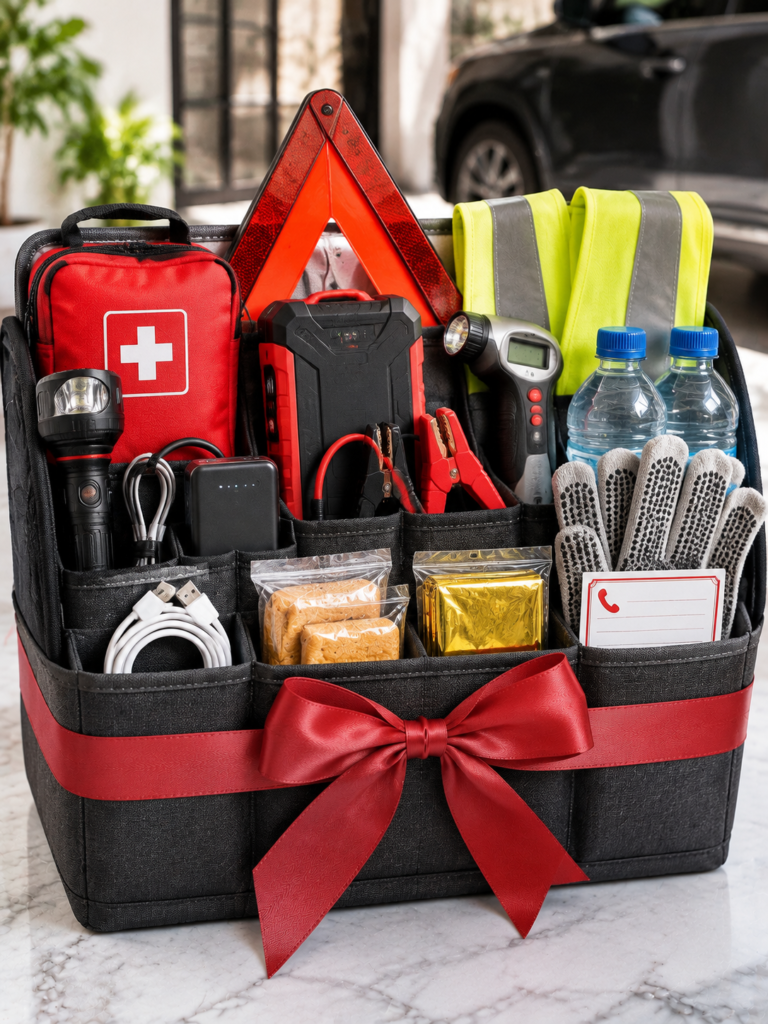
A long-distance trip can be interrupted by a flat tyre, a dead battery or an unexpected breakdown. Having a few essential supplies in the car can make an inconvenient situation easier to manage while she arranges assistance.
This basket is designed for a friend who regularly drives between cities or spends several hours travelling by road. Rather than using a decorative hamper, arrange the supplies in a sturdy boot organiser that can stay in the vehicle.
What to include:
- A first-aid kit: Choose one with basic supplies for minor injuries. Check the contents and expiry dates periodically so that used or outdated items can be replaced.
- A rechargeable torch: This can provide light when she needs to inspect the vehicle or find something inside the car after dark. Include the appropriate charging cable.
- A reflective warning triangle: This can alert approaching drivers when her vehicle has broken down. Check the road-safety requirements where she lives.
- A high-visibility vest: Choose one that can be reached easily rather than stored underneath luggage or other heavy items.
- A tyre-pressure gauge: This allows her to check the tyres against the pressure recommended by the vehicle manufacturer.
- Jumper cables or a compatible jump starter: These can help when a vehicle battery fails, but she should understand the correct procedure and check that the equipment is suitable for her car.
- A phone charging cable and power bank: Keeping her phone charged is useful for calls, navigation and contacting roadside assistance.
- Sealed drinking water and non-perishable snacks: These can come in handy during lengthy delays. Choose supplies that can be stored safely and replaced regularly.
- A compact blanket and work gloves: These are useful additions for cold conditions and basic roadside tasks.
- An emergency contact card: Include roadside assistance details, important telephone numbers and relevant vehicle information.
Checking the emergency supplies: The contents should reflect the vehicle, the routes she travels and the road-safety rules in her location. Requirements for warning triangles and other roadside equipment differ between countries, so check local guidance before buying.
The US National Highway Traffic Safety Administration includes items such as a torch, first-aid supplies, jumper cables, a tyre-pressure gauge, water and non-perishable food in its emergency preparedness advice for motorists.
Choose a boot organiser that keeps the supplies secure without interfering with access to the spare tyre or other vehicle equipment. Batteries, food, water and first-aid items should be checked and replaced when necessary.
13. The Digital Photo Organisation Basket for a Friend With Thousands of Phone Pictures
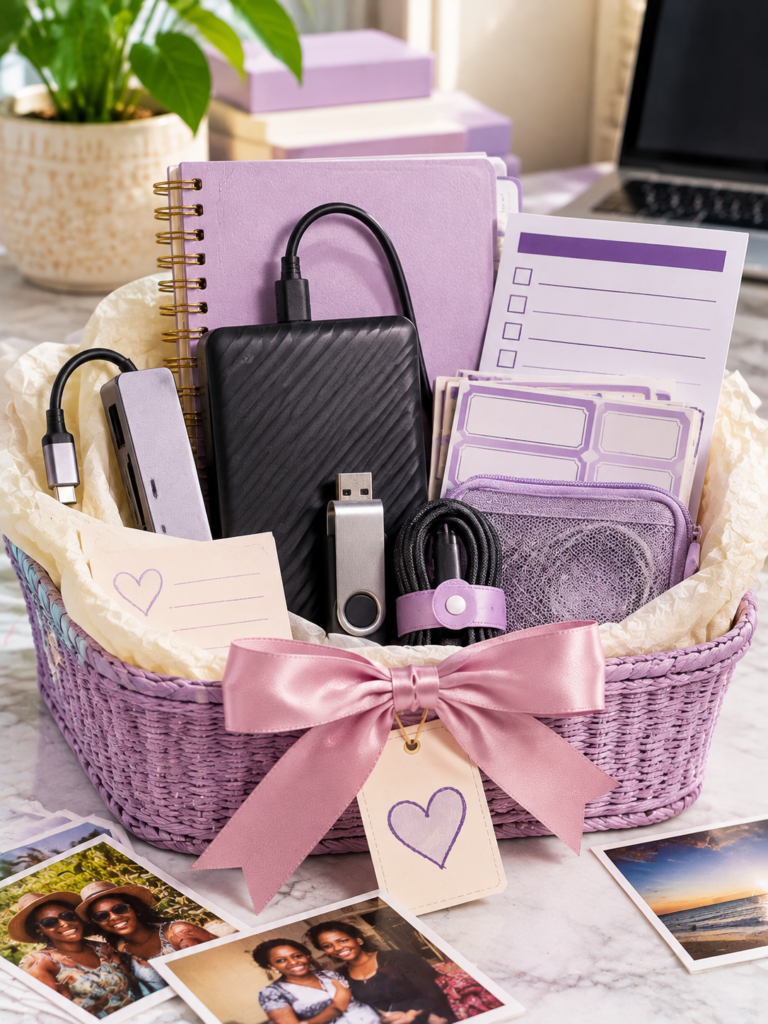
Birthday pictures, screenshots, holiday photographs and everyday snapshots can pile up in a phone gallery over the years.
When everything is mixed together, finding one particular photograph or keeping track of important memories can become a task of its own.
This basket is for a friend who takes plenty of pictures and would appreciate a better way to sort, label and back them up.
What to include:
- An external storage drive: Choose one with enough capacity for her existing photographs and future collections. Check that it works with her phone or computer before buying.
- A USB flash drive: This offers another convenient way to store selected photographs, provided her device supports the connection or she has the correct adapter.
- A compatible phone adapter or card reader: Include this when she needs to transfer pictures from her phone or memory cards to another storage device.
- A cable organiser: This will keep charging cables, adapters and other small accessories together.
- Photo-sorting labels: Prepare categories such as Family, Birthdays, Travel, Friends and Special Occasions to give her a starting point for organising her folders.
- An organisation notebook: She can record folder names, storage locations, backup dates and other useful details about her collection.
- A photo-sorting checklist: Include reminders to review duplicate pictures, remove unwanted screenshots and identify the photographs she wants to preserve.
- A handwritten note: Add a personal message encouraging her to keep some of the photographs that remind her of special moments in your friendship.
Keeping digital photographs safe: Sorting pictures is useful, but protecting them from loss matters just as much. Keeping the only copy on a phone or one storage device leaves the collection at risk if that device is lost, damaged or stops working.
The Library of Congress recommends making multiple copies of important digital photographs and keeping them in different locations. It also advises organising files into folders, using descriptive file names and checking periodically that saved files can still be opened.
An external drive is a useful addition, but it should not be the only backup. She can keep another copy on a separate storage device or a suitable cloud service.
Before purchasing a drive or adapter, check its storage capacity, connection type and compatibility with her devices.
A thoughtful care package can brighten someone’s day during recovery. 15 DIY Get Well Soon Gift Baskets for Elderly Friends That Feel Comforting, Warm, and Deeply Thoughtful offers gentle gift ideas for older friends.
14. The Calligraphy Practice Basket for a Friend Who Enjoys Hand Lettering
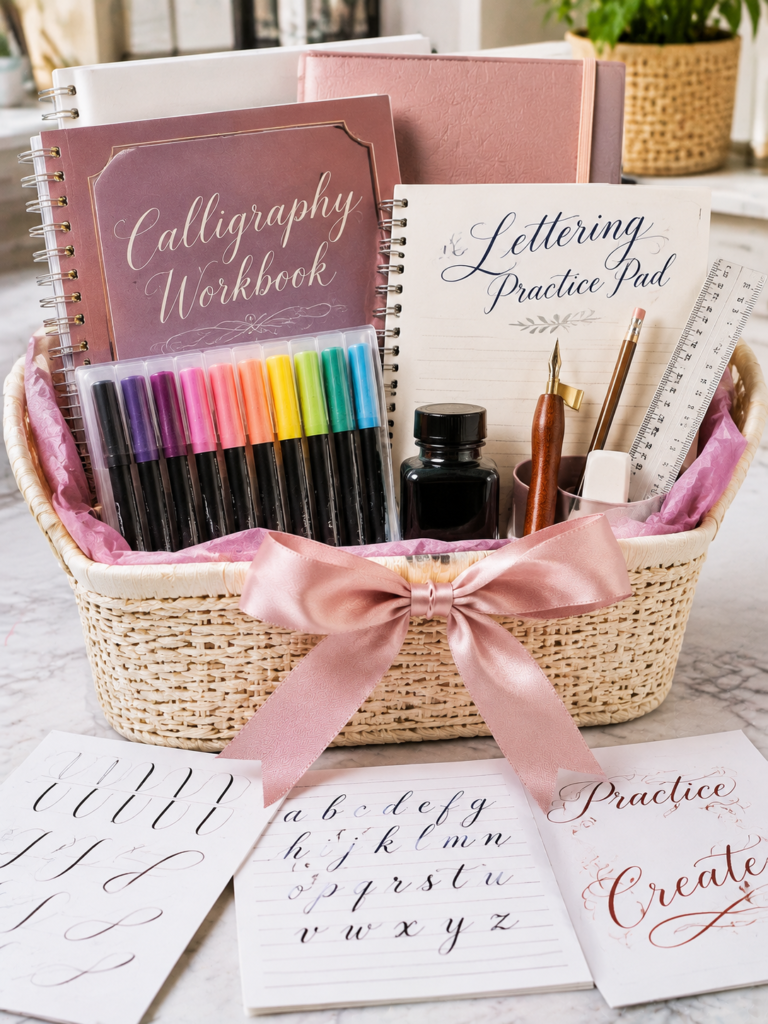
Greeting cards, invitations, gift tags and handwritten notes can take on a different character when the lettering is carefully done.
For someone who enjoys decorative writing, practising calligraphy can also provide a relaxing creative hobby and a way to develop a skill.
This basket brings together the basic supplies a friend can use to practise lettering at home, whether she is just starting or wants to improve her technique.
What to include:
- Brush pens: These are useful for modern brush lettering, where pressure on the flexible tip creates thicker and thinner strokes. Choose a beginner-friendly set with a few different tip sizes.
- A pointed-pen holder and nib: Traditional pointed-pen calligraphy uses a separate holder and metal nib. Choose a beginner-friendly nib and a holder that feels comfortable in her hand.
- Smooth practice paper: Look for paper designed for lettering. Rough or unsuitable paper can cause pen tips to catch and ink to spread.
- Compatible ink: Pointed-pen practice requires suitable dip-pen ink, while most brush pens already contain their own ink.
- A lettering workbook: Choose one with basic strokes, letter guides, spacing exercises and practice examples.
- A pencil and eraser: These help her sketch guidelines and plan the layout of a card or lettering project before applying ink.
- A ruler: This is useful for drawing straight baselines and keeping letters evenly spaced.
- A practice folder: She can use it to store completed exercises and compare her progress as she learns.
Choosing supplies for her lettering style: Brush lettering and traditional pointed-pen calligraphy require different tools. Brush pens are a convenient starting point for modern hand lettering, while pointed-pen practice needs a compatible holder, nib and dip-pen ink.
Choosing one style for the basket will make the supplies more useful than mixing tools that do not work together.
Smooth paper is worth prioritising because unsuitable surfaces can make the pen difficult to control and cause ink to feather or bleed.
A beginner workbook with practice guidelines can also help her work on consistent letter height, spacing and strokes.
For someone new to calligraphy, a brush-pen set with a smooth lettering pad is a practical choice. A friend who already uses dip pens may appreciate a compatible nib or a bottle of suitable ink instead.
15. The Home Coffee Brewing Basket for a Friend Who Wants to Improve Her Coffee Routine
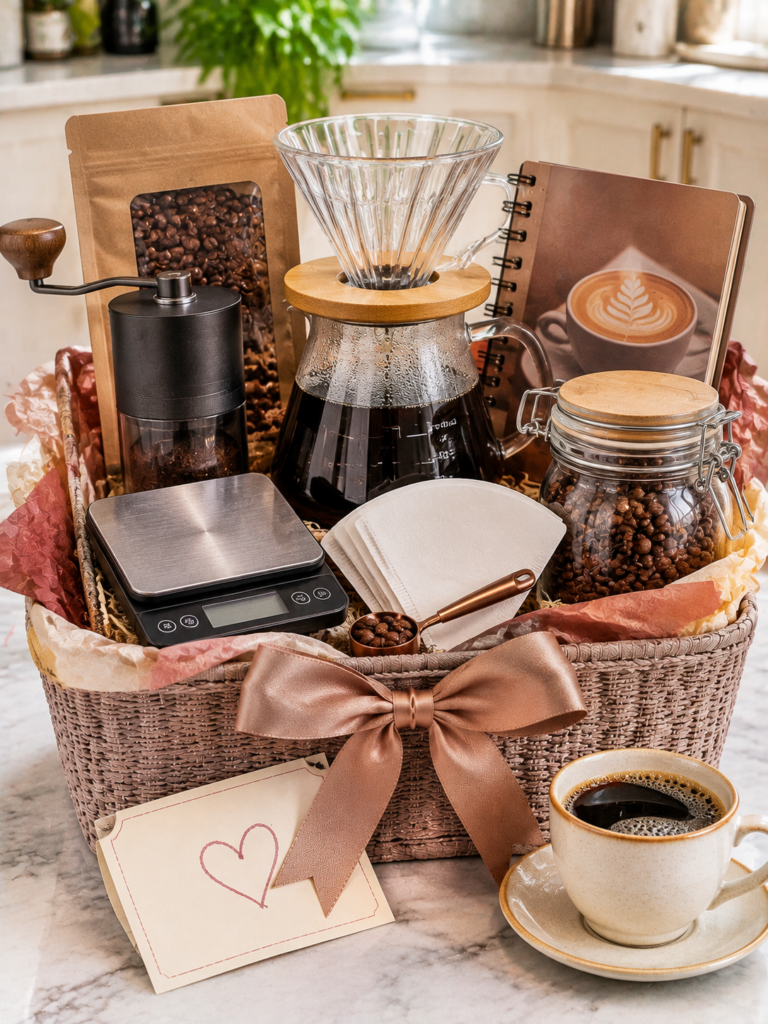
Some people are happy with the coffee they make at home, while others enjoy experimenting with different beans, brewing methods and grind sizes to get a cup they prefer.
For the latter, the right equipment can make the morning coffee routine more interesting and consistent.
This basket is for a friend who enjoys making coffee at home and would like to learn more about the brewing process.
What to include:
- A coffee brewer: Choose a pour-over dripper, French press or another brewing device that matches the method she enjoys. Consider her available kitchen space before buying a larger piece of equipment.
- A bag of good-quality coffee: Select whole beans when she owns a grinder, or ground coffee when she does not. Choose a roast and flavour profile that suits her usual preference.
- A burr coffee grinder: This is useful for someone who buys whole beans. Look for adjustable grind settings so she can match the grind to her brewing method.
- A digital coffee scale: Measuring coffee and water in grams makes it easier to repeat a recipe than relying on scoops alone.
- Compatible paper filters: Include these when she uses a pour-over brewer that requires them. Check the filter size and shape before purchasing.
- An airtight coffee container: This gives her a place to store opened coffee away from moisture, air and strong odours.
- A coffee scoop: Although a scale provides more consistent measurements, a scoop is convenient for everyday use.
- A coffee-tasting notebook: She can record the coffee variety, grind setting, coffee and water quantities, brewing method and her impressions of each cup.
Getting more consistent results: The equipment should match the brewing method. A French press does not require paper filters, while many pour-over brewers do. Someone who already owns a grinder may get more use from a digital scale or fresh beans than from receiving another grinder.
Coffee-to-water ratio, grind size, water temperature and brewing time all influence the final cup. A digital scale helps her measure quantities consistently, while an adjustable grinder makes it easier to experiment with different grind sizes.
For a friend interested in pour-over coffee, a starter set with a compatible dripper, filter papers and digital scale is a useful choice.
Someone who prefers French press coffee would be better suited to a French press and beans ground appropriately for that brewing method.
Horror movie fans may appreciate a gift basket filled with spooky treats and themed surprises. 25 Halloween Gift Basket Ideas for Boyfriend Who Loves Horror Movies has ideas for creating a fun Halloween gift.
How to Arrange the Items So the Basket Looks Full Without Overspending
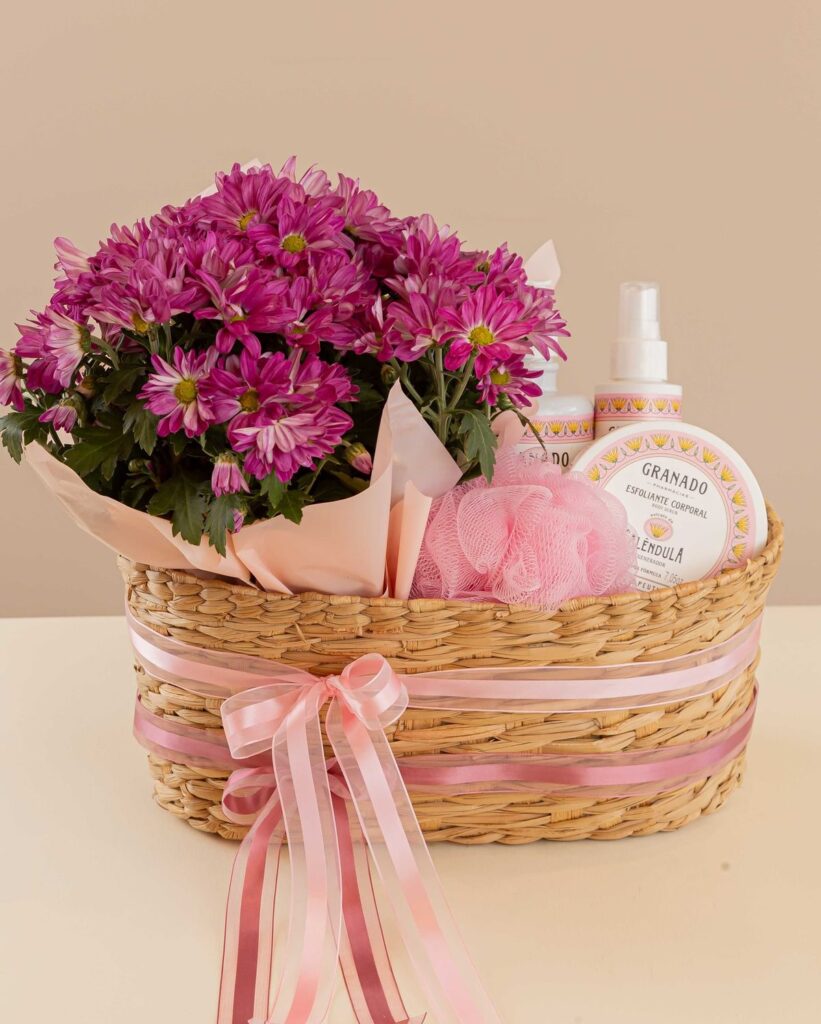
Even a basket with carefully chosen gifts can look untidy when everything is dropped inside without a little arrangement.
Some items may disappear beneath larger packages, while empty spaces make the basket look unfinished.
The trick is to arrange what you have properly before spending more money on decorations or extra products.
How to arrange the basket:
- Place the tallest or main item toward the back: Start with the largest or tallest product and position it at the back of the basket.
This gives you a starting point for arranging the smaller items in front without hiding the main gift. - Use crinkle paper or tissue as a base: Line the bottom with shredded paper, tissue or another suitable filler to raise shorter products.
This helps smaller items remain visible instead of sinking to the bottom. Adjust the amount until the contents sit at a comfortable height. - Keep heavier items at the bottom: Put heavier products, such as jars, bottles and larger containers, close to the base. This makes the arrangement more stable and reduces the chance of lighter items being pressed underneath them.
- Position fragile products carefully: Keep delicate items such as mugs, glass containers and small ornaments away from places where heavier products could knock against them.
Wrap them individually with suitable protective material and secure them so they do not move around. - Use clear wrapping when it serves a purpose: Cellophane can hold the arrangement together and protect the contents during transport, while also allowing the recipient to see the gifts.
Use it when it suits the basket rather than assuming every gift basket needs to be wrapped. - Skip unnecessary filler purchases: Buying extra products simply to make the basket look bigger can increase the cost without making the gift more useful.
Use tissue, crinkle paper or clean decorative material to fill small gaps instead of adding items your friend may not need.
Choosing the right basket size: The container should fit the gifts without leaving large empty spaces or forcing everything together.
Lay the items out before placing them inside so you can see how much room they will take up. A smaller basket with neatly arranged, useful gifts can look much more appealing than a large one filled with unnecessary purchases.
When the arrangement is complete, check that every item is visible, nothing is leaning too far over the edge and the basket can be carried without the contents shifting.
A simple ribbon or gift tag can finish the presentation without adding much to the cost.
Handmade details can make a home feel more festive and romantic during Valentine’s Day. A Cozy Valentine’s Home Filled With Warm, Handmade Touches shares inspiration for adding personal touches to your space.
How to Package and Deliver the Basket
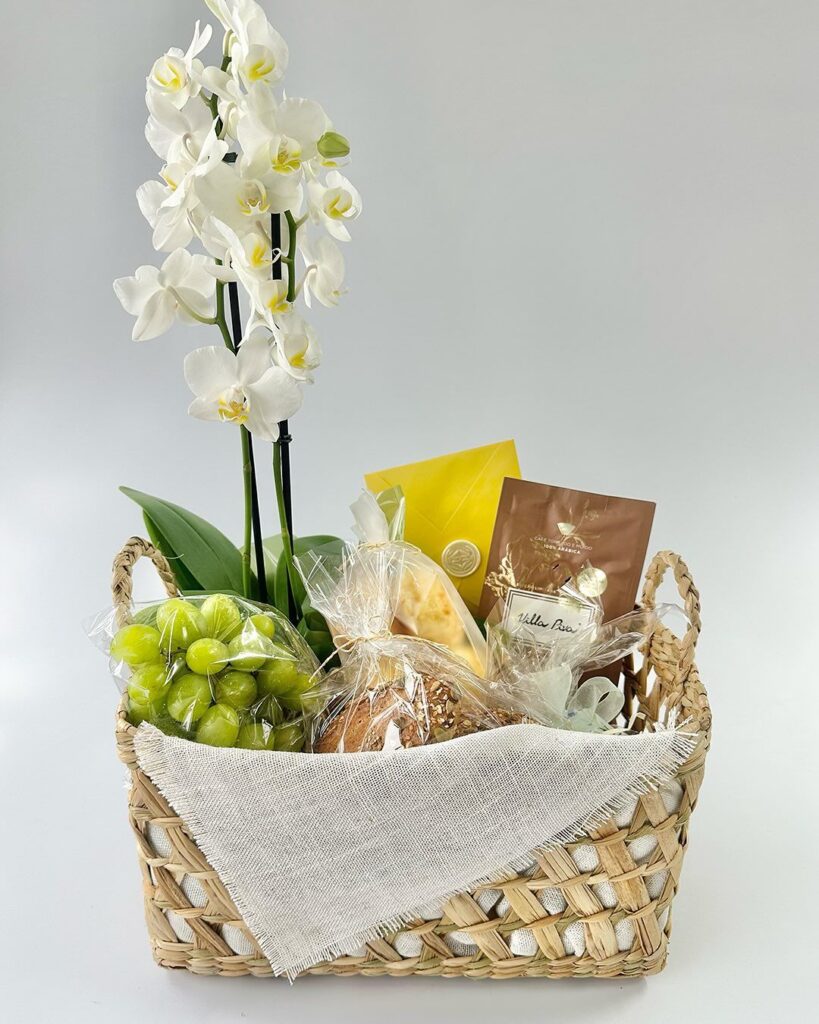
After putting together your DIY Valentine gift baskets for your best friend, take a little time to make sure everything stays in place until she receives them.
A basket that looks lovely on the table may not hold up as well during a car ride or delivery, especially when it contains glass jars, mugs, food or other delicate items.
How to package the basket:
- Use tissue paper or protective wrapping: Fill small gaps with tissue paper or crinkle paper to prevent products from moving around. Wrap individual items where necessary, particularly containers with lids or loose accessories that could fall out.
- Separate fragile items from heavier products: Keep mugs, glass jars, candles and ornaments away from heavier items that could knock against or crush them.
Bubble wrap or other suitable protective padding can help protect delicate products during transport. - Keep food separate from non-food products: Chocolates, biscuits, snacks and other edible gifts should be properly sealed and kept away from products that could leak, leave residue or have strong odours.
Use food-safe packaging rather than placing unwrapped food directly against decorative materials. - Secure the wrapping: Cellophane or clear gift wrap can hold the contents together and protect the arrangement from dust and handling.
Gather it neatly around the basket and secure it with ribbon or a suitable tie. Avoid wrapping so tightly that delicate products become squeezed. - Check the size and weight before shipping: A basket that is comfortable to carry by hand may be too bulky or heavy for ordinary parcel delivery. Check the courier’s weight and size limits, and ask whether the basket needs to be packed inside a suitable outer shipping box.
- Consider the delivery conditions for food: Chocolates and other heat-sensitive treats can melt during transit, while some baked goods and fresh foods require specific storage conditions.
Perishable items should not be sent in an ordinary parcel without appropriate temperature-controlled packaging and a delivery service that can maintain safe conditions.
Preparing the basket for delivery: Before handing it over, gently check whether the contents shift when the basket is lifted.
Add more padding where needed and make sure lids are secure. For shipped baskets, place the arrangement in a sturdy outer box with cushioning around the sides so it cannot move freely during handling.
Pay attention to the weather and delivery distance when including food. Shelf-stable, individually sealed treats are generally easier to package than fresh or refrigerated products.
When the basket contains items that need refrigeration, arrange a suitable temperature-controlled delivery rather than relying on ordinary wrapping to keep them safe.
A handwritten Valentine card can be placed on top or attached to the outside of the basket so your friend sees the message without having to search through the gifts.
This small detail gives the finished package a personal touch while keeping the contents protected.
Conclusion
The little details you remember about your best friend can make a Valentine’s gift feel more personal than an expensive present.
Maybe she is always trying a new coffee blend, taking photographs, tending to her plants or finding time for a hobby she loves.
Those details give you a good starting point when putting together something she will appreciate.
These DIY Valentine gift baskets for your best friend do not have to be large or filled with expensive products. Choose a theme that reflects her interests, include items she can genuinely use and leave room for a handwritten message.
Even a simple collection of carefully selected gifts can become a lovely reminder of your friendship long after Valentine’s Day has passed.
Start with the basket that feels most like her, check what you already have at home and add only the things needed to complete it. You may find that the most meaningful gift is also one you can put together without stretching your budget.