This post contains affiliate links. This means I may earn a small commission if you purchase through my links at no extra cost to you.
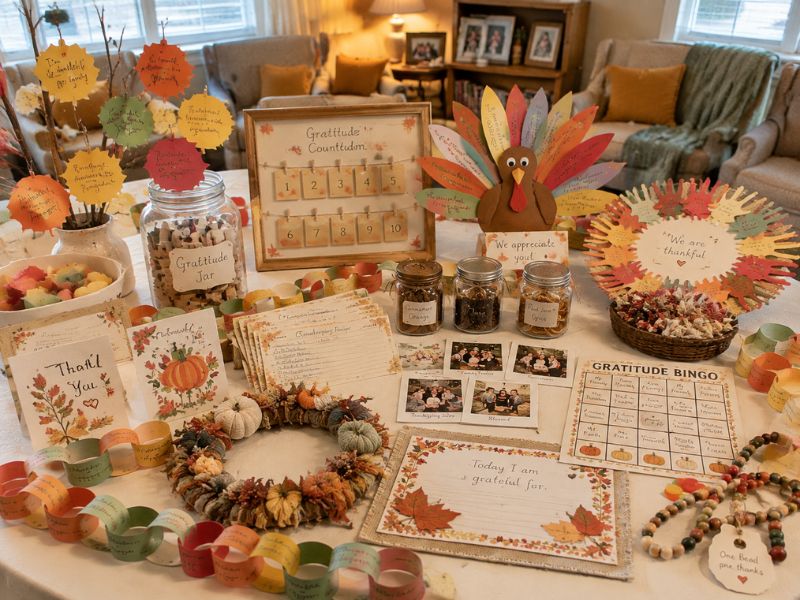
Silence during gratitude time isn’t rare. These Thanksgiving gratitude crafts help even quiet residents open up, see which craft breaks the ice.
Thanksgiving gratitude activities always look lovely on a table. What’s harder to plan for is the moment right after, when you ask someone to share what they’re thankful for and get a polite smile back, a one-word answer, or nothing at all.
That’s not a participation problem. It’s a starting-point problem. “What are you thankful for” is an open question with no handle on it, nothing to hold, write on, or react to. Give people something to build instead of a blank space to fill, and the sharing tends to take care of itself.
That’s the idea behind these 15 Thanksgiving gratitude crafts.
Each one gives residents a starting point they can hold, write on, build, or pass around, something to do before they have to say anything, so that sharing feels like the natural next step instead of the whole ask.
Whether you’re planning for a senior living community, a care home, or any group setting where quiet residents tend to sit out, these are built to bring them in.
Make the activity more meaningful with Handmade Thanksgiving Gifts for Seniors in Nursing Homes (They Can Gift or Be Gifted), especially when residents want to turn their creativity into something they can share.
Why Most Gratitude Crafts Stall Out
Before the list, it helps to know why so many gratitude activities go quiet in the first place. It’s rarely about the craft itself.
The question does two jobs at once. “What are you thankful for?” isn’t one ask, it’s two. First, pull up a memory or a feeling. Then, put it into words on the spot. For most people that’s manageable.
For someone whose memory doesn’t retrieve on command anymore, or who needs a minute to find the right words, doing both at once in front of a group is a lot to ask. The silence isn’t reluctance. It’s the question being harder than it looks.
Solo crafts don’t need a reason to talk. Hand someone a pumpkin and a paintbrush, and they can finish the whole thing without saying a word to the person next to them. Nothing about the activity requires speaking, so speaking becomes optional, and optional usually loses.
Repeat crafts lose the room fast. The gratitude tree works the first year. By the third, residents who’ve already made one have nothing new to reach for, and they sit it out rather than do the same leaf again.
Keep those three in mind, and the list below stops looking random. Every craft on it is built to solve one of them.
Bring a little more Thanksgiving fun to younger crafters with 20 Handprint Turkey Crafts for Kids You Will Want to Keep Forever.
1. Finish-the-Sentence Gratitude Leaves
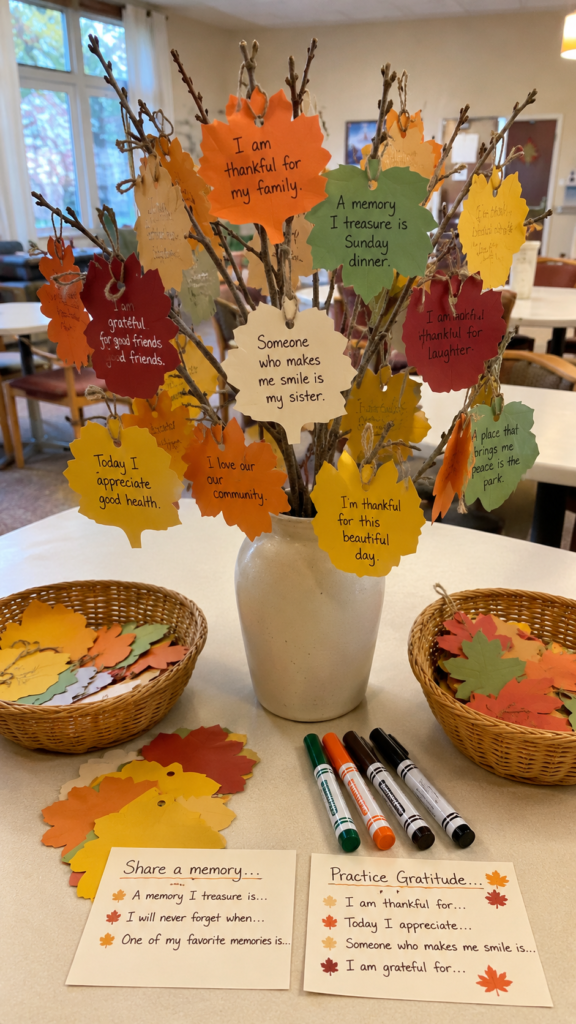
This is the gratitude tree everyone already knows, but with one change that fixes the blank-leaf problem: the sentence is already started for them.
Instead of handing residents a blank paper leaf and a pen, print (or write) the first half of a sentence on each one.
“I’m thankful for someone who ___.” “My favorite Thanksgiving memory is ___.” “Something that made me smile this week was ___.” All a resident has to do is finish it, no retrieving a topic from scratch, no staring at empty space wondering where to start.
Why it works: This solves the two-step problem directly. The retrieval part, deciding what to be thankful for, is already done.
All that’s left is filling in a few words, which is a much smaller ask, especially for residents with memory loss or word-finding trouble.
It also gives shy residents cover: completing a sentence feels lower-stakes than composing one from nothing.
What you’ll need:
- Paper or felt leaf cutouts in fall colors
- A handful of different sentence starters (rotate them so the tree doesn’t look repetitive)
- Markers or pens with a thick, easy grip
- A branch, dowel, or wall display to hang the finished leaves
How to run it:
Set out leaves with 4–5 different starters mixed in a basket so residents can pick one that speaks to them rather than all facing the same prompt. Read a starter aloud for anyone who needs it read rather than seen.
As leaves go up on the tree, encourage residents to read a few aloud to the table, the finished sentences tend to prompt actual conversation in a way a blank tree never does.
Looking for another way to bring people together around a table? 30 Craft Night Ideas for Moms Who Need One Night That’s Just Theirs has plenty of group-friendly inspiration.
2. The Gratitude Jar (With the Prompts Already Inside)

Same fix as the leaves, different format. A gratitude jar sounds simple, but most versions still ask residents to write their own note from scratch and drop it in, which means the jar fills up slowly, if at all.
Flip it: fill the jar with prompt slips first, and let residents draw one out instead of generating one.
Why it works: Drawing a slip turns the activity into a small, low-pressure moment of chance rather than a blank-page task.
It also gives you a built-in reason for residents to take turns, someone draws, reads it (or has it read to them), and answers. That structure alone gets more people through the activity than an open jar ever does.
What you’ll need:
- A mason jar or decorative jar
- Slips of fall-colored paper with prompts pre-written (“A person I’m grateful for is ___,” “A place that makes me happy is ___,” “A smell that reminds me of home is ___”)
- A small basket or bowl to hold drawn slips as they’re read
How to run it:
Pass the jar around the table rather than leaving it in one spot, that alone turns it into a shared activity instead of something residents approach one at a time.
Whoever draws can answer, pass to a neighbor for help, or simply have the prompt read aloud without answering. All three count as participating.
Save the handprint fun for another season with 15 Santa Handprint Crafts You Will Want to Keep Forever, especially when you’re collecting keepsake-style projects.
3. Two-Sided Thank-You Cards (Made in Pairs)

Most Thanksgiving card crafts are solo, decorate a card, write a note, done. This version pairs two residents together, because the card only works if both people take part.
Why it works: This is the fix for the solo-craft problem. When a craft doesn’t require a partner, talking becomes optional.
When it does, conversation happens by default, residents have to ask each other questions to finish the card (“What do you want the front to say?” “Who’s it going to?”), which does more for connection than the card itself.
What you’ll need:
- Blank cardstock, folded
- Stickers, ribbon, stamps, or pre-cut leaf shapes for decorating
- Markers or pens
How to run it:
Pair residents at the start, table neighbors work fine, or pair someone chatty with someone quieter.
One decorates the front while the other writes the message inside, then they swap and finish each other’s half.
The card gets delivered to a third resident, a staff member, or a family member, so the sharing continues past the craft table.
4. The Gratitude Chain (One Link Per Person)

A twist on the classic paper chain: instead of every resident writing their own link and adding it to a communal pile, each link has to connect to someone else’s , by name.
Why it works: This solves the repeat-craft problem and the solo-craft problem at once. It’s structurally different enough from the gratitude tree that residents who’ve “already done that” have a reason to join in again, and because each link names another person, it can’t be completed in silence.
What you’ll need:
- Construction paper strips in fall colors
- Markers
- Tape or a stapler
- A visible spot to hang the growing chain (a doorway, a bulletin board, a wall in the activity room)
How to run it:
Each resident writes one thing they’re thankful for about the person sitting next to them, staff writes it for them if needed, then loops it into that person’s link before adding the next strip.
By the end, the chain is a visible, growing record of who noticed what about whom, and it keeps building all month if you leave it up.
Ease into the season with Cozy September Crafts for Seniors That Bring Calm and Creativity to Fall Days if you’re planning activities across several fall months.
5. Gratitude Recipe Cards
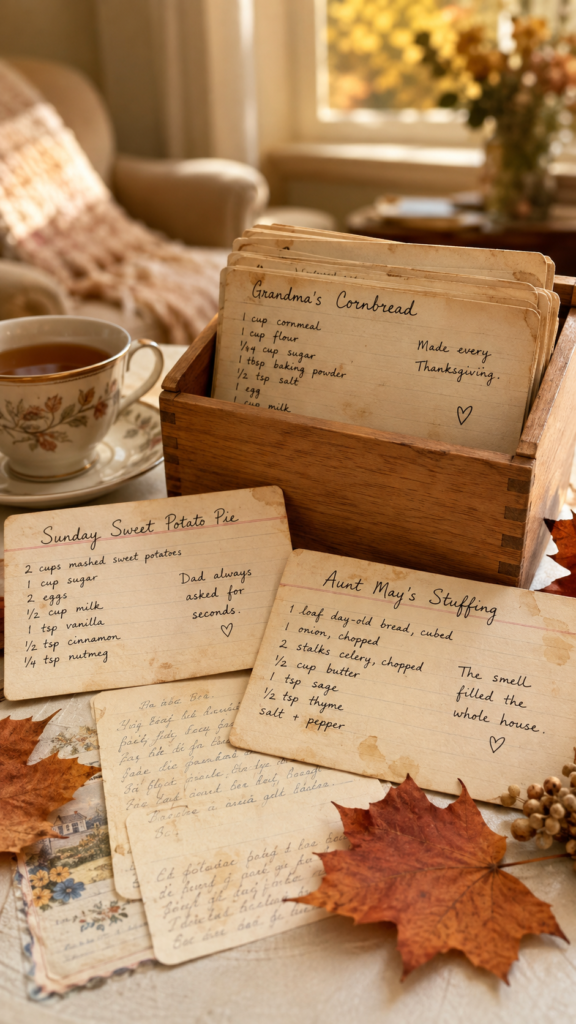
Among Thanksgiving gratitude crafts, this one uses food as the memory trigger instead of a blank prompt.
Residents write down a favorite Thanksgiving dish, their own recipe if they remember it, or just the dish’s name if the details are fuzzy, on a decorated recipe card, then add one line about who used to make it or when they ate it.
What it actually is: food memories tend to stick even when other memories fade, so naming a dish is often easier than answering an abstract question.
The recipe itself becomes the prompt, a resident doesn’t have to reach for a feeling out of nowhere, just a dish they remember, and the “thankful for” part tends to follow naturally once they start talking about it.
What you’ll need:
- Blank recipe cards or index cards
- Markers or pens
- Optional: a small basket or recipe box to collect the finished cards
How to run it:
Ask about the dish before asking about the feeling, “what was your favorite Thanksgiving food?” is a much easier opener than “what are you thankful for?”
A staff member can write for anyone who can’t, since talking through the dish is the point, not the handwriting.
Collect the finished cards into a shared recipe box residents can flip through together, or read a few aloud at the table once everyone’s done.
6. Scent-Sachet Gratitude Jars

Among Thanksgiving gratitude crafts, this is the one built for residents who can’t easily answer a question at all, particularly those with memory loss for whom words don’t always come, but smell still does.
Instead of writing or speaking gratitude, residents fill a small jar or muslin pouch with dried cinnamon sticks, cloves, dried orange peel, and a bit of nutmeg, the classic fall scent combination.
What it actually is: a hands-on sensory craft where the “sharing” happens through reaction, not language.
As residents scoop and layer the spices into their jar, the smell alone tends to pull up a memory, a kitchen, a person, a holiday, and they’ll often say something about it out loud without ever being asked a direct question.
What you’ll need:
- Small mason jars or muslin drawstring pouches
- Cinnamon sticks, whole cloves, dried orange peel, star anise
- Small scoops or spoons for easy handling
How to run it:
Let residents smell each spice before adding it, and narrate what you’re doing as you go (“this one’s clove, it’s got a strong kick to it”), that narration itself often prompts a response, even a small one.
No one needs to explain what they’re thankful for. If a memory surfaces and they mention it, that’s the share. If it doesn’t, the jar itself is still a finished, satisfying project.
Keep the seasonal crafting going into October with October Crafts for Seniors in Nursing Homes That Create Memories, Not Just Decorations.
7. Texture-Sort Fall Wreaths
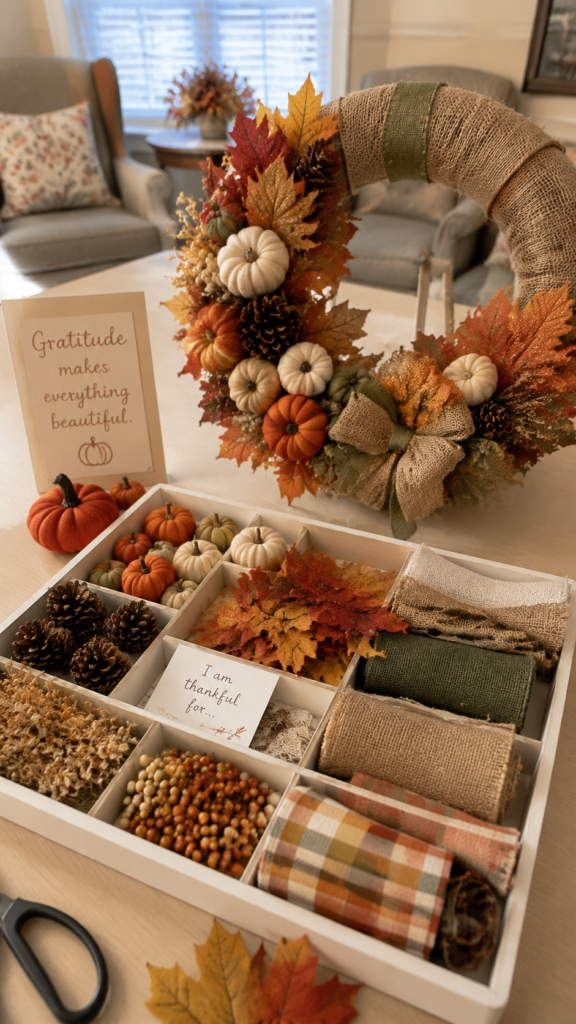
This one solves the same problem as the scent jars, but through touch instead of smell.
Residents sort a mixed pile of fall materials, silk leaves, small pinecones, strips of burlap, felt pumpkins, by texture, color, or shape, then arrange them onto a wreath base.
What it actually is: less a “make something from scratch” craft and more a guided sorting-and-building activity.
The sorting step is doing the real work, it’s simple, repetitive, and doesn’t require verbal instructions to follow, which makes it accessible to residents who’d otherwise sit out a craft that requires reading or writing.
What you’ll need:
- A foam or wire wreath base
- A mixed bag of silk leaves, small pinecones, burlap ribbon, felt shapes
- Hot glue (staff-applied) or adhesive dots for a safer, resident-friendly option
How to run it:
Spread the materials on a tray so residents can touch and choose rather than being handed pre-picked pieces.
Ask simple either/or questions as they work (“this leaf or that one?”) instead of open questions, it keeps them engaged without requiring composed answers.
The finished wreaths make good hallway or door decorations, so the activity has a visible result even for residents who never said a word during it.
Keep the seasonal creativity going with 15 Cozy November Crafts for Seniors in Assisted Living to Enjoy This Fall, with ideas suited to relaxed fall crafting.
8. The Gratitude Countdown Frame
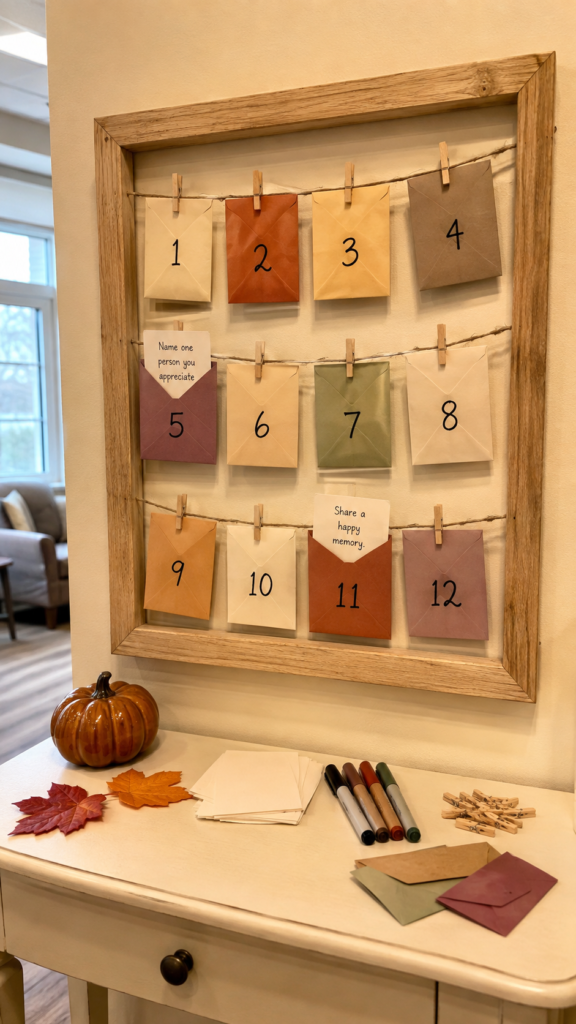
This is a display-format craft, built to keep the sharing going for the whole month rather than in one sitting.
Remove the glass from an old picture frame, stretch string across the back, and clip small numbered envelopes or tags to it, one for each day left until Thanksgiving.
What it actually is: a daily gratitude ritual disguised as a craft project. Residents build the frame once, as a group, and then it becomes a standing activity. one envelope opened and read (or filled in) each day leading up to the holiday.
What you’ll need:
- An empty picture frame (glass removed)
- String or twine, staples or tape
- Small numbered envelopes or tags
- Blank slips for each envelope, pre-printed with a short prompt or left blank for a resident to fill in that day
How to run it:
Build the frame together as one activity, but treat opening the envelopes as a separate daily moment, at breakfast, before an activity, or during a quiet part of the afternoon.
Because it’s spread across many small moments instead of one big ask, residents who go quiet in a group setting often open up more during a one-on-one envelope reading.
9. Gratitude Placemats (Made Once, Used All Month)
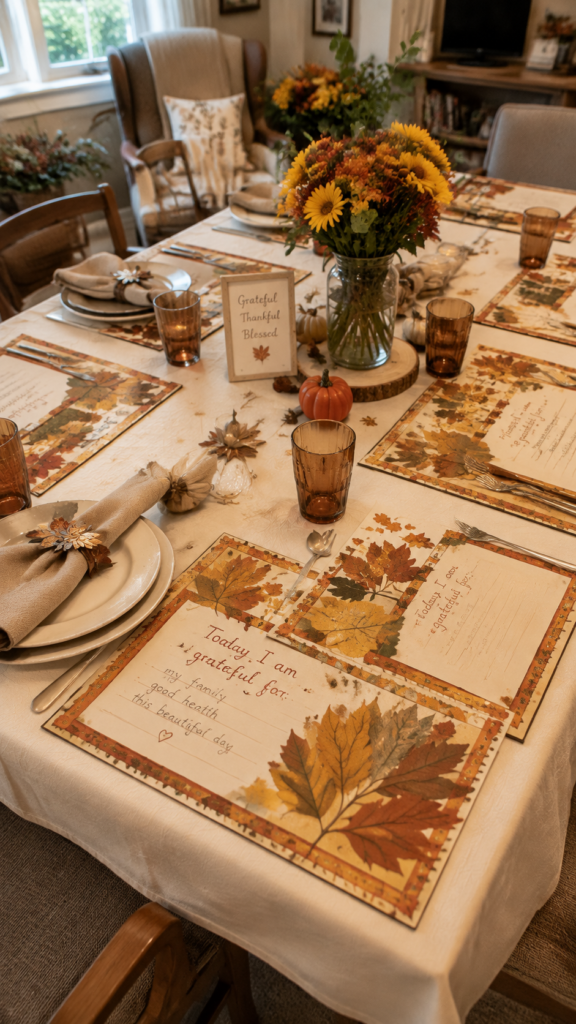
Most Thanksgiving gratitude crafts get made once and displayed once. This one gets reused at every meal between now and the holiday.
Residents decorate a paper placemat with fall colors, pressed leaves, or stamped designs, then leave a blank strip at the bottom where a new thank-you note gets added each day.
What it actually is: a craft that turns the dining table itself into the gratitude activity, rather than a separate event residents have to be gathered for.
Because it’s already sitting in front of them at every meal, it catches residents who skip organized activities but still show up to eat.
What you’ll need:
- Large sheets of construction paper or cardstock
- Pressed leaves, stamps, or stickers for decorating
- Laminating sheets or clear contact paper (so it holds up to daily use)
- A dry-erase marker for the blank strip, so it can be wiped and rewritten daily
How to run it:
Decorate the mats as a group activity once, then hand them out at breakfast or dinner and ask a simple daily question, “one thing today”, while residents eat.
Because it repeats in small doses instead of asking for one big answer, it tends to catch residents who wouldn’t speak up in a formal gratitude circle.
When the next holiday rolls around, 15 Halloween Crafts for Adults That Are Easy to Do offers another collection of approachable seasonal projects.
10. Pass-the-Pumpkin Story Starter
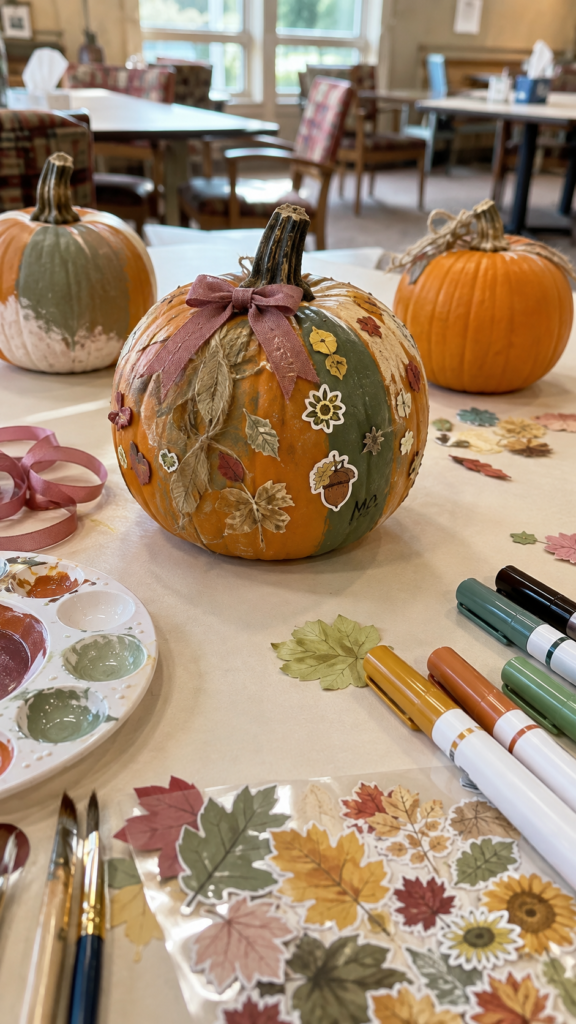
A twist on painting pumpkins solo. Residents sit in a circle and pass a small pumpkin around.
Whoever’s holding it when the music stops (or after a set count) gets to add one decoration, a sticker, a painted leaf, a ribbon, and shares one word or short phrase about what it represents before passing it on.
What it actually is: a group version of a normally solo craft, restructured so the pumpkin can’t be finished without everyone contributing.
Among Thanksgiving gratitude crafts, this is one of the few built around turn-taking rather than individual output, which makes participation feel like part of the game instead of a request.
What you’ll need:
- One or two small real or craft pumpkins
- Stickers, ribbon, paint pens, or washi tape for decorating
- Music or a simple counting method to signal when to pass
How to run it:
Keep the ask small, one word, not a full sentence, so residents who’d freeze at “share what you’re thankful for” can still take part.
By the time the pumpkin’s fully decorated, it’s a physical record of the whole table’s contributions, not just one person’s.
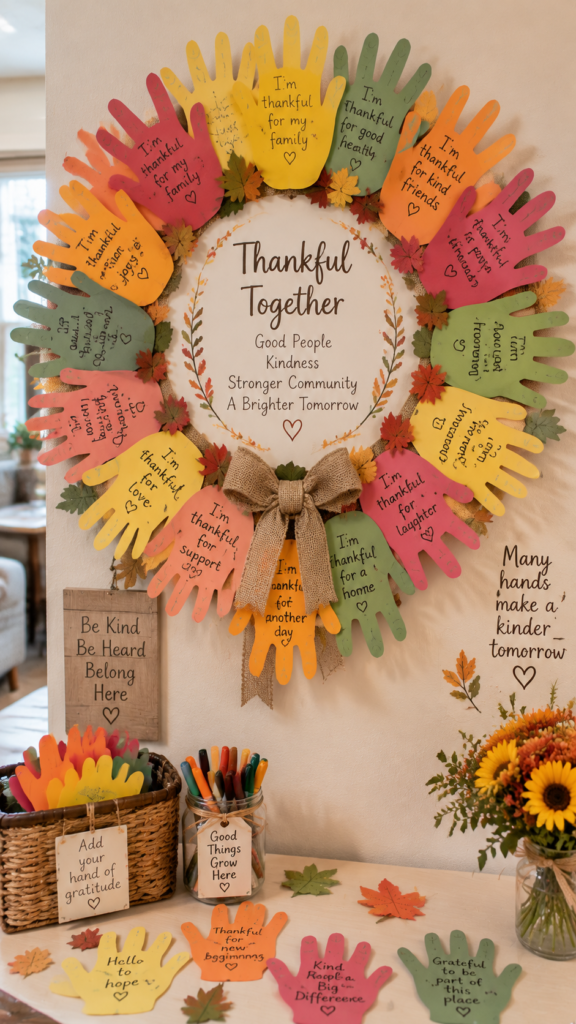
11. Gratitude Handprint Wreath (Multi-Generational Option)
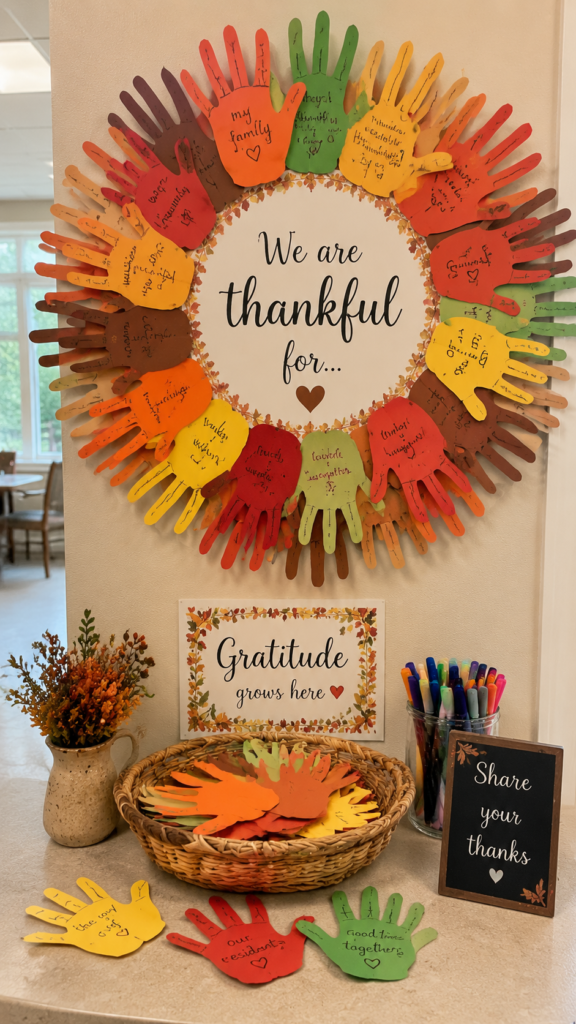
A classic craft reworked for shared participation instead of solo output.
Each resident traces and cuts out a handprint in a fall color, writes or dictates one thing they’re thankful for on it, and adds it to a shared wreath base , building one collective wreath rather than individual take-home pieces.
What it actually is: among Thanksgiving gratitude crafts, this is one of the easiest to open up to visiting family or grandchildren, since handprints from residents and younger visitors can go on the same wreath side by side.
That mix tends to prompt exactly the kind of cross-generational conversation gratitude activities are usually aiming for.
What you’ll need:
- Construction paper in red, orange, yellow, brown
- Scissors (or pre-cut hands for residents with limited dexterity)
- A large wreath base or poster board
- Markers or a staff member to write dictated answers
How to run it:
Offer pre-cut handprints for residents who can’t manage scissors, so no one sits out over a physical limitation.
As each hand goes onto the wreath, have the resident or a staff member read the note aloud, the collective wreath makes a strong hallway or entrance display once finished.
Create something that can become a keepsake with 15 Handprint Flower Bouquet Crafts for Grandparents Day (Toddler to Tween Friendly).
12. Memory Card Match (Old Photos Meet New Words)

This one uses old photos instead of blank prompts. Residents look through a handful of family or holiday photos, their own if they have them, or general fall/Thanksgiving stock photos if they don’t, and pick one that means something to them.
Then they glue it onto a card and add a short caption about what’s happening in it.
What it actually is: the photo does the remembering, so the resident doesn’t have to pull a memory out of nowhere. Looking at a picture and describing what’s in it is much easier than answering “what are you thankful for” cold. Most people can say something when they’re looking right at the thing that sparked it.
What you’ll need:
- A small stack of photos (family photos if available, or printed fall/holiday images)
- Cardstock or blank cards
- Glue sticks
- Markers or pens for captions
How to run it:
Spread the photos out on the table and let residents pick one themselves rather than assigning them.
Ask what’s happening in the photo before asking how it makes them feel, that order matters. Describing a photo is a much smaller ask than explaining an emotion, and one usually leads naturally into the other.
Free Conversation Starter Cards for Seniors
Sometimes the hardest part of spending time with an elderly loved one is knowing what to talk about. That’s exactly why I created the Memory Keeper Cards a free set of conversation prompts designed to help families spark meaningful memories together.
They cover everything from childhood and growing up to faith, family, and favorite things. Just pick a card, ask the question, and let the stories flow.
Grab your free Memory Keeper Cards here.
13. Turkey Feather Praise Board

Draw or cut out one big turkey body and pin it to a board or wall. Then give residents blank paper feathers to fill in, not with what they’re thankful for, but with something they appreciate about another resident or staff member.
Each finished feather gets pinned to the turkey.
What it actually is: a compliment activity dressed up as a craft. Naming something good about another person is often easier than naming something abstract like “gratitude,” because it’s specific and it’s about someone sitting right there.
The turkey fills in slowly over several days, so nobody has to finish it in one sitting.
What you’ll need:
- A large turkey body cut from brown paper or poster board
- Blank paper feather shapes in fall colors
- Markers or pens
- Pins, tape, or a glue stick
How to run it:
Leave the turkey up somewhere residents pass by often, a hallway or the dining room, rather than making it a one-time sit-down activity.
Encourage residents to write about someone specific: a staff member, a table neighbor, a family member who visits. Naming a real person tends to get a real answer, even from residents who go quiet during open-ended prompts.
For another keepsake idea centered around little ones, try 12 Grandparents Day Footprint Crafts Before Those Tiny Feet Grow.
14. Gratitude Bingo Cards (Craft Your Own Board)
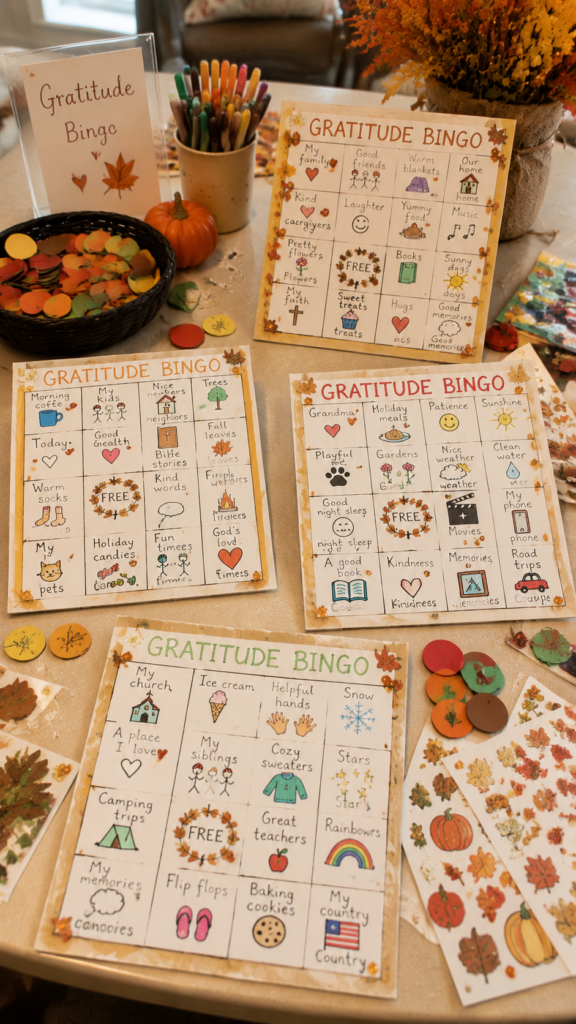
Residents build their own bingo card instead of using a printed one.
Each square gets filled in with a small drawing or word for something they’re thankful for, family, sunshine, a favorite meal, a pet, using stickers, stamps, or simple drawings.
Once the boards are made, play a round where residents call out or point to squares that match.
What it actually is: among Thanksgiving gratitude crafts, this is the one that turns sharing into a game instead of a question.
Filling in a bingo square feels like play, not performance, so residents who freeze up at “what are you thankful for” often fill a whole card without noticing they just answered the question nine times over.
What you’ll need:
- Blank bingo grid printouts (9 or 16 squares)
- Stickers, stamps, or markers for filling in squares
- Bingo chips or scrap paper for covering squares during the game
How to run it:
Have residents fill in their own squares first, then play a round afterward using their personal boards instead of a shared caller sheet.
Calling out “sunshine” or “grandkids” during the game naturally leads to a follow-up question from the table, which does more of the sharing work than the craft itself.
Thanksgiving crafting doesn’t have to be limited to one type of crafter, and Crafts for Men Over 50 That Are Actually Worth Making and Nothing Like What You Expected offers some different project ideas.
15. Gratitude Garland (One Bead, One Thanks)

String a long garland using beads, buttons, or paper rings, one piece added per person, per thing they’re thankful for.
Residents keep adding to the same garland over several days or weeks, so it grows the way an actual list of thanks would, instead of being finished all at once.
What it actually is: a slow-build version of the classic paper chain, made to stretch across the whole lead-up to Thanksgiving rather than one activity session.
Because it’s never really “done” until the holiday itself, residents who missed the first session can still join in later without feeling like they’re behind.
What you’ll need:
- String or ribbon for the base
- Wooden beads, buttons, or paper rings in fall colors
- A marker for labeling pieces, if residents want to note what each one represents
How to run it:
Keep the garland somewhere visible and easy to reach, a common room or hallway table, so adding a piece becomes something residents can do in passing, not just during a scheduled activity.
By Thanksgiving, the finished garland is a visual record of the whole group’s gratitude, built up piece by piece rather than written down all at once.
Keep late-summer crafting going with 20 August Crafts for Seniors in Assisted Living, especially when you want simple projects that encourage conversation and connection.
Conclusion
The real measure of a good Thanksgiving activity isn’t how the finished craft looks, it’s whether more people spoke up than usual.
A wreath, garland, decorated card, none of it matters much if the same three residents did all the talking again. What matters is whether the format gave someone a reason to open up who normally wouldn’t have.
That’s really what separates the Thanksgiving gratitude crafts above from the ones you’ve probably tried before.
The goal was never the object on the table. It was giving every resident, including the quiet ones, something to hold onto besides a blank page and a hard question.
Pick two or three to start with rather than trying all 15 in one sitting, see which formats get your group talking, and lean into more of those as the month goes on.
Some rooms open up fastest with a partner activity, others with something they can touch and sort in silence. There’s no wrong way in, only the one that actually gets your residents sharing.
If you try one of these with your group, I’d love to hear which one worked best for you, drop a comment below and let me know.
FAQs
How do I get a resident to join in who flatly refuses every activity?
Skip the push for verbal participation. Set materials in front of them with no expectation to speak or finish, and let them start on their own time. If that doesn’t work, letting them watch from nearby often opens the door for next time.
How far in advance should I start Thanksgiving gratitude crafts with residents?
Start two to three weeks out, not Thanksgiving week itself. Crafts like the countdown frame and garland are built to stretch across several days, so starting early gives residents more chances to join in.
Are any of these crafts a choking or safety risk for memory care residents?
Beads, buttons, and small pinecones need supervision, since some residents may put small items in their mouths. Swap in larger wooden beads, pre-string garlands, and lean on the sensory crafts for closer-supervision settings.
What if a resident can’t hold a pen, scissors, or small craft pieces?
Pre-cut and pre-fold as much as possible before the activity starts. For anything that still needs fine motor control, a staff member can act as their hands while the resident directs the choices.
How do I keep family visitors involved without taking over the activity?
Give visitors a small, specific role, writing down what a resident dictates, or holding materials steady, instead of open-ended crafting time. It keeps the moment focused on the resident.