This post contains affiliate links. This means I may earn a small commission if you purchase through my links at no extra cost to you.
Find Valentine’s Day women’s ministry craft night ideas beyond decorations.
At a Valentine’s gathering, some women will arrive with close friends, while others may come on their own or attend a women’s ministry event for the first time.
A shared activity can make it easier for everyone to join in, start conversations and feel included without being put on the spot.
The right craft night can also give the group something meaningful to work on together.
Rather than spending the evening making similar decorations that may not be used again, women can create a shared display for the church, prepare encouragement cards, explore stories of women in the Bible or make items for a community project.
These Valentine’s Day women’s ministry craft night ideas that bring everyone together include different ways to combine creativity, Christian fellowship and practical service.
Each one comes with suggestions for materials and details to help ministry leaders choose an activity that suits their group, available time and budget.
Women looking to combine creativity with fellowship can find inspiration in Women’s Christian Craft Night: 15 Easy Ideas for Women’s Ministry, with activities suitable for church groups and ministry gatherings.
How Can You Encourage Conversation Among Women Who Barely Know Each Other?
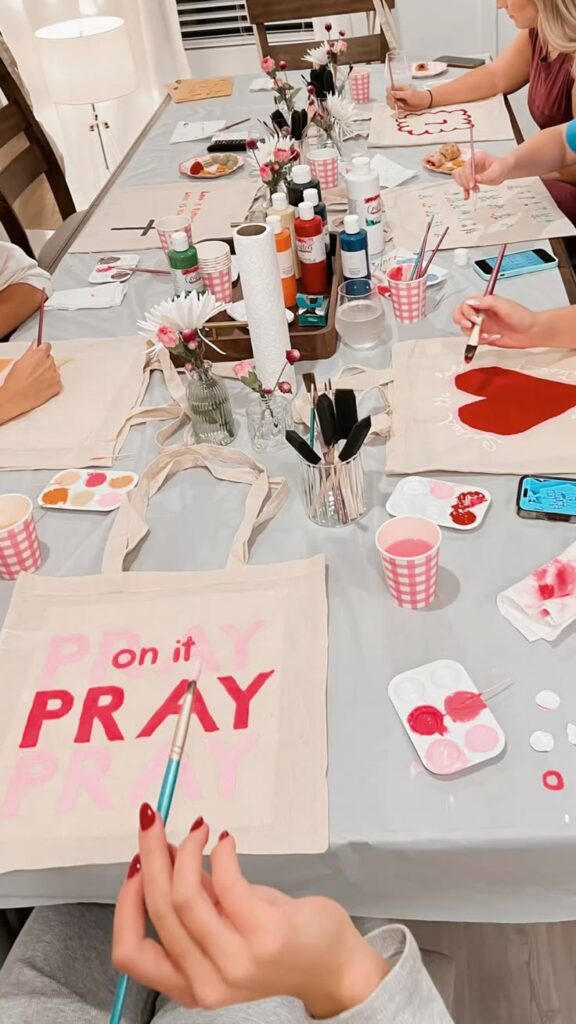
At a church gathering, women who already know one another may naturally sit together, while first-time guests or quieter members may find it difficult to join an existing conversation.
Simply asking everyone to introduce themselves may not solve this, especially when some participants feel uncomfortable speaking in front of a whole group.
For a Valentine’s Day women’s ministry craft night, organisers can make conversation easier by giving women opportunities to interact in smaller, less formal ways.
- Arrange seating thoughtfully: Avoid allowing all the established friends to occupy one table while newcomers sit together elsewhere.
Mix the seating where possible, while allowing women to choose a comfortable place. - Use simple conversation prompts: Place a few questions on each table, such as “What is one thing you enjoy doing in your free time?” or “What is a kind gesture someone has shown you that you still remember?” These give women something to talk about without demanding personal stories.
- Let conversations develop naturally: Avoid asking every woman to speak in turn or share something deeply personal. Some may be happy to listen at first before joining the discussion.
- Give newcomers a warm introduction: A ministry leader or host can introduce a first-time guest to one or two women who can help her feel included, rather than leaving her to approach an established group by herself.
- Don’t make relationship status the centre of the evening: Valentine’s Day can be a sensitive occasion for women with different life experiences.
Keep conversations focused on friendship, faith, shared interests and encouragement rather than assuming everyone is married, dating or celebrating in the same way. - Allow time for informal interaction: Avoid filling every part of the programme with announcements, instructions or speeches.
Leave room for conversation while refreshments are served and as women work alongside one another.
The aim is not to make every woman become close friends in one evening.
It is to create a welcoming environment where people can learn one another’s names, find common ground and feel comfortable returning for another women’s ministry gathering.
That sense of belonging is an important part of Christian fellowship.
A creative evening can also be a chance to slow down and recharge. How to Host a Cozy Self-Care Craft Night for Busy Women shares ideas for making that time relaxing and enjoyable.
Valentine’s Day Women’s Ministry Craft Night Ideas
1. Collaborative ‘Love One Another’ Mosaic for the Women’s Ministry Room
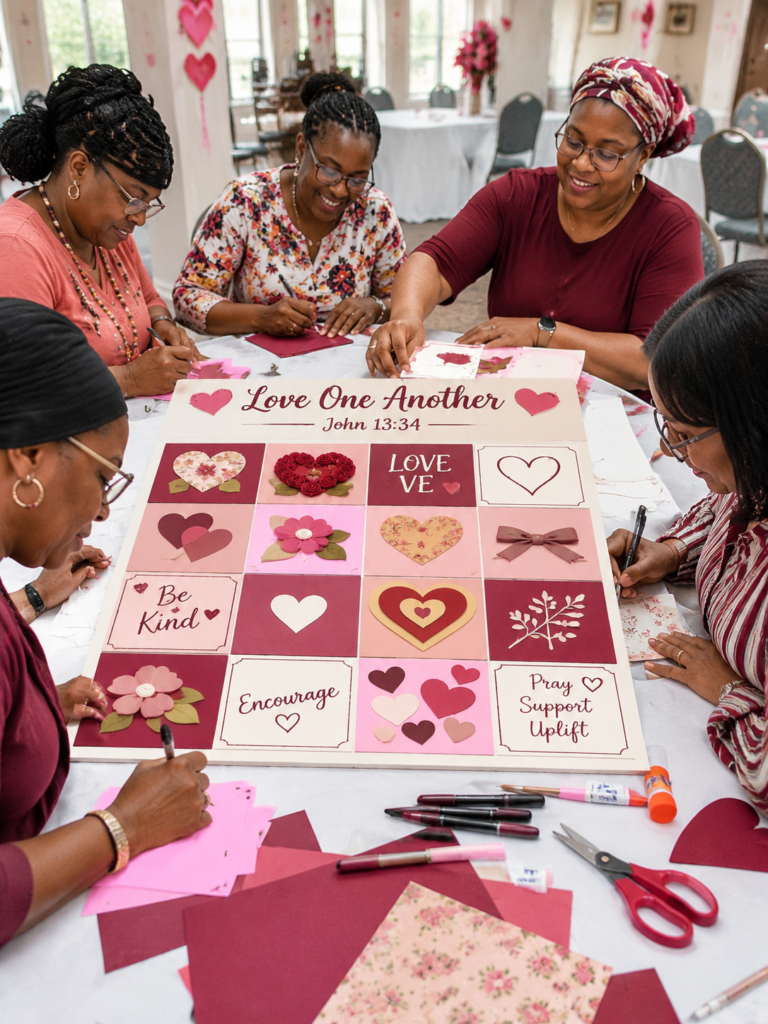
Women in a church serve in different ways, from welcoming visitors and organising events to checking on members who are unwell or absent. This collaborative project brings those everyday acts of Christian care together in one shared display.
It is one of the Valentine’s Day women’s ministry craft night ideas that can leave the church with something meaningful to display.
How to make the mosaic:
- Prepare matching paper tiles: Cut heavyweight cardstock into 4-by-4-inch squares and provide one per participant, plus a few extras.
- Give everyone a prompt: Ask each woman to complete: “One way we can show Christ’s love in our church is…” Examples include welcoming newcomers, listening to someone who needs support or checking on an absent member.
- Decorate the tiles: Let participants write their responses and add simple drawings, lettering or pre-cut paper shapes.
- Arrange the artwork: For 16 participants, arrange the tiles in four rows and four columns on a backing board. Adjust the layout to suit the group size.
- Add a Scripture reference: Include the title Love One Another with John 13:34 and, optionally, 1 Corinthians 12:12–27.
- Assemble the display: Arrange the tiles before gluing them to the backing board. Add a frame if the church intends to display the work permanently.
Materials: Heavyweight cardstock, coloured paper, markers, pencils, glue sticks, scissors, ruler, backing board and display frame.
Taking the message beyond the artwork: Read the contributions together and identify one practical way the ministry can put them into action. The group might decide to improve how it welcomes first-time guests or checks on members who have been absent. Agree on a realistic follow-up action with the ministry leadership.
John 13:34 teaches love for one another, while 1 Corinthians 12:12–27 describes the church as one body with different members who belong together. These passages provide the biblical connection for the project without suggesting that the mosaic is a biblical tradition.
Busy schedules can make it difficult to set aside personal time, but a simple craft evening can provide a welcome break. How to Host a Cozy Self-Care Craft Night for Busy Women shares ways to plan one.
2. Women of the Bible Accordion Storybooks
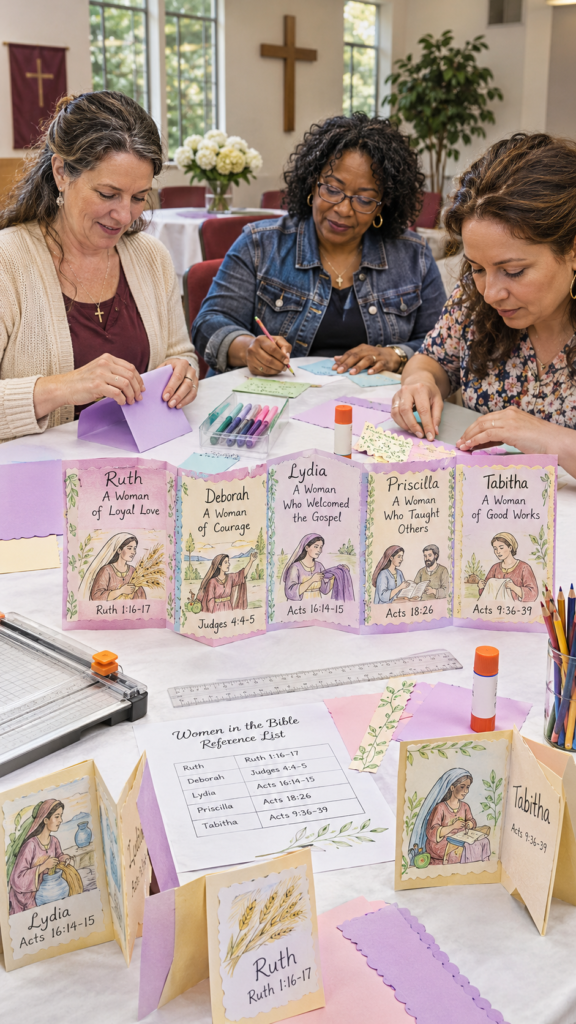
Ruth is often remembered for her loyalty, Deborah for her leadership and Lydia for her hospitality. Reading their stories more closely gives women an opportunity to examine what Scripture says about their lives and actions.
This activity combines Bible study and creativity, making it a meaningful addition to your Valentine’s Day women’s ministry craft night ideas.
What to include:
- Coloured cardstock: Choose sturdy paper that folds easily without tearing.
- Printed Bible passages: Assign each group a woman and provide the relevant references: Deborah (Judges 4–5), Ruth (Ruth 1–4), Lydia (Acts 16:11–15, 40), Priscilla with Aquila (Acts 18:24–26) or Tabitha (Acts 9:36–42).
- Markers and coloured pencils: Use these for illustrations, headings and important details.
- A ruler and paper trimmer: These help create evenly sized panels. Pre-cutting the paper can save time.
- Decorative paper and glue sticks: Use these for simple borders and illustrations.
- Printed panel headings: These help groups organise their information.
Making the accordion booklets: Fold each sheet into five or six panels. Use the first for the woman’s name and Bible references, then include the story’s setting, key events, her actions and a discussion question on the remaining panels.
For example, Acts 9:36–42 describes Tabitha as a disciple known for good works and helping the poor. The widows also showed Peter the clothing she had made. These details give participants specific points to discuss.
Lydia’s hospitality in Acts 16:11–15 and Priscilla and Aquila’s instruction of Apollos in Acts 18:24–26 offer other useful discussion topics.
Keeping the booklets biblically accurate: Ask each group to distinguish what Scripture states from what it does not explain. For example, Lydia’s account does not provide a detailed personal biography, so avoid adding assumptions.
The finished booklets can be collected in a folder for future women’s Bible study meetings or displayed in the ministry room.
Seasonal fellowship can bring women together around gratitude and shared experiences. 12 Thanksgiving Women’s Ministry Ideas for a Meaningful Gathering offers activities to make the occasion more meaningful.
3. Community Prayer and Service Map
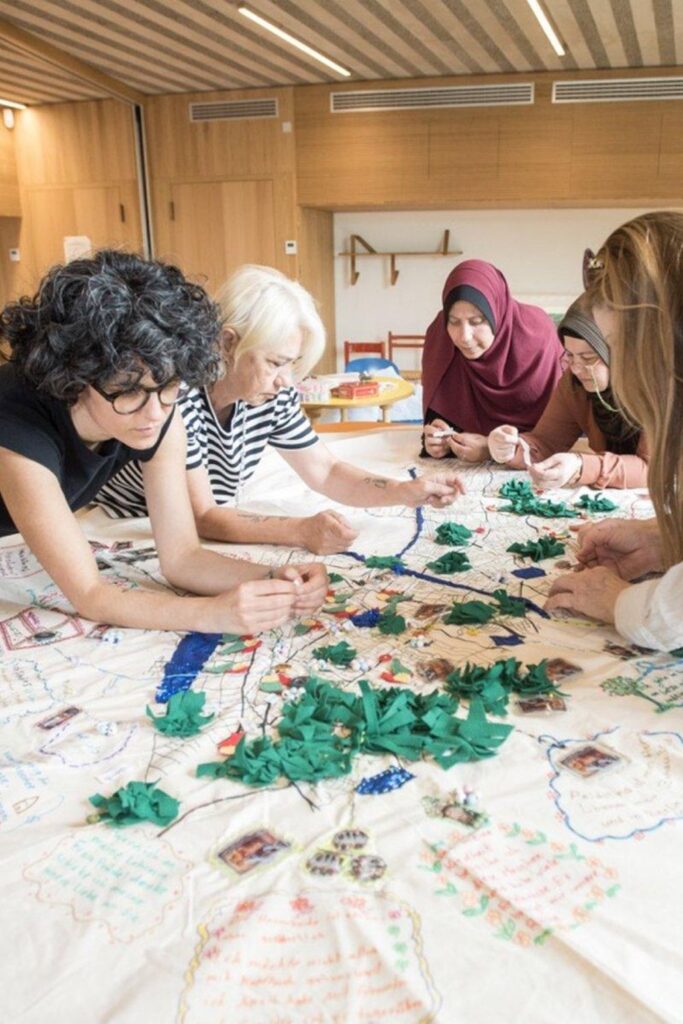
Church members may know the names of nearby schools, community centres, support organisations and other local institutions, but they may not know how these places connect with the work their church already does.
A community map gives the women’s ministry an opportunity to examine those connections and consider where it could participate constructively.
For this Valentine’s Day women’s ministry craft night, the group can create a visual map showing community resources, existing church connections and possible opportunities for service.
The purpose is not to assume what people need, but to identify places the ministry can learn more about and approach appropriately.
What to include:
- A printed neighbourhood map: Choose a map that covers the area the church realistically serves. A simple map showing streets, public landmarks and major institutions is sufficient.
- Coloured paper markers: Cut small circles, squares or other shapes to represent different categories of community resources and possible ministry connections.
- Coloured pens and markers: These will help participants label locations, add notes and distinguish between different types of resources.
- Small label cards: Prepare labels for schools, community centres, libraries, food support organisations, health facilities and other relevant public institutions.
- Adhesive dots or removable stickers: These allow participants to position and move markers around the map without permanently attaching every suggestion.
- A map key: Create a small legend explaining what each colour or symbol represents.
Building a useful community map: Begin with places the church already knows or has an established relationship with.
These might include a school where members volunteer, a community organisation the church supports, a local food bank or a centre that provides services to families.
Next, let the women add other public resources they know about.
Use separate marker colours to distinguish existing church connections, community organisations, and places the ministry would like to learn more about. Leave room for questions where information has not yet been verified.
The distinction matters. A group may know that a community has a health centre, for example, but that does not automatically mean the centre needs volunteers or donations.
Any proposed assistance should be discussed with the organisation concerned before the church makes commitments.
Community asset mapping is a recognised community-development approach. It helps groups identify existing resources, organisations, relationships and local strengths rather than looking only at problems.
The NAACP’s community asset-mapping guide also recommends defining the area being mapped, involving relevant partners and organising the identified resources into useful categories.
Turning the map into a ministry action: Once the map is complete, ask the women to identify one or two places they would genuinely like to learn more about.
The ministry leader can contact those organisations, ask about their existing programmes and find out whether there is a suitable way to get involved.
Keep personal addresses, private prayer requests and unverified reports about individuals off the display.
The finished map can remain in the women’s ministry room as a planning resource. It can also be updated when the church establishes new relationships or learns about other community resources.
Handmade presents can carry a personal touch that store-bought gifts sometimes lack. Crafts to Make for Friends: Meaningful DIY Gift Ideas They’ll Actually Love offers ideas for creating thoughtful gifts.
4. Encouragement Postcard Workshop for Women in the Community
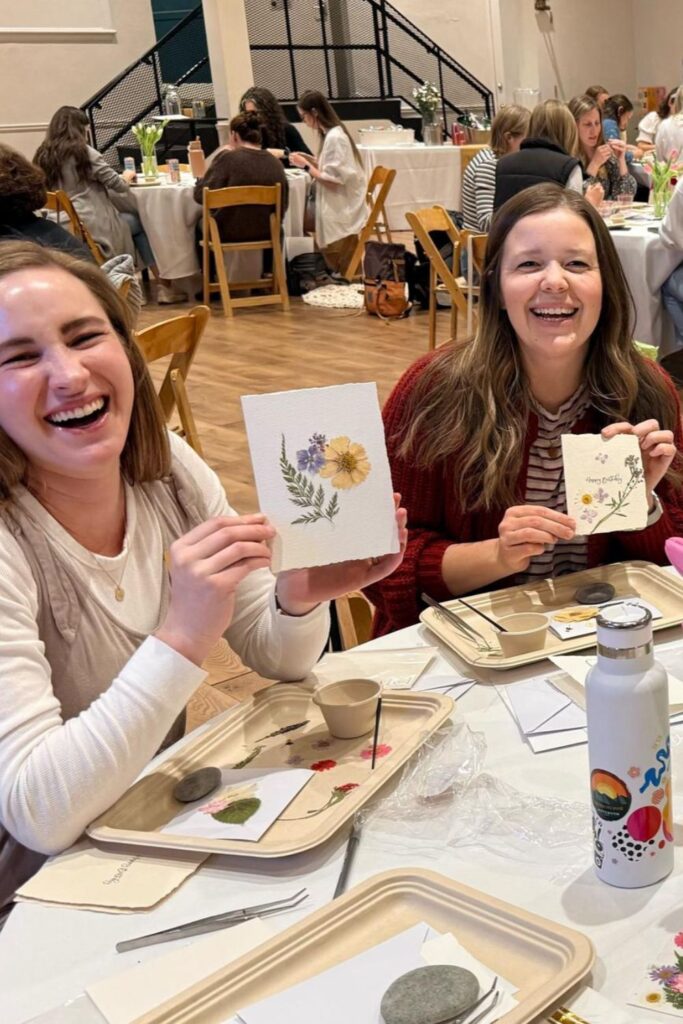
Someone who has been away from a church community for a while, is receiving support through a local organisation or has limited opportunities for social interaction may appreciate a thoughtful message.
However, a card is more appropriate when it is sent through a recognised contact who understands the recipient group and has agreed to distribute it.
For this craft night, women can create handwritten encouragement postcards for an existing church outreach or a community organisation that accepts this type of correspondence.
What to include:
- Blank postcard-sized cardstock: Choose sturdy paper with enough space for a short handwritten message and simple decoration.
- Coloured pencils and markers: These can be used to create illustrations, borders, flowers and encouraging lettering.
- Decorative paper: Small pieces of patterned paper can be used for layering and simple designs without making the cards difficult to write on.
- Glue sticks: These are useful for attaching paper details neatly without leaving wet patches on the cardstock.
- Pressed flowers or simple paper cut-outs: These provide optional decorative details. Use flat, securely attached materials so the finished cards remain easy to handle.
- Envelopes: Include suitable envelopes when the receiving organisation requires cards to be enclosed. Check its instructions before preparing the batch.
- Writing prompts: Prepare a few message suggestions to help participants who are unsure what to write.
Writing messages that are appropriate for the recipients: Keep the wording warm but do not assume that everyone receiving a card is experiencing the same circumstances.
Messages such as “Wishing you a peaceful week” or “Sending you a note of encouragement today” are less likely to make assumptions than statements about someone’s health, family or personal situation.
Where the cards are intended for a Christian women’s fellowship or an established church home-visiting programme, Scripture references can be included when they are appropriate for the recipients.
For a community organisation serving people from different religious backgrounds, check whether faith-based messages are welcome before adding Bible verses.
Check delivery arrangements before the craft night: This is particularly important when the intended recipients are hospital patients. Organisations have different rules about handmade cards, religious messages, envelopes and delivery.
For example, WakeMed requests positive messages and specifies that its patient cards should not be sealed in envelopes, while Norton Children’s states that it does not accept homemade cards for distribution to patients.
UVA Health also asks donors to contact its volunteer services office before bringing donations.
For this reason, the ministry leader should confirm that the chosen organisation accepts the cards, how many are needed and what content or materials are permitted.
The finished postcards should be collected and delivered through the approved contact rather than handed out directly to people whose privacy or circumstances are unknown.
Autumn provides plenty of inspiration for a church gathering, and 15 Fall Church Craft Night Ideas for the Slow, Reflective Fall Your Heart Actually Needs shares seasonal projects for a creative evening.
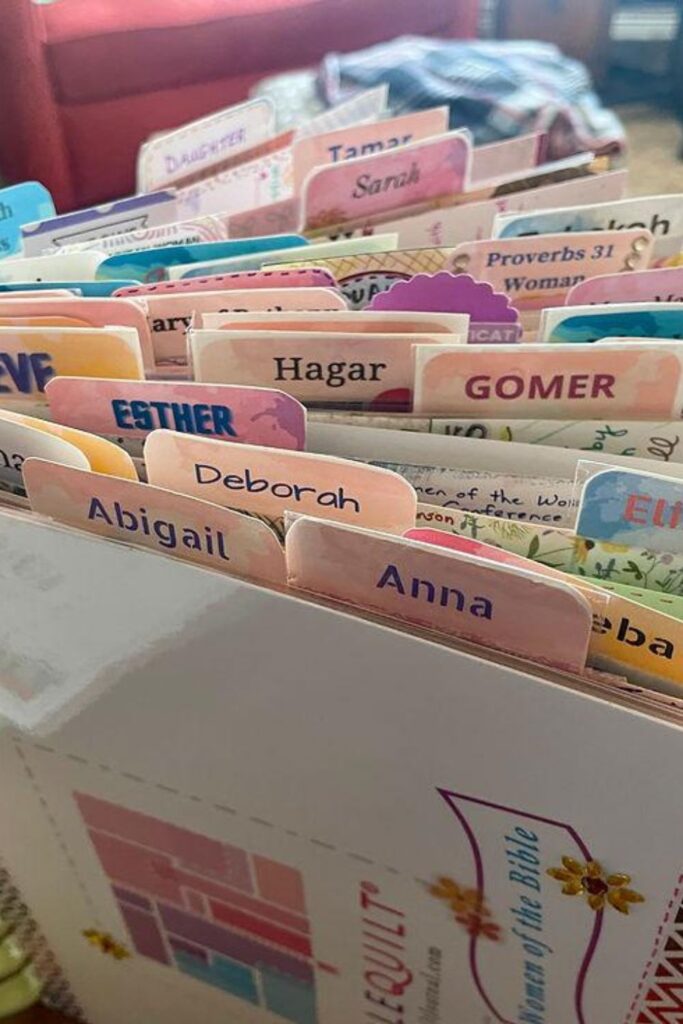
Within a women’s ministry, one woman may be comfortable using digital tools, another may have experience growing vegetables in containers, while someone else may know how to prepare a particular dish or organise a small community event.
These everyday abilities can become opportunities for women to learn from one another.
This activity turns those interests and skills into a small, handmade directory that the ministry can use to organise future skill-sharing sessions
. It gives women something to contribute and something they may like to learn, without assuming that everyone has a professional qualification or must volunteer for a particular task.
What to include:
- Blank cardstock cards: Prepare two cards for each participant. One can be titled Something I Can Show Someone, while the other can read Something I Would Like to Learn.
- Markers and coloured pencils: These allow participants to personalise their cards with small illustrations, lettering or simple borders.
- Printed category labels: Prepare headings such as digital skills, gardening, cooking, creative activities, language practice and everyday practical skills.
- A ruler and paper trimmer: These will help produce cards of consistent sizes that can be arranged into a booklet.
- Binder rings or a small ring binder: Use these to bring the completed cards together into a directory that can be rearranged when new participants contribute.
- Tabbed dividers: These separate the different skill categories so women can find subjects that interest them.
- A sign-up sheet: Keep a separate sheet for women who would like to attend a future demonstration or small group session.
Putting the skill-share booklet together: Ask each participant to write down one practical skill she is comfortable demonstrating and one thing she would like another woman to teach her. Encourage specific entries rather than broad descriptions.
For example, “showing someone how to organise photographs on a phone” is clearer than simply writing “technology.”
Other possible contributions include demonstrating how to grow herbs in containers, preparing a familiar local dish, using a spreadsheet, creating a simple household organisation system or practising greetings in another language.
Once the cards are completed, group them under the printed categories and assemble them into a ring-bound booklet. Participants can then look through the entries and identify subjects that interest them.
The ministry leader can use the responses to arrange a future short workshop, demonstration or informal learning session.
Keeping the arrangement voluntary: Do not treat the booklet as a list of services women are obliged to provide. Someone who writes that she can demonstrate a skill should have the freedom to decide whether and when she is available.
Ask permission before including names or contact details in a directory that will be shared beyond the event.
It is also useful to distinguish informal peer learning from professional advice; the booklet should not present a participant as a qualified health, legal or financial adviser unless her credentials have been verified and the activity is properly arranged.
The biblical connection can be made through 1 Peter 4:10, which encourages believers to use the gifts they have received in serving one another.
The skill-share activity is a practical application of that principle, not a claim that every hobby or ability is a spiritual gift.
Keep the first follow-up simple: choose one subject that several women want to learn and invite a willing participant to demonstrate it at a future meeting.
The booklet can then grow as other women contribute their interests and abilities.
A bridal shower becomes more interactive when guests get involved in making something for the celebration. The Most Creative Bridal Shower Craft Night Ideas for the Bride and Her Girls has activities to consider.
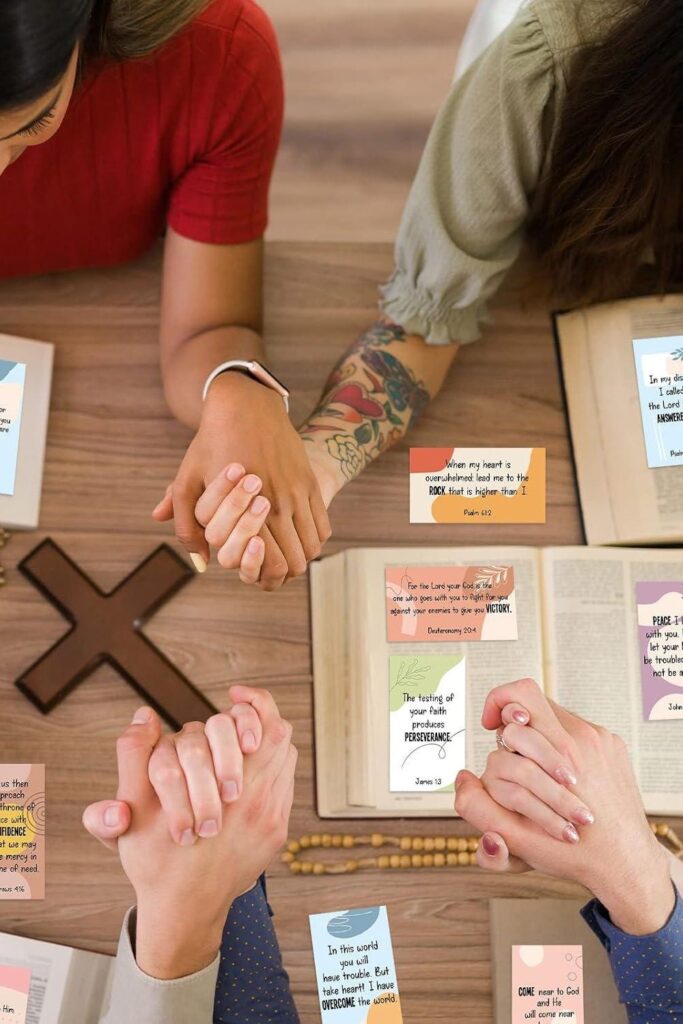
Not every woman feels comfortable sharing personal prayer requests in front of a group. A set of Scripture-based prayer cards gives everyone another way to participate in shared prayer.
This is one of the Valentine’s Day women’s ministry craft night ideas that can also provide a useful resource for future fellowship meetings and Bible studies.
What to include:
- Blank index cards: Choose sturdy cards that can withstand repeated handling.
- Coloured pens and markers: Use these to write and decorate the prompts.
- Category labels: Prepare headings for thanksgiving, spiritual growth, church leadership, families and community.
- Bible reference slips: Include relevant passages to guide the prayer themes.
- Card dividers: Keep the different categories organised.
- A storage box or card holder: Choose one that fits the completed deck.
Preparing the prayer prompts: Give each woman a few cards to write general prayer topics and relevant Bible references. Examples include:
- Thanksgiving: Give thanks for God’s goodness and faithfulness (Psalm 100:4).
- Spiritual growth: Pray for wisdom and understanding (Colossians 1:9–12).
- Love and discernment: Pray for growing love and wise decisions (Philippians 1:9–11).
- Church leaders: Pray for those serving in leadership and positions of responsibility (1 Timothy 2:1–2).
- Christian service: Pray for opportunities to use individual abilities to serve others (1 Peter 4:10).
Using the deck: Sort the cards into their categories and place them in the storage box. During future meetings, the leader can select one or two prompts for the group to pray about. Women can pray aloud or silently, according to their comfort.
Protecting privacy: Keep the cards focused on general prayer themes, not identifiable personal requests or private family and health matters. A prompt such as “Pray for women going through difficult seasons” is suitable without naming anyone or disclosing her circumstances.
The finished prayer deck can be kept with the women’s ministry supplies and reused during future gatherings.
Candle making can give guests something practical and personal to take home. 20 Candle Making Night Ideas That Smell Better Than Anything on Etsy offers inspiration for organising a candle-making session.
7. Block-Printed Table Linens for the Church Hospitality Team
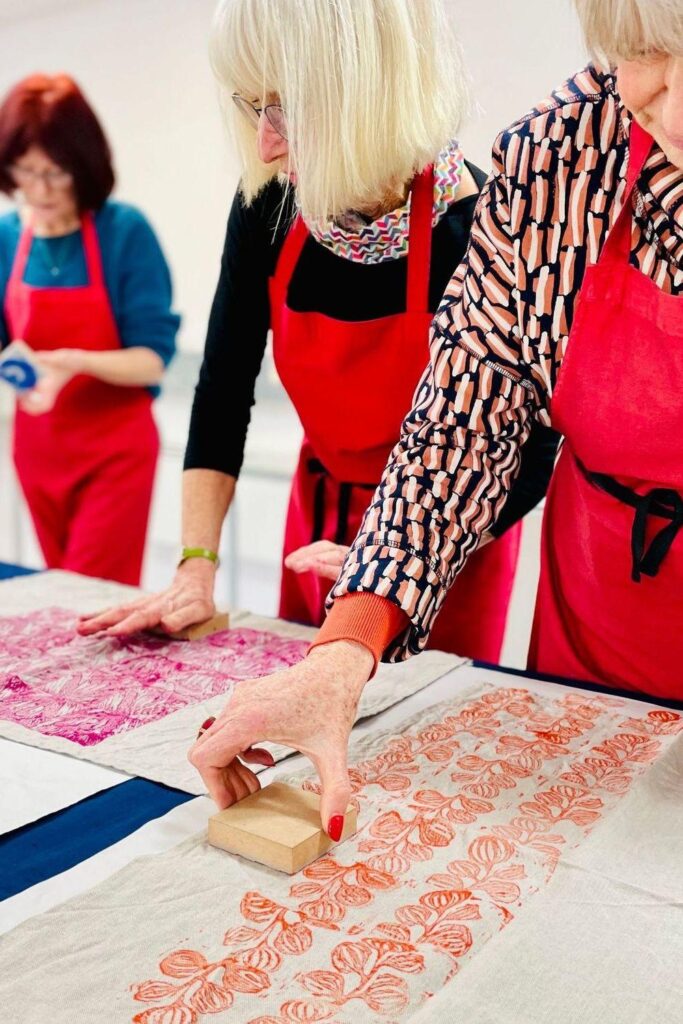
When the women’s ministry hosts fellowship meals or welcome teas, decorated table linens can make the setting more inviting. This craft gives the women an opportunity to create reusable pieces for future church gatherings.
It is one of the Valentine’s Day women’s ministry craft night ideas that produces something the church can continue using.
What to include:
- Plain cotton table runners or tea towels: Choose pre-washed, smooth cotton for clearer prints.
- Reusable foam or rubber printing blocks: Select simple patterns such as leaves, flowers or geometric shapes.
- Fabric paint: Use textile paint suitable for printing on cotton. Two or three coordinating colours are enough.
- Paint trays and sponge applicators: These help distribute a thin, even layer of paint on the printing blocks.
- Scrap cotton fabric: Let participants test their designs before printing the finished pieces.
- Protective table covers and aprons: These help prevent paint stains on clothing and work surfaces.
- Cardboard sheets: Place these beneath the fabric to prevent paint from transferring to the table.
Printing the table linens: Wash and dry the cotton according to its care instructions, then iron it flat. Let each woman practise on scrap fabric before applying the design to the finished piece. Press the printing block firmly without sliding it to avoid blurred patterns. Participants can work on separate sections of one table runner to create a coordinated design.
Preparing the linens for reuse: Fabric paints have different drying and curing requirements. Some require heat-setting before washing. Jacquard, for example, recommends heat-setting its Textile Color paint for maximum permanence. Always follow the instructions for the specific product rather than assuming overnight drying is sufficient.
Table runners and decorative tea towels are suitable starting projects. Keep printed areas away from direct food contact unless the paint manufacturer confirms that the product is suitable for that purpose.
Reusable printing stamps, foam rollers and suitable fabric paints are useful supplies to purchase. The church can complete any required heat-setting after the craft night before storing the finished linens for future events.
Older adults can enjoy creative activities that bring Scripture into the experience. 7 Bible Verse Craft Night Ideas for Seniors That Inspire Faith and Joy offers faith-based projects to try.
8. Pressed Botanical Gratitude Frames
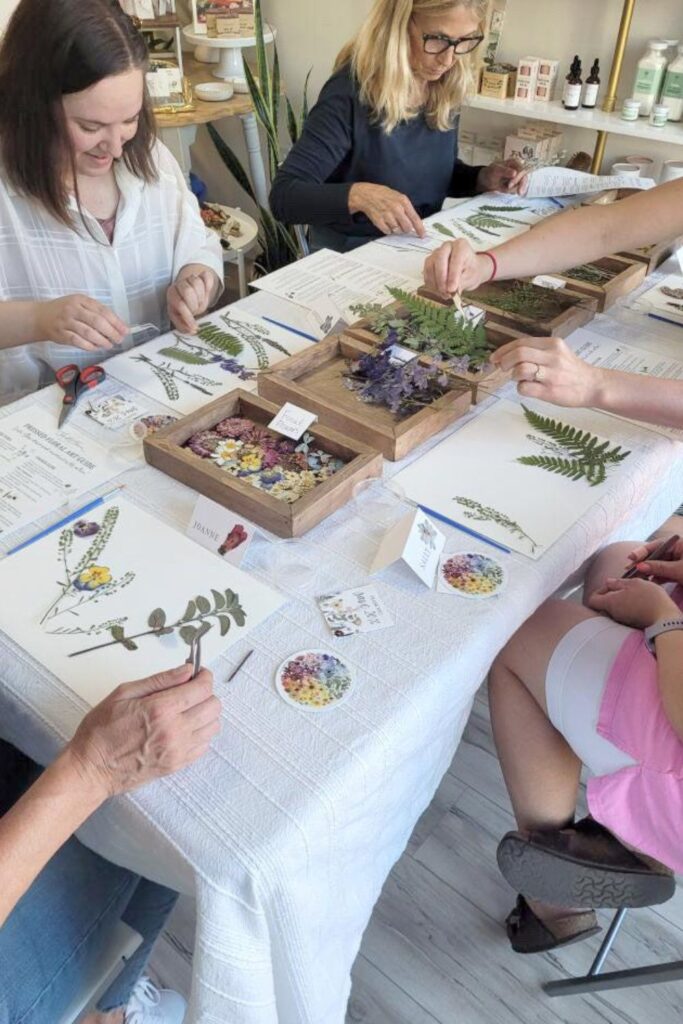
Pressed flowers and leaves can be arranged into simple framed artwork for the women’s ministry room, church office or home. This craft gives participants an opportunity to create something personal using natural materials.
It is another way to bring creativity and gratitude into your Valentine’s Day women’s ministry craft night.
What to include:
- Pressed flowers and leaves: Prepare completely dried specimens in different shapes and sizes. Flat leaves and delicate flowers are easier to arrange.
- Heavy cardstock or acid-free paper: Use these as the background for the botanical designs.
- Small picture frames: Choose frames that fit the paper and allow room for the pressed materials.
- Tweezers: These help handle delicate petals without tearing them.
- PVA glue: Use small amounts to secure the flowers and leaves.
- Pencils and fine-tip markers: Add a short gratitude message or Bible reference, such as Psalm 100:4.
- Identification labels: Include plant names only when they have been reliably identified.
Making the botanical frames: Let each woman arrange her flowers and leaves on the paper before applying glue. She can create a border, centre one larger flower or arrange smaller leaves around a Scripture reference. Once satisfied, use a little PVA glue to secure the materials. Avoid ordinary sticky tape, which can discolour or detach over time.
Preparing the flowers: Fresh flowers will not be ready for framing during a typical craft night. Pressing and drying can take several days or weeks, depending on the plant and conditions. Prepare the specimens beforehand or purchase ready-pressed flowers. Make sure they are completely dry before handling and framing.
Obtain permission before collecting flowers from private gardens or church grounds, and avoid protected or unidentified plants.
A flower press, tweezers, suitable mounting paper and small shadow-box frames are useful supplies for this activity. Participants can also take their unfinished arrangements home to frame later.
Moms who want time to connect and enjoy a creative activity can explore 30 Craft Night Ideas for Moms Who Need One Night That’s Just Theirs for ideas suited to a moms’ night out or home gathering.
9. Air-Dry Clay Encouragement Tokens
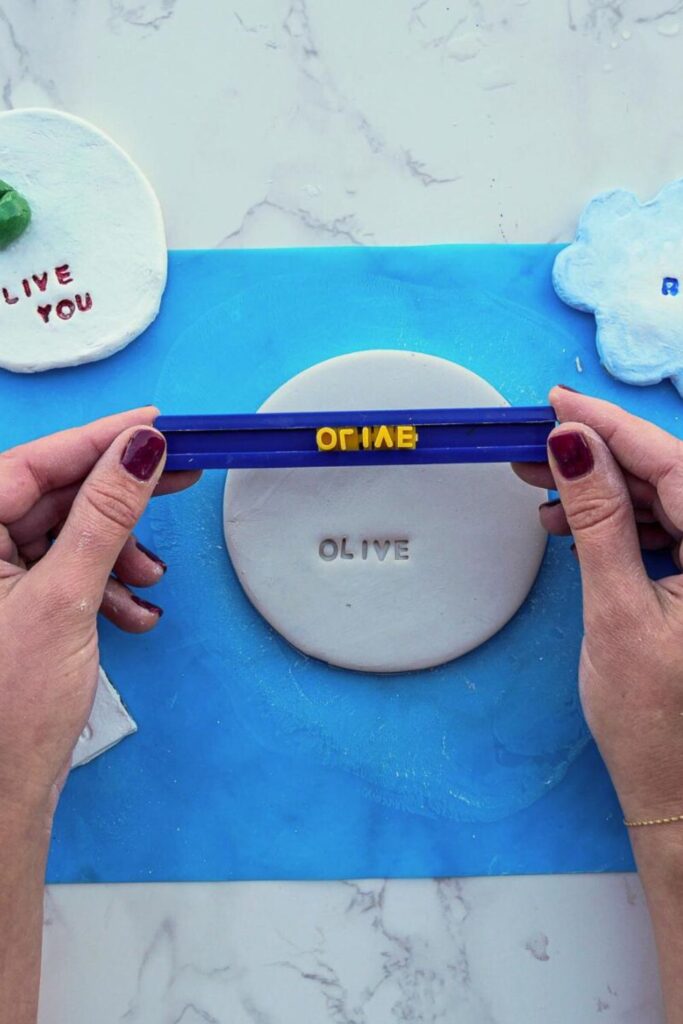
A small clay token stamped with a word such as hope, peace, kindness or courage can serve as a reminder of a Christian value or encouraging Bible passage.
Women can make these during the craft night and finish them at home once the clay dries.
What to include:
- Air-dry clay: Choose clay that hardens without a kiln and provide enough for one or two tokens per person.
- Small rolling pins: Use these to flatten the clay evenly.
- Alphabet stamps: Choose letters that can imprint short words clearly.
- Shape cutters: Round, oval and rectangular cutters help create neat tokens.
- Drinking straws: These can make holes for hanging decorations before the clay dries.
- Modelling tools: Use these to smooth edges and refine the lettering.
- Acrylic paints and brushes: These are for decorating the tokens after they dry completely.
- Work boards and table covers: These protect the work surfaces and keep the clay manageable.
Making the tokens: Let each woman choose a word, flatten her clay, cut out a shape and stamp the lettering. A small accompanying card can carry a related Bible reference, such as Philippians 4:6–7 for peace or Ephesians 4:32 for kindness.
Allowing the clay to dry: The tokens will not be ready for painting at the end of the evening.
Crayola recommends approximately 72 hours for its Air-Dry Clay to dry completely, depending on the thickness and conditions.
Follow the drying instructions for whichever brand you purchase. Avoid making the pieces too thin, as they may crack.
Once fully dry, participants can paint and finish their tokens according to the manufacturer’s instructions.
Remember that sealing Crayola Air-Dry Clay does not make it waterproof. These pieces are decorative keepsakes, not functional pottery or food containers.
Little ones can create a memorable keepsake for their grandparents with 15 Handprint Flower Bouquet Crafts for Grandparents Day (Toddler to Tween Friendly), featuring flower-inspired projects for different ages.
10. Community Seed-Packet Making and Exchange Table
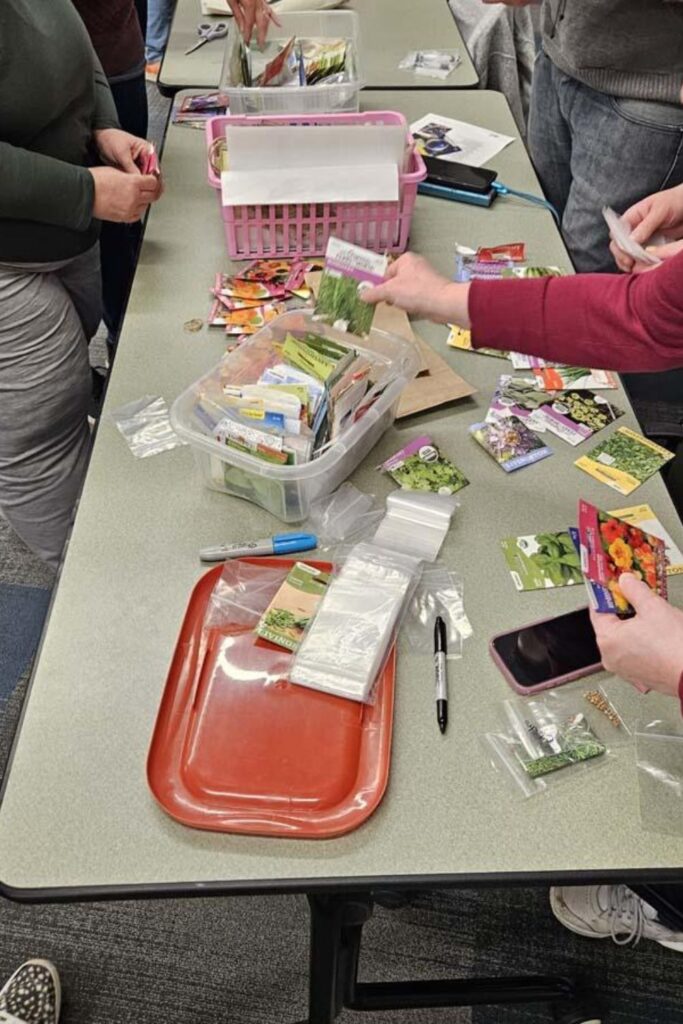
Women who enjoy gardening may have different herbs, vegetables or flowers they would like to grow or share.
This is one of the more practical Valentine’s Day women’s ministry craft night ideas, especially for a group supporting a church garden or local growing project.
Participants decorate, label and organise seed packets for a local exchange or community garden.
What to include:
- Seeds from reliable sources: Choose correctly identified seeds suited to the local climate and planting season.
- Small paper envelopes: Use envelopes that can be sealed and labelled clearly.
- Original seed packets: Keep the supplier’s information, including variety, germination details and any seed treatment warnings.
- Labels and waterproof markers: Use these to identify each seed variety and record relevant dates.
- Sowing instruction cards: Include accurate planting details, such as depth, spacing, sunlight and planting season.
- Decorative paper and coloured pens: Let participants personalise the envelopes without covering essential information.
- Storage boxes: Sort the finished packets by plant type for easy collection and distribution.
Preparing the seed packets: Check the seed labels before the event. When dividing commercial seeds into smaller portions, retain the original supplier information.
For saved seeds, record the plant variety, source and collection date, and only share seeds that have been identified correctly.
A practical option is to keep commercial packets intact and let participants decorate paper sleeves for them. This avoids losing important growing and treatment information.
University extension guidance also recommends checking seed labels and recording variety and date information for saved seeds.
Choosing suitable seeds: Growing requirements vary by plant and location. Ask a local seed supplier, agricultural extension service or experienced grower which varieties suit the community’s climate and planting season.
Avoid distributing unidentified seeds or plants that may be invasive, and check local rules before transporting seeds across borders.
Giving the exchange a purpose: Decide whether the packets are for participants to take home, a church garden or an established community project.
For a shared garden, speak with the person managing it first to confirm which seeds are suitable and how many are needed.
Paper seed envelopes, storage boxes and waterproof markers are useful supplies for this activity.
A local gardening volunteer can also answer questions about planting and help participants make better use of the seeds.
A church picnic can be more than a meal outdoors; it can create opportunities for women to connect. Church Picnic Themes for Women’s Groups That Make Every Woman Feel Like She Belongs shares ideas for planning a welcoming gathering.
How Do You Make a Women’s Ministry Craft Night Welcoming to First-Time Guests?
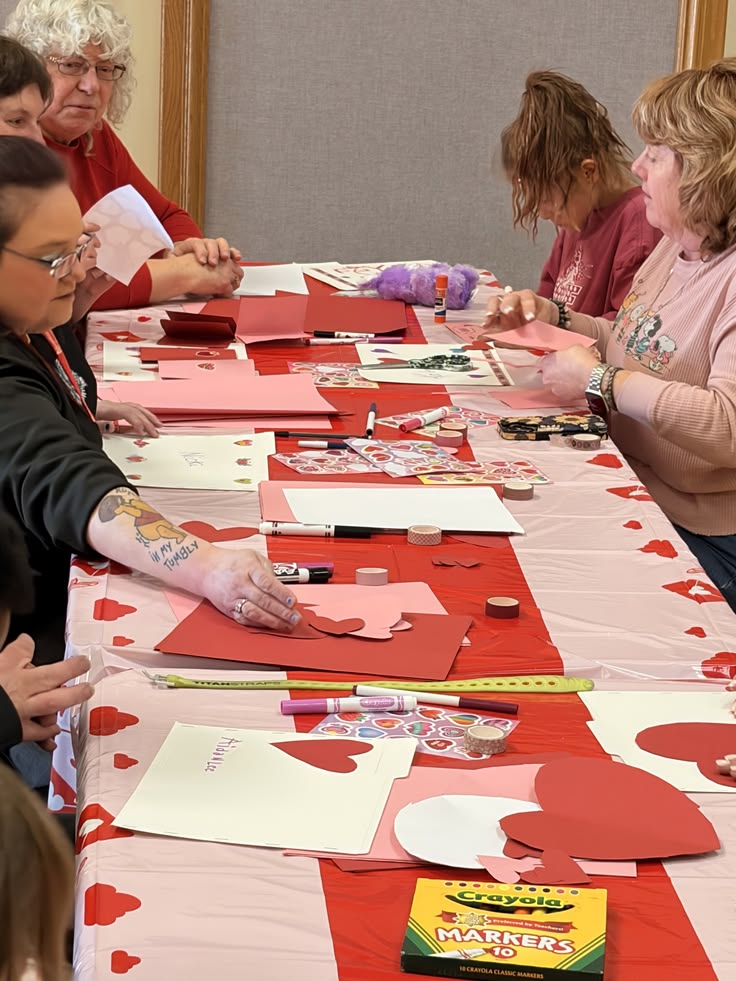
Walking into a room where most women already know one another can feel uncomfortable for a first-time guest.
A few
How Do You Make a Women’s Ministry Craft Night Welcoming to First-Time Guests?
A few thoughtful arrangements can help newcomers feel comfortable and included.
- Welcome guests at the entrance: Ask a ministry member to greet them, introduce herself and show them around.
- Mix the seating: Help newcomers sit with women who can include them in conversations.
- Display a finished craft: Show an example and briefly explain the steps, especially for beginners.
- Provide spare supplies: Keep extra scissors, markers and glue available so guests do not need to bring their own.
- Use conversation starters: Try questions such as “What hobby would you like to learn?” to encourage relaxed conversations.
- Allow flexible participation: Give women room to observe, ask for help or work at their own pace.
Avoid putting first-time guests on the spot with compulsory introductions or personal questions. A warm greeting, clear instructions and an inviting place at the table can help them feel part of the group.
Friends who live far apart can still share a creative evening online. How to Plan a Virtual Craft Night Party with Friends (DIY Girls Night Guide) explains how to organise a virtual get-together.
Conclusion
A Valentine’s Day women’s ministry gathering can be a chance for women to spend time together, learn from one another and put their faith into practical expressions of love and service.
The craft does not have to be complicated or expensive to make the evening worthwhile.
These Valentine’s Day women’s ministry craft night ideas offer different ways to bring creativity, Scripture, fellowship and community involvement into one gathering.
Choose an activity that suits your group’s size, budget and interests, prepare the materials beforehand and give everyone room to participate.
Start with one project your women will enjoy, invite them to contribute and let the evening create opportunities for friendships to grow beyond the craft table.