This post contains affiliate links. This means I may earn a small commission if you purchase through my links at no extra cost to you.
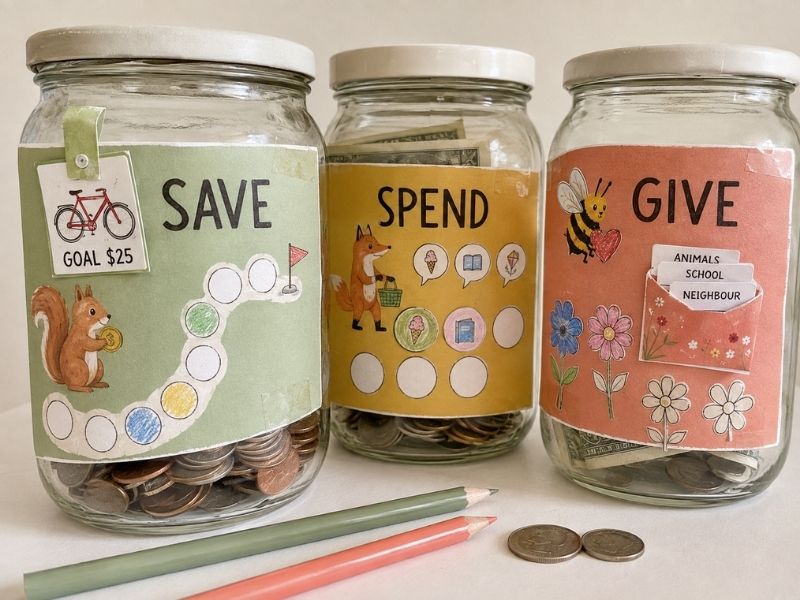
Some lessons are much easier when a child can hold them in her hand. Save spend give jars for kids turn money from a grown-up conversation into three choices sitting right there on the shelf: enjoy some, wait for something, and help someone.
And honestly? That tiny pause before a child drops a coin into one jar instead of another is the lesson.
She is not memorizing a definition of budgeting. She is deciding what her money should do.
The system does not need an app, a complicated reward chart, or a perfectly planned allowance. Three clear containers, three labels, and a few small bills are enough to begin.
What Are Save Spend Give Jars for Kids?
The idea is exactly what it sounds like. Every time your child receives money from allowance, a birthday card, a paid extra job, or Grandma slipping a few dollars into a pocket she divides it among three jars.
- Save holds money for a larger goal that takes time.
- Spend holds money she may use for small wants now.
- Give holds money she chooses to use for another person or a cause.
That is the whole system. Simple enough for a five-year-old to see, but useful enough to shape years of money decisions.
Save, Spend, and Give jars work because young children learn best through concrete experiences.
The Consumer Financial Protection Bureau’s guidance for young children explains that children between ages three and five are still developing the foundations for future financial understanding.
These jars help them practise waiting, planning, making choices, and recognizing the difference between needs and wants.
If your child enjoys making useful things with her hands, let her decorate the containers herself.
The same open-ended confidence behind these farm animal crafts for kids works here too: her jars do not need to match a picture to be “right.”
Why Three Jars Work Better Than One Piggy Bank
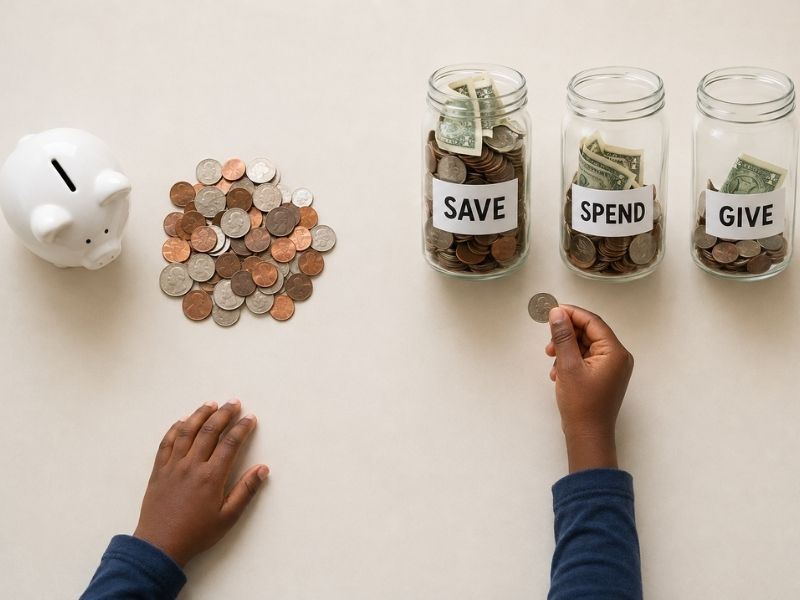
A traditional piggy bank teaches one thing well: money can be kept. But it does not show a child what the money is being kept for.
That is why save spend give jars for kids are different: every coin keeps a visible purpose instead of disappearing into the same dark little belly.
With save spend give jars for kids, the purpose stays visible. One jar slowly fills toward a bicycle helmet. Another holds enough for stickers.
The last carries two crumpled dollars waiting to become canned food for a local pantry.
They Make Waiting Visible
“Save your money” feels vague when you are six. A clear jar with a picture of a $24 building set taped to it feels different.
Your child can count $8, see the empty space above it, and understand that she is one-third of the way there. Waiting stops feeling like nothing is happening.
This is the same reason hands-on learning lands so well in weather crafts that turn curiosity into understanding. Children can see the idea instead of being expected to hold an abstract explanation in their heads.
They Let Small Mistakes Stay Small
Your child may empty the Spend jar on a toy that breaks before bedtime. Ouch. Still, a disappointing $4 choice at age seven is a much gentler teacher than a disappointing $400 choice at age twenty-seven.
Do not rush in with replacement money. Let the feeling arrive, then keep the conversation calm: “You wish you still had the money.
What might you check before buying next time?”
That moment is not failure. It is practice with training wheels on.
They Make Generosity Concrete
“Be generous” is a lovely sentence. But a child choosing $3 from her Give jar to buy pencils for a classroom understands something deeper.
The FDIC’s Money Smart for Young People includes age-appropriate lessons about spending, saving, and giving.
At home, the jar makes that lesson personal: this is my money, and I can use part of it to make something kinder.
For a gentle follow-up activity, try these friendship-themed preschool crafts. A handmade card plus a small Give-jar purchase can turn generosity into a moment your child can picture and remember.
How to Make the Three Money Jars
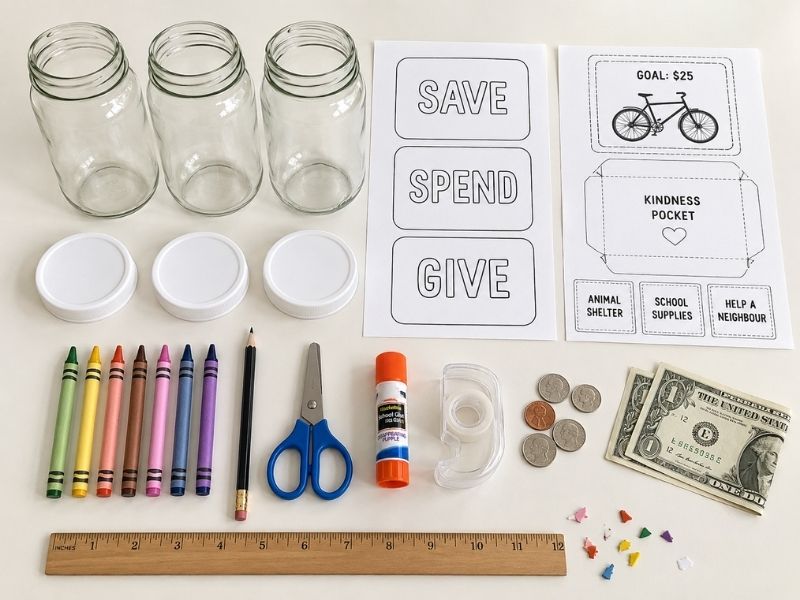
This one takes about fifteen minutes. The decorating may take longer than the setup, which is exactly how kids like it.
What You Need
- Three clear plastic jars, mason jars, or clean food containers
- Paper labels or large stickers
- Markers, paint pens, washi tape, or ribbon
- A small photo or drawing of the current savings goal
- Optional: a simple tracking card and a child-safe cash box for larger amounts
Choose clear containers if possible. Watching the money rise is part of what makes save spend give jars for kids work. For younger children, use plastic rather than glass and choose wide openings that little hands can manage.
If decorating jars turns into the best part of the afternoon, lean into it. These glow-in-the-dark Halloween crafts and handprint fall deer crafts offer playful jar inspiration you can adapt without making the labels hard to read.
Label Each Jar Clearly
Write SAVE, SPEND, and GIVE in large letters. Then add a visual for children who are not reading confidently yet: a star beside Save, a shopping bag beside Spend, and a heart beside Give.
Let your child choose the colors. Ownership starts before the first coin goes in.
For a sweet personal touch, decorate the Give jar with a tiny handprint.
The keepsake feel of these handprint turkey crafts for kids fits beautifully here, especially when the jar becomes part of your family’s yearly routine.
Choose One Real Savings Goal
Do not label the jar “future.” That word means almost nothing to a seven-year-old. Tape on a picture of the exact thing she wants and write the price underneath.
A $12 craft kit, $20 book set, or $30 scooter accessory gives the jar somewhere to go. Start with a goal your child can reach in four to eight weeks, because an eighteen-month wait will make the jar feel decorative instead of useful.
If she needs goal ideas that lead to making rather than collecting, browse these bright summer crafts for kids ages 6–12 together. Choosing the goal is already a money decision.
How Much Money Goes Into Each Jar?
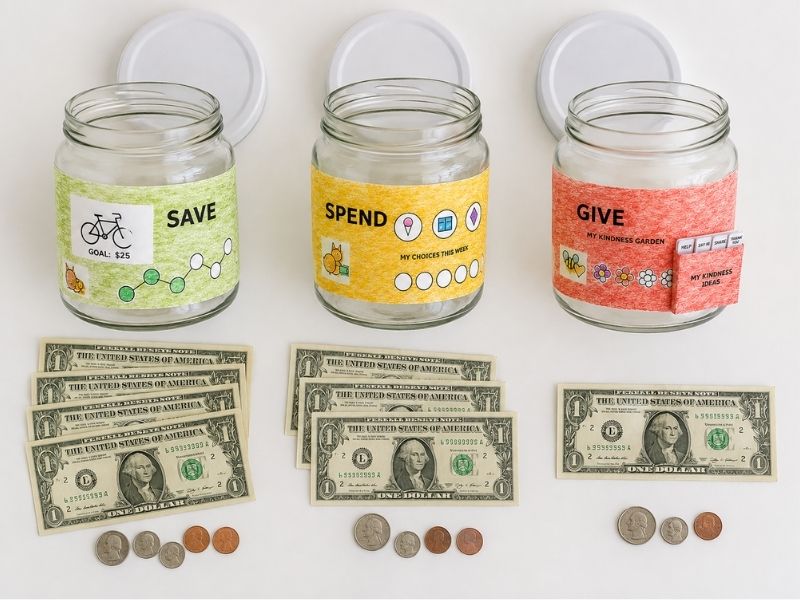
Parents can get stuck here because percentages make the system sound like a test. It is not. The best split is one your child understands and your family can repeat.
A balanced starting point for save spend give jars for kids is:
- 50% Save
- 40% Spend
- 10% Give
So, if your child receives $10, she puts $5 into Save, $4 into Spend, and $1 into Give. Clean. Countable. Done.
The three-bank budgeting guide from Better Money Habits suggests deciding the percentages together and keeping them consistent. Consistency matters more than chasing a mathematically perfect split.
A Simpler Split for Younger Children
For ages four to six, three equal parts may be easier. Give $3, $6, or $9 so one-third can drop into each jar without a worksheet appearing at the kitchen table.
Yes, equal thirds give a larger share to generosity than many adult budgets would. That is fine. At this age, the point is sorting, choosing, and repeating—not optimizing cash flow.
A Goal-Heavy Split for Older Kids
An older child saving for something specific may choose 60% Save, 30% Spend, and 10% Give. Let her explain why she wants the change, then agree on a period—perhaps one month before adjusting again.
That small negotiation matters. She is learning that a budget can reflect a goal without changing every time she sees something shiny.
What Each Jar Can—and Cannot—Pay For
The labels look obvious until your child wants to use Give money for her best friend’s birthday present or Save money for a snack.
Agreeing on the rules while everyone is calm is what keeps save spend give jars for kids clear and prevents a checkout-line debate later.
The Save Jar
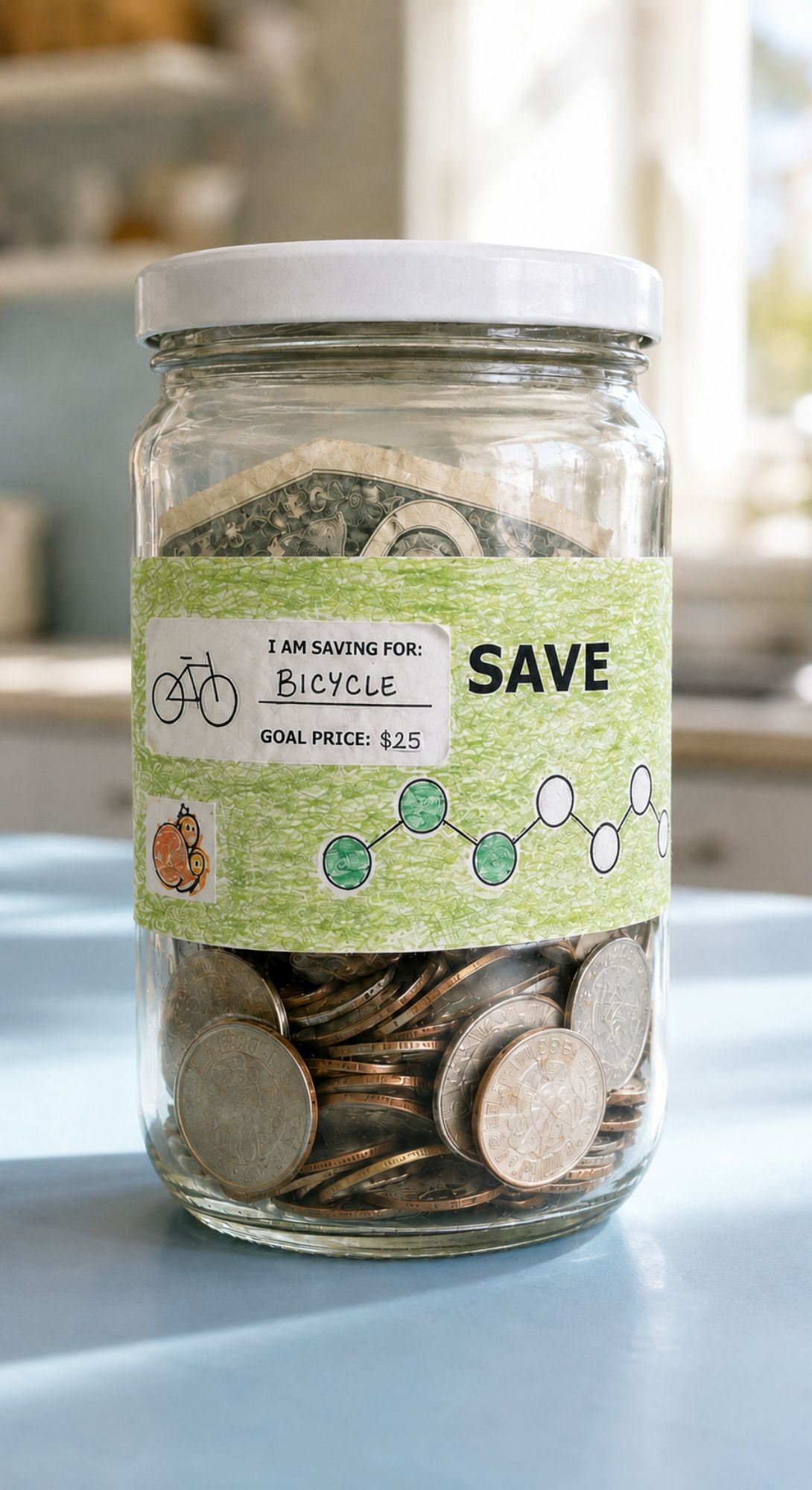
Save is for a named goal that cannot be purchased yet. A child might save for a science set, special outing, headphones, a larger toy, or supplies for a project.
Keep the goal visible and mark progress every week. A $20 goal with $14 saved feels possible; a jar of unexplained coins feels endless.
Educational goals work beautifully here. A child who loves hands-on learning might save for supplies after seeing these skeleton crafts that teach body parts or corn husk crafts made with simple materials.
The Spend Jar
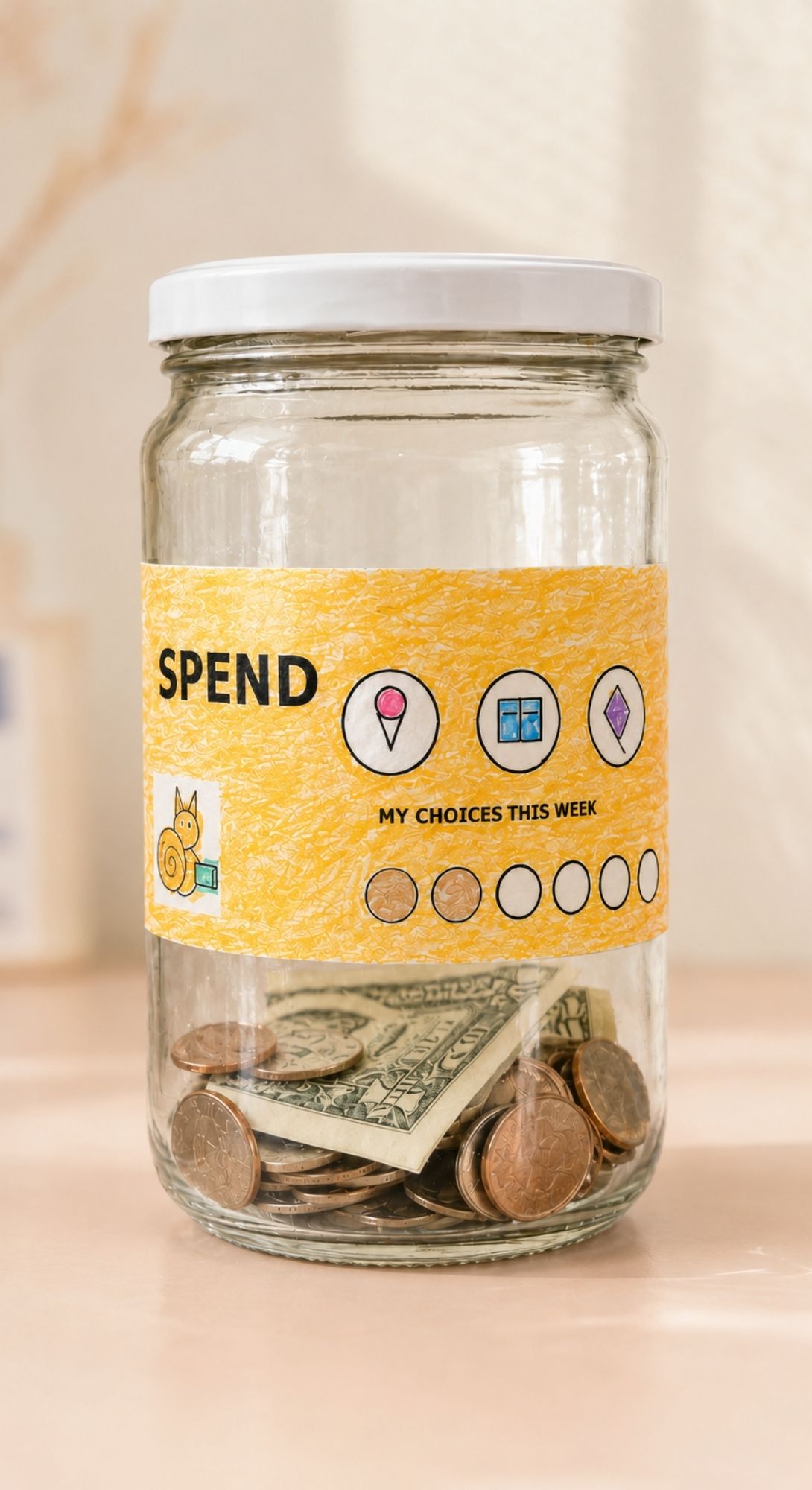
Spend is for small wants your child can choose now: a treat, stickers, a low-cost toy, a comic, or an inexpensive app with parental approval. Once the Spend jar is empty, spending stops until more money arrives.
Parents still set boundaries. Unsafe, age-inappropriate, or family-prohibited purchases do not become acceptable because a child has cash.
Still, leave room for a harmless choice you would not make yourself. If every purchase requires your approval of its wisdom, it is not really her practice money.
The Give Jar
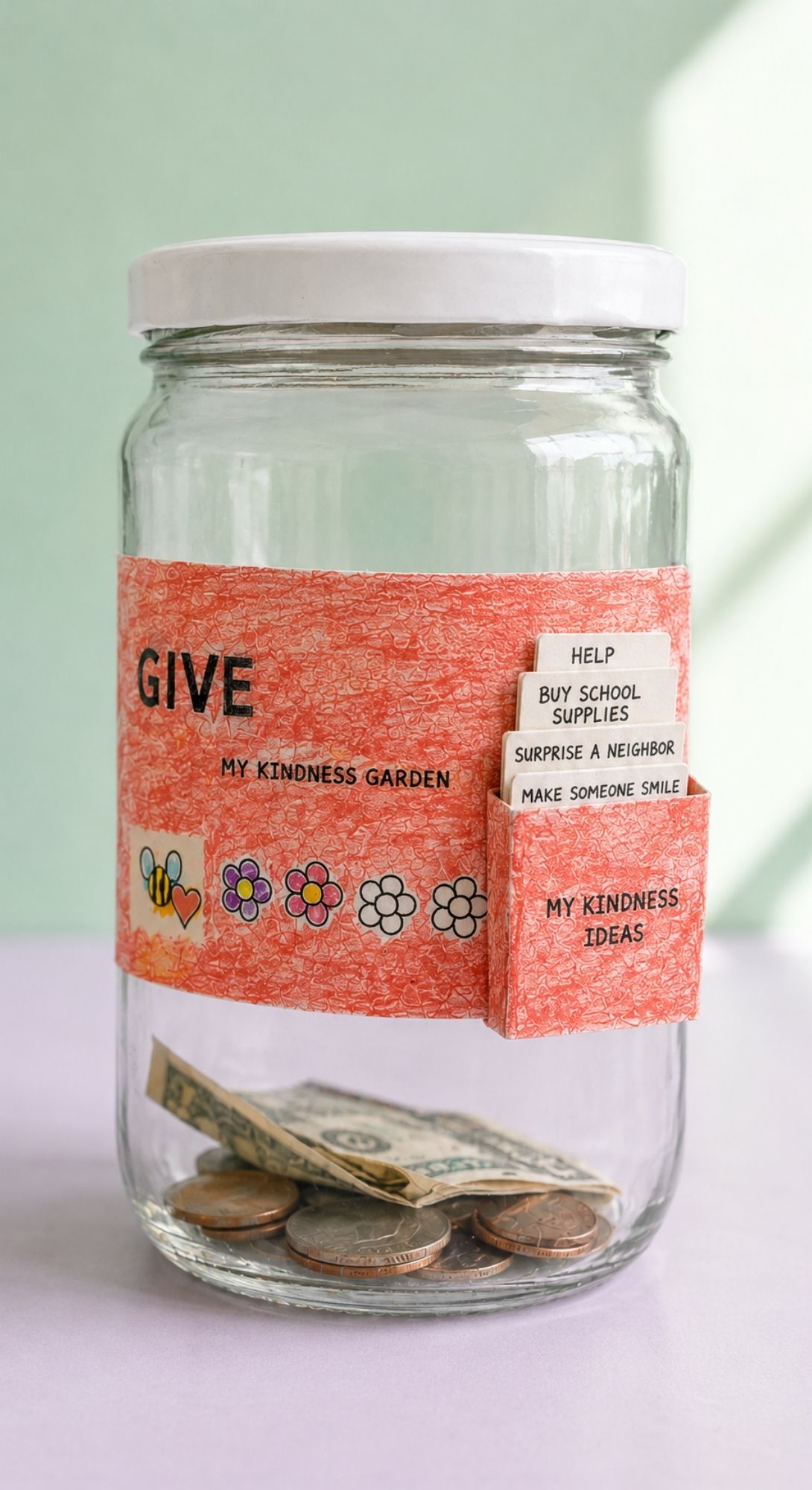
Give is for kindness chosen with intention. It may buy pet food for an animal shelter, a small gift for someone who is ill, school supplies for another child, or ingredients for cookies delivered to a neighbor.
Let your child help choose where the money goes. When considering an organization, parents can use Charity Navigator to review established charities together.
Generosity feels different when a child understands who the money may help and how.
The Give jar can also fund a handmade-and-purchased gift combination.
These sweet DIY Easter fillers for kids show how small, thoughtful items can feel special without becoming a mountain of clutter.
Where the Money Should Come From
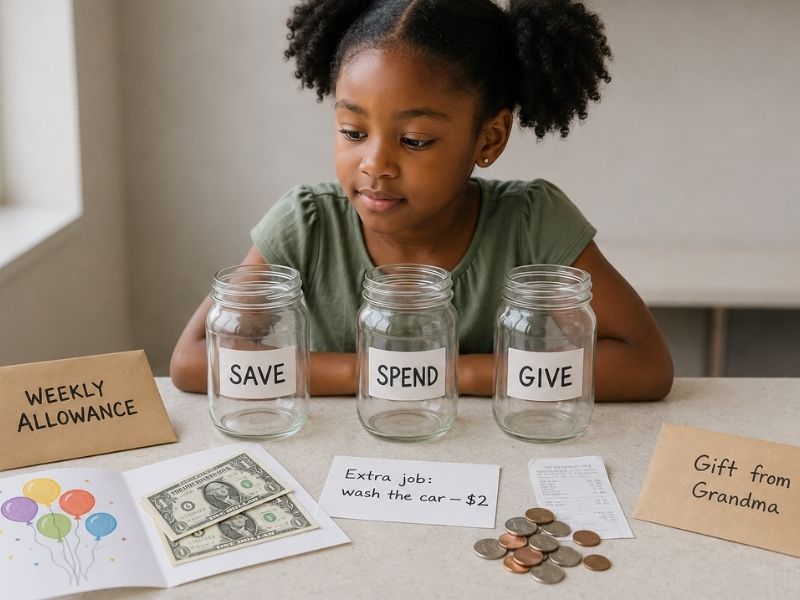
You do not need a large weekly allowance to make save spend give jars for kids useful. The system can work with birthday money, holiday cash, tooth-fairy money, or payment for occasional jobs beyond normal family responsibilities.
The important part is that money arrives often enough for your child to practice. Once a year is a gift. Once a week or twice a month becomes a habit.
Allowance Without Turning Every Chore Into a Transaction
Some families give a regular allowance simply to teach money management. Others connect part of it to work. Both approaches can work, but be clear about what everyone contributes because they belong to the family.
Putting away personal clothes or carrying a plate to the sink may be an expected household contribution. Washing the car, organizing the garage shelves, or helping with a larger garden job could earn extra money.
Children need both messages: “We help because we live here” and “Some work can earn income.”
Make the Cash Easy to Divide
If the split is 50/40/10, hand over ten $1 bills instead of one $10 bill. A child cannot physically divide a single note across three containers, and the physical act of sorting is the useful part.
For coins, count together slowly. That turns jar day into a quiet math activity without announcing that math has entered the room.
The Jar-Day Conversation That Keeps It Working
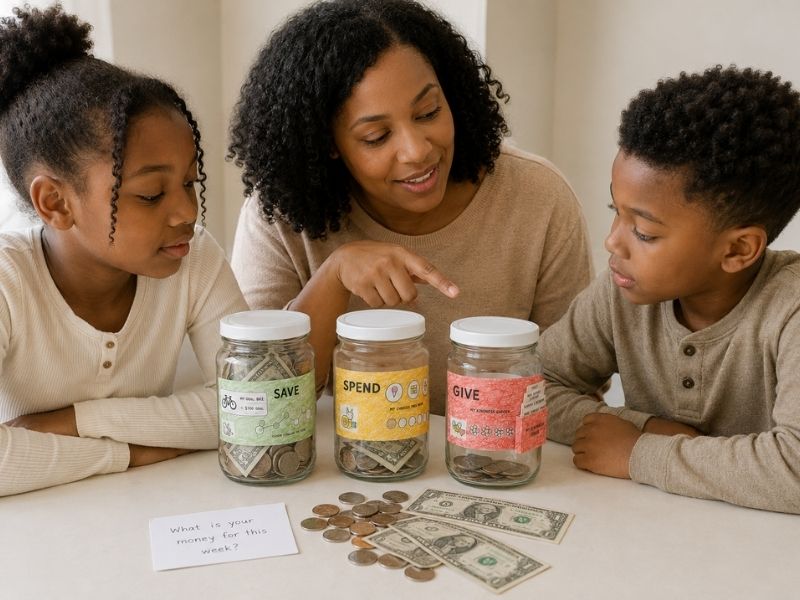
Save spend give jars for kids teach more when the parent talks less. Ask short questions, then give your child enough silence to answer.
Try these:
- “What are you saving for now?”
- “How much more do you need?”
- “Do you want this enough to use your Spend money?”
- “Who would you feel happy helping?”
- “Would buying this move your goal closer or farther away?”
- “What did your last purchase teach you?”
Avoid turning every choice into a speech. A child who feels examined will start saying whatever sounds correct. A child who feels trusted will show you how she is actually thinking.
You can make jar day feel warm instead of formal by pairing it with a small family ritual hot chocolate, music, or ten minutes of crafting.
A mother-daughter craft afternoon can create exactly that kind of unhurried conversation.
How to Adjust the System by Age
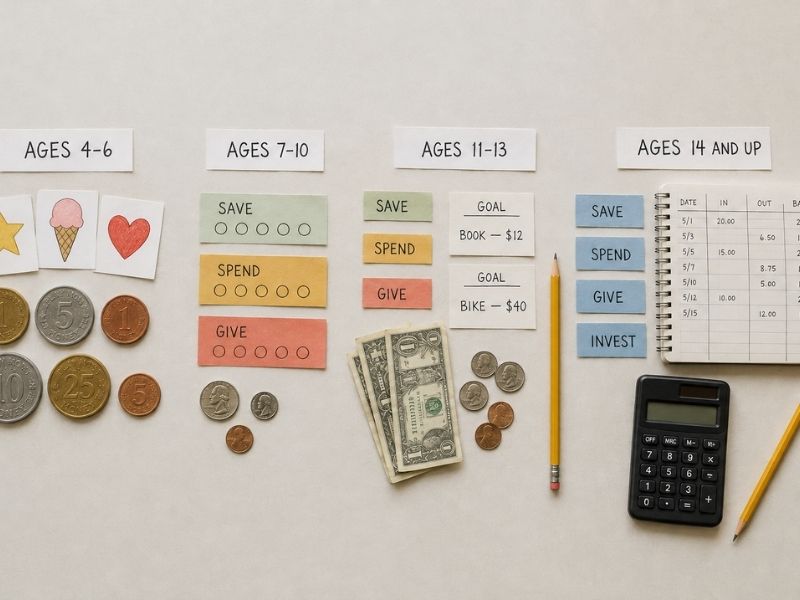
The labels stay the same, but the freedom should grow. Save spend give jars for kids are supposed to mature with the child, not freeze her at age six.
Ages 4–6: Sort and Name
Keep the amounts small, use pictures, and count aloud. One simple sentence per jar is enough: “Spend is for now. Save is for later. Give is for helping.”
At this stage, repetition is the win. Do not expect long-term planning from a child who still thinks next Friday is approximately one hundred years away.
Ages 7–10: Set Goals and Compare Choices
Add a written target and a progress tracker. Let your child bring Spend money on an outing and compare two possible purchases within the amount she has.
This age is wonderful for connecting money to meaning. Bible-story activities such as David and Goliath crafts that teach courage or Noah’s Ark crafts for Sunday school can also open gentle conversations about stewardship, patience, and caring for others.
For a conversation about choices, forgiveness, and using what we have well, these Joseph and his coat of many colors crafts give you an easy, child-friendly starting point.
Ages 11–13: Add Records and Real Prices
Keep the physical jars if they still enjoy them, but add a notebook or simple spreadsheet. Ask them to record deposits, withdrawals, goal price, and remaining amount.
Now include sales tax, shipping, and comparison shopping. The sticker price is not always the final price, and discovering that before checkout is a useful little shock.
Ages 14 and Up: Move From Jars to Accounts
The three categories can become savings pots in a youth account, while the principles stay intact. Involve your teenager in checking balances, reviewing purchases, and planning for longer goals.
Do not remove all supervision overnight. The goal is a gradual handoff—from visible jars, to written records, to responsible digital money.
Seven Mistakes That Make the Jar System Fizzle Out
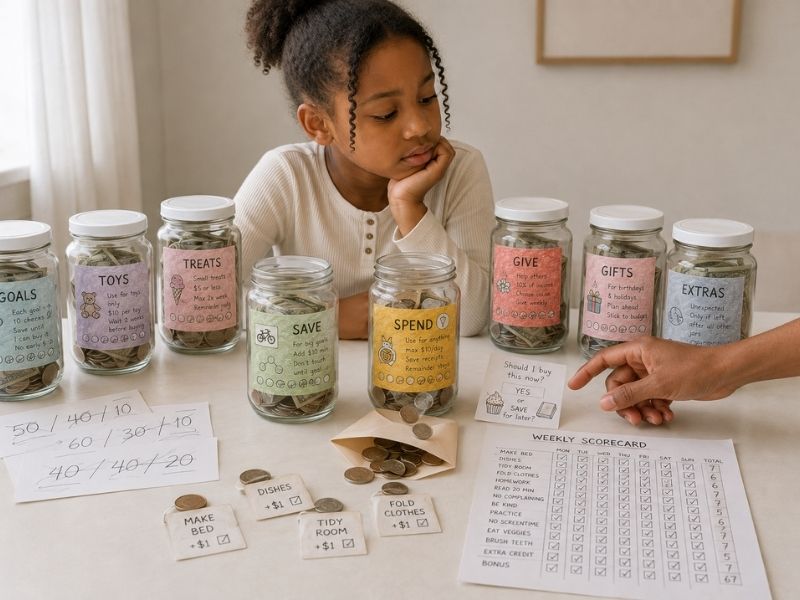
Most abandoned jar systems did not fail because the child was “bad with money.” They became confusing, invisible, or controlled so tightly that the child stopped caring.
1. Starting With Too Many Rules
If the first jar day includes a fifteen-minute policy briefing, everyone will avoid the second one. Start with three labels and one split.
You can add detail after the habit exists.
2. Choosing a Savings Goal That Takes Forever
A $300 goal funded by a $2 weekly allowance is not motivating. Help your child choose an early win she can reach within a month or two.
Then celebrate by letting her make the purchase herself. The sound of those saved coins becoming the thing she waited for is the payoff.
3. Refilling the Spend Jar After Regret
Rescuing a child from every disappointing purchase erases the lesson. Offer empathy, not reimbursement.
“I know. That did not last as long as you hoped” is enough. Kindness and consequences can sit at the same table.
4. Forcing the Give Choice
Parents may set a family expectation that a portion goes into Give, but the child should have a real voice in where it goes. A cause she understands will mean more than a donation chosen entirely by an adult.
Generosity grows through connection, not guilt.
5. Borrowing From the Jars
Do not grab $5 from Save because the delivery driver is at the door. Even if you plan to replace it, the container stops feeling secure.
The jars are small, but your respect for them tells your child whether her goals count.
6. Changing the Split Every Week
One week of 50/40/10 followed by equal thirds and then “save everything this month” creates noise. Choose a split and keep it for at least four weeks before reviewing it together.
A routine needs enough repetition to become recognizable.
7. Treating the System Like a Morality Scorecard
A child who loves spending is not selfish. A child who loves saving is not automatically responsible. Both can learn balance.
Notice choices without attaching identity: “You used all your Spend money today” is better than “You are such a spender.” Money habits can change; labels tend to stick.
A Four-Week Plan to Start Without Overthinking It
You can start save spend give jars for kids this weekend and let the system grow one small step at a time.
Week 1: Make and Fill
Decorate the jars, agree on the split, and divide the first amount. Help your child choose one reachable savings goal.
Then stop. A clean beginning is better than a crowded one.
Week 2: Count and Notice
Add the next money, count each jar, and ask what your child notices. Do not suggest a purchase or a charity yet unless she asks.
The jars should begin to feel like hers. Curiosity does more work than pressure.
Week 3: Make One Spend Decision
Let your child take a set amount from Spend during a normal outing. If she chooses not to buy anything, that is also a decision.
No nudging. No “Are you sure?” repeated six times. The choice needs enough room to belong to her.
Week 4: Choose One Give Action
Talk about a person, animal, classroom, church, or community need your child recognizes. Use the available amount, even if it is only $2, to take one visible action.
She might add it to a family donation, buy a card for someone recovering, or contribute one item to a care basket. DIY get-well gift baskets for elderly friends can help turn a few Give-jar dollars into something personal.
The amount may be small. The meaning does not have to be.
Get the Free Save, Spend and Give Jar Printable
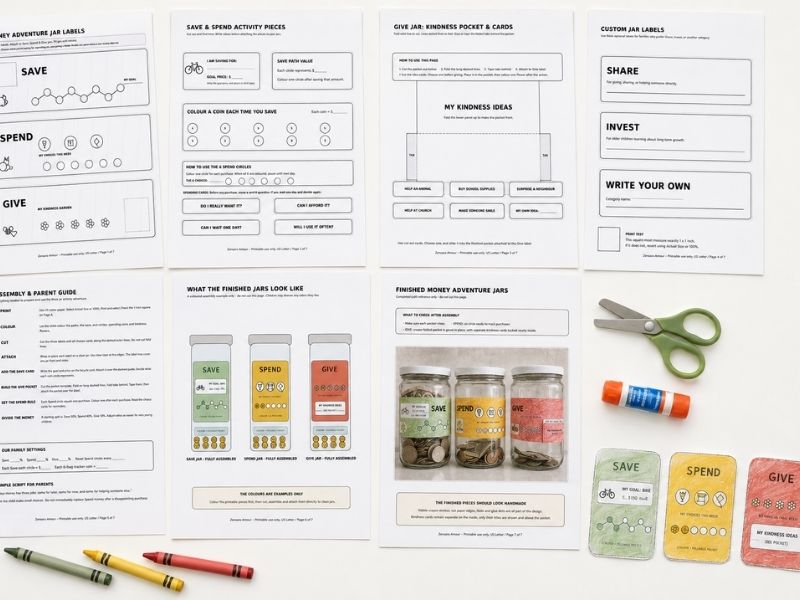
You could draw all three labels from scratch. But honestly? There is no prize for making this harder than it needs to be.
I created a free seven-page save spend give jars for kids printable with everything already laid out. Print it, let your child colour the pieces, cut them out and attach them to three clean jars.
What Is Included
The printable pack includes:
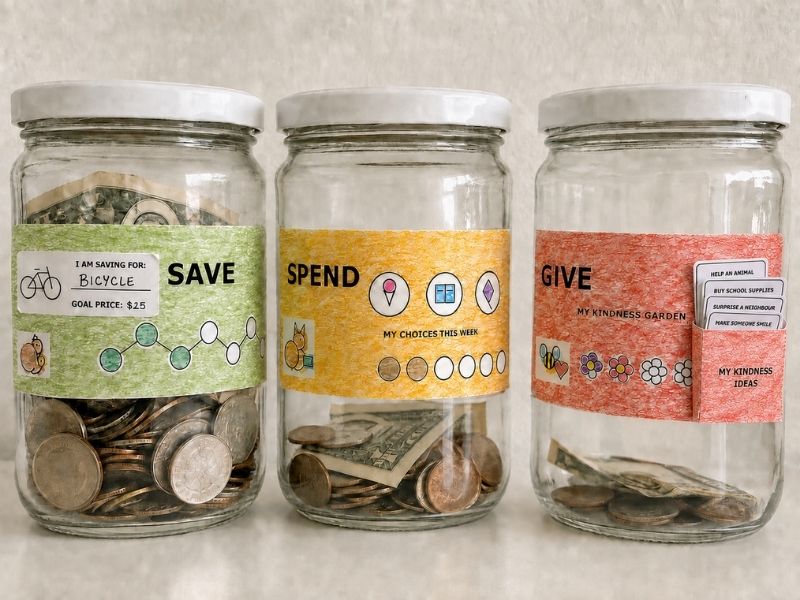
- Three main jar labels: Save, Spend and Give
- A bicycle savings-goal card
- An eight-circle Save path
- A separate ten-coin savings tracker
- Six Spend circles
- Four questions to read before buying something
- A foldable “My Kindness Ideas” pocket
- Six individually cut kindness cards
- Share, Invest and write-your-own labels
- A parent assembly and use guide
- A coloured photograph showing how the completed jars should look
The working pages are black and white on purpose. Your child gets to choose the colours, fill in the savings goal and gradually colour the trackers as money is saved, spent or given.
Download the Free Money Adventure Jar Printable
How to Print and Assemble It
Print the PDF on US Letter paper using Actual Size or 100% scale. Do not select “Fit to Page,” because that may change the size of the labels and pocket.
Colour the pieces before cutting them. Next, cut along the dotted outer lines and keep the dashed fold lines intact. Wrap the three main labels around clean jars with clear tape.
Write the chosen goal and price on the bicycle card, then glue it over the box on the Save label. For the Give jar, cut and fold the kindness pocket, glue its tabs behind it and attach it over the pocket box. Cut every kindness idea into a separate removable card and tuck the cards mostly inside the finished pocket.
Page seven shows the completed craft. Keep that page nearby while assembling everything. Once the jars are ready, add the first small amount of money and let your child make the first three-way decision.
The Part Parents Wish They Had Started Sooner
The magic is not that save spend give jars for kids create tiny financial experts. They do something quieter and more useful: they give children years to practice before the choices become expensive.
Your child gets to want something, wait, change her mind, overspend, recover, give, and try again. All while the stakes are a handful of dollars and a shelf in the kitchen.
Start with whatever amount fits your family. Use recycled containers if that is what you have. Let the labels lean a little crooked.
Then keep showing up on jar day. Because the jars are not really the system.
The repeated conversation is.
Pin this for your next family craft afternoon, then choose the three containers before another birthday envelope disappears into a drawer.
Frequently Asked Questions About Save Spend Give Jars for Kids
What age should children start using save spend give jars?
Many children can begin around ages four to six, once they can sort objects and understand “now” versus “later.” Keep the money small and the labels visual.
What is the best percentage for save spend give jars for kids?
A simple starting split is 50% Save, 40% Spend, and 10% Give. Equal thirds also work well for younger children because the math is easy to see and do.
Should allowance be tied to chores?
It can be, but families handle this differently. Keep some household tasks as normal family contributions, then consider paying for extra jobs that go beyond the child’s usual responsibilities.
What if my child spends all the Spend money immediately?
Let the jar stay empty until the next scheduled money arrives. Offer empathy and ask what she might do differently, but do not refill it to erase the consequence.
Can we use envelopes instead of jars?
Yes, especially for older children or families with limited space. Still, clear jars are powerful for beginners because the child can watch each category grow.
What can children use the Give jar for?
They can support a charity, buy supplies for someone, contribute to church, help an animal shelter, or make a thoughtful gift. The best choice is one your child can understand and feel connected to.
When should the money move from jars to a bank account?
Move larger savings to a secure account once cash builds up or when your child is ready for digital tracking. Keep the three-category language so the familiar habit continues even after the containers are gone.