This post contains affiliate links. This means I may earn a small commission if you purchase through my links at no extra cost to you.
Nobody needs a Christmas cookie table that feels like an icing exam. Christmas cookie decorating for seniors should feel warm, social, familiar, and easy enough that nobody spends the afternoon apologizing for shaky lines.
The goal is to make something festive together, not to produce 30 bakery-perfect snowflakes.
The best designs use broad shapes, soft toppings, easy-squeeze icing, and decorating motions that still feel satisfying when grip strength or eyesight has changed.
More importantly, they give people a reason to talk. One red-and-green cookie can bring back a childhood kitchen, a mother’s apron, or the Christmas someone accidentally used salt instead of sugar.
These 15 ideas are designed for senior living communities, nursing homes, church groups, adult day programs, family gatherings, and quiet afternoons at home.
Every cookie can be decorated while seated, every design has an easier variation, and none requires professional piping skills.
If you are building a full seasonal activity calendar, pair this edible activity with the gentler projects in these November crafts for seniors in assisted living.
Cookie decorating deserves its own day. Nobody needs wet glue and buttercream sharing a table.
Why Cookie Decorating Works So Well for Senior Groups
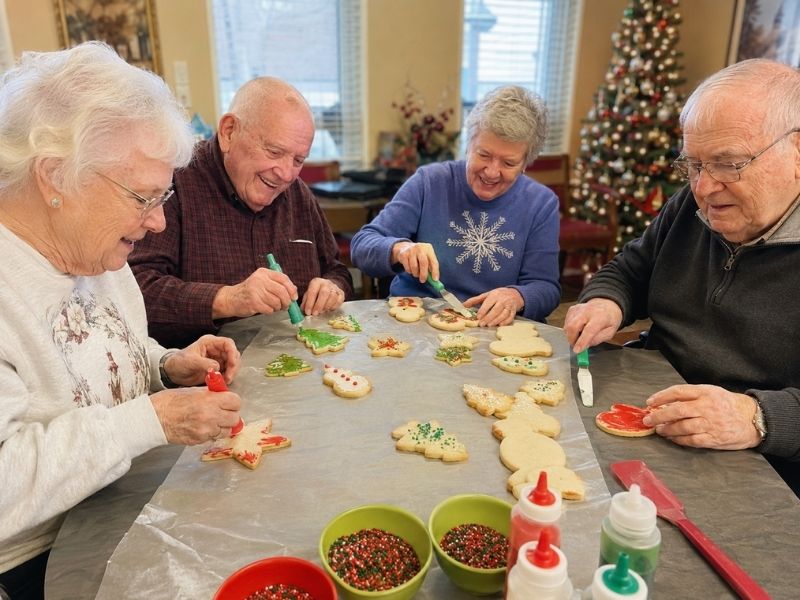
Cookies give everyone a clear starting point. The base is already there. There is no blank canvas large enough to feel intimidating and no complicated project that takes three sessions to finish.
The activity also invites choice without demanding too much of it. A person can choose red or green icing, stars or sprinkles, one cookie or three. Small choices help people participate without making the table feel like a test.
Then there is the smell. Vanilla, ginger, cinnamon, chocolate, and peppermint can pull old Christmas memories into the room before anyone asks a single question.
That sensory element makes christmas cookie decorating for seniors especially useful when open-ended conversation prompts usually fall flat.
This is the same reason tactile activities work so well in these crafts for seniors with low vision: the experience is not dependent on perfect sight or perfect words.
How to Set Up Christmas Cookie Decorating for Seniors
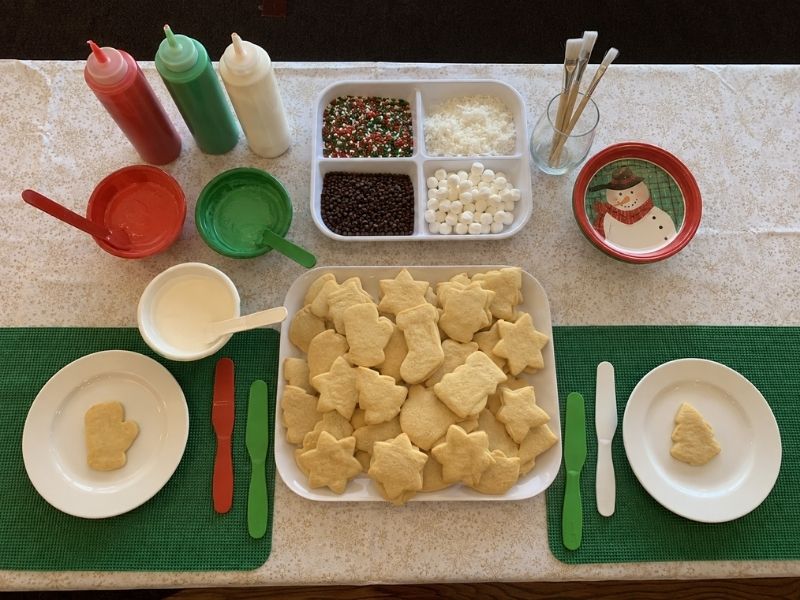
Keep the group activity focused on decorating. Baking adds hot trays, timing, standing, and cleanup when the part people actually came for is sitting around the table together.
Choose cookies that are:
- soft enough to bite comfortably
- firm enough to hold icing
- at least three inches wide
- flat rather than heavily domed
- fully cooled before decorating
Plain sugar cookies, soft gingerbread, shortbread, and chocolate cookies all work. Prepare two shapes per person plus a few extras for breakage, appetite, or the resident who suddenly becomes very invested in making a fifth snowman.
For christmas cookie decorating for seniors, size matters more than an elaborate cookie-cutter shape.
A broad circle is easier to hold, easier to see, and far more pleasant to decorate than a tiny detailed angel.
For general group preparation and cleanup, this craft-night hosting guide has a station system that adapts easily to an edible activity.
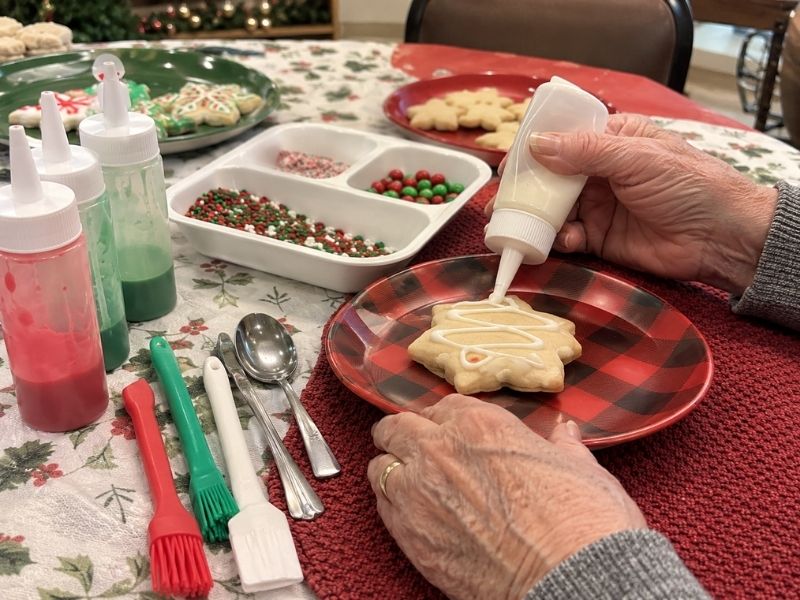
Use easy-squeeze icing rather than narrow piping bags
Traditional piping bags require continuous hand pressure. That can become uncomfortable quickly for someone with arthritis, tremors, weakness, or hand pain.
Transfer soft icing into small squeeze bottles with medium-width openings. Another option is to place icing in shallow bowls and provide teaspoons, silicone spreaders, and short-handled pastry brushes.
A set of wide-tip squeeze bottles for cookie icing is worth buying for a large group because the bottles can be filled ahead of time and shared between two people.
Check that the bottles are food-safe and easy to wash.
Arrange toppings in shallow, stable containers
Deep bowls hide the toppings and require people to reach. Use muffin tins, divided trays, or low ramekins instead.
Put only four or five options on each table:
- soft sprinkles or sanding sugar
- mini chocolate chips
- shredded coconut
- crushed soft peppermint candy, where appropriate
- small pieces of soft marshmallow
- colored icing in squeeze bottles
Avoid hard dragees, large jawbreakers, and very small candies when they do not suit the eating needs of the group.
If a resident follows a texture-modified diet, allergy plan, diabetes meal plan, or swallowing recommendation, check with the appropriate staff member before serving any cookie or topping.
The easiest christmas cookie decorating for seniors setup gives residents enough choice to feel creative without making them search through 20 nearly identical sprinkle containers.
The accessibility approach used in these paper crafts requiring little grip strength works here too: larger materials, fewer choices, and preparation before participants sit down.
Make food safety visible without making the afternoon clinical
Wash hands before decorating, clean the tables, use separate utensils for different toppings, and do not let anyone lick a spoon and return it to a shared bowl.
The USDA’s four food-safety steps provide a simple planning framework: clean, separate, cook, and chill.
Keep ingredient labels from every cookie, icing, and topping.
The FDA’s food-allergen guidance is especially important when products may contain milk, eggs, wheat, peanuts, tree nuts, soy, sesame, or cross-contact warnings.
A pretty cookie is never worth guessing about an allergy.
15 Simple Christmas Cookie Decorating Ideas for Seniors
Each idea begins with a cookie design that looks intentional but uses one or two easy decorating motions.
Put one finished sample at every table, then let residents copy it, simplify it, or ignore it completely.
Good Christmas cookie decorating for seniors leaves room for personal decisions. The sample is a starting point, not a picture everyone must reproduce.
1. Sprinkle-Dipped Snowball Cookies

This is the easiest cookie on the list and the one to choose when you want everybody to experience a quick success. Half the cookie is frosted, dipped, and finished. No piping. No tiny details.
What you’ll need: round cookies, white icing, white sanding sugar, pale-blue sprinkles, shallow bowls, and silicone spreaders.
Spread icing over the top half of the cookie. Hold the unfrosted edge, turn the cookie over, and press the icing gently into a shallow bowl of sprinkles. Lift, tap once, and place it on the drying tray.
For someone who cannot hold the cookie steadily, leave it flat and sprinkle the topping from a small spoon. The finished result still looks like snow catching the light.
Among all the christmas cookie decorating for seniors ideas here, this is the best first cookie because it teaches the basic icing-and-dipping method in under two minutes.
2. Easy Candy-Cane Stripe Cookies

Candy-cane stripes look festive even when the lines wander. Honestly, a slightly crooked stripe has more charm than a factory-perfect one anyway.
What you’ll need: rectangular or candy-cane-shaped cookies, white icing, red icing in wide-tip bottles, and crushed peppermint or red sanding sugar.
Cover the cookie with white icing using a spoon or spreader. Add three or four diagonal red lines across the top. Stop there, or sprinkle red sugar over the wet lines for texture.
If squeezing is difficult, prepare red icing in a shallow dish and let participants paint the stripes with a short, wide pastry brush. It produces softer lines and requires much less pressure.
Use the activity to ask one simple memory question: “Did your family hang candy canes on the tree, or did they disappear before that could happen?”
3. Melted Snowman Face Cookies

The snowman is already melting, so nothing needs to be straight. That makes this design wonderfully forgiving for hands that move differently from one moment to the next.
What you’ll need: round cookies, white icing, mini chocolate chips, orange icing, and short pieces of soft licorice or fruit strip.
Spoon a loose circle of white icing onto the cookie, allowing it to spread unevenly. Add two chocolate-chip eyes, dot on an orange nose, and place a soft scarf strip along one edge.
Skip the mouth if the pieces feel too small. Two eyes and one bright nose are enough to make the whole face appear.
For residents living with memory changes, demonstrating one topping at a time works better than presenting the whole cookie as a set of instructions. The same approach appears throughout these gentle crafts for seniors with dementia.
4. Button Christmas Wreath Cookies

This wreath is built from large icing dots rather than delicate leaves. Every dot becomes part of the circle, even when the sizes vary.
What you’ll need: round cookies, green icing in squeeze bottles, red icing or soft red sprinkles, and one small bow-shaped candy if suitable.
Place green dots in a ring around the outer edge of the cookie. Add a few red dots between them as berries, then leave the middle open. A red icing bow at the bottom finishes it.
For limited grip strength, put the icing into a zip-top bag, press it toward one corner, and make a medium opening. The host can support the top of the bag while the resident guides the corner.
The wreath works because repetition does the decorating. One dot. Then another. Then another. Conversation can happen without anyone losing her place.
5. Soft Coconut Snow-Covered Trees
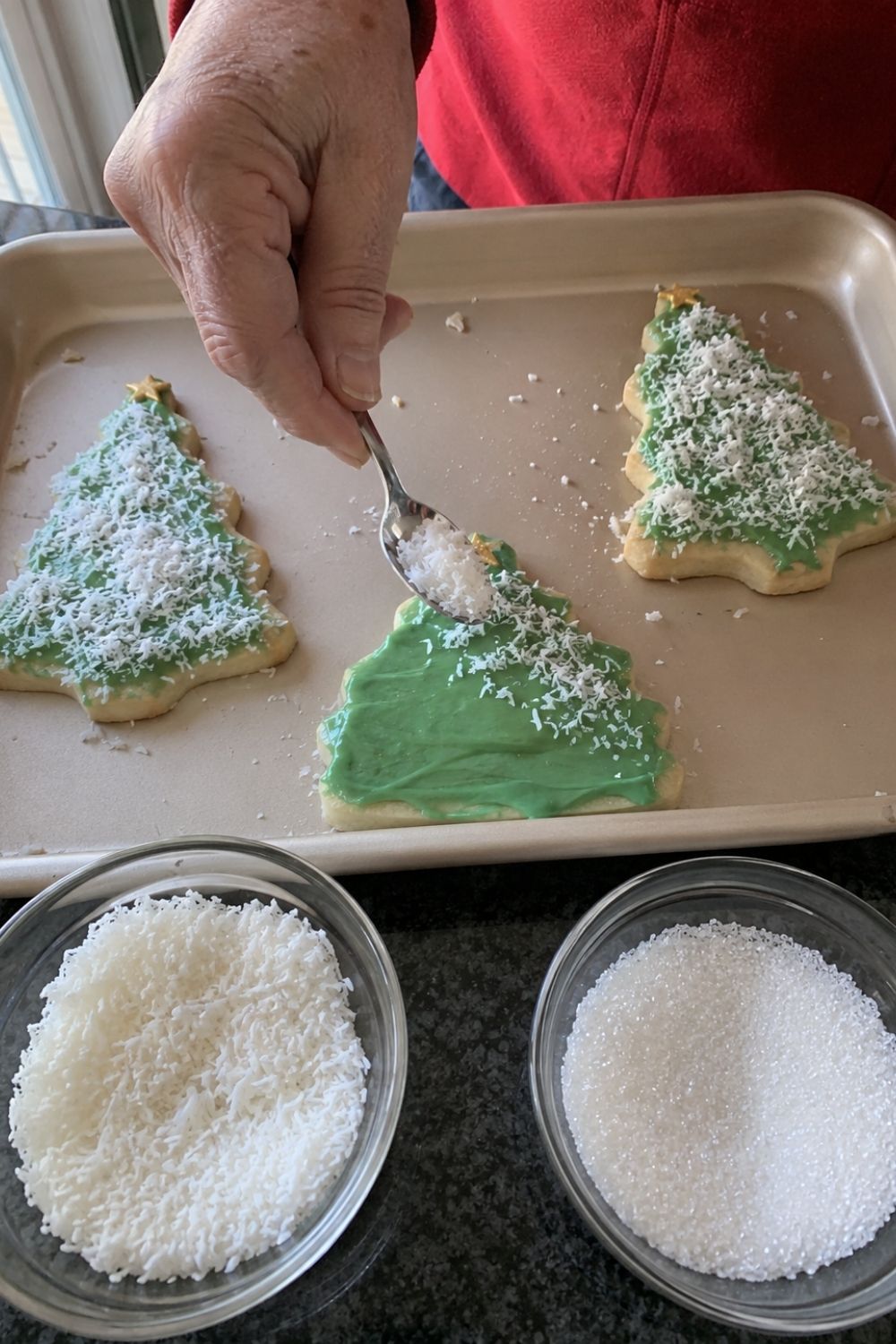
These trees look as though a soft snowfall landed on every branch. Shredded coconut creates the texture, so residents do not need to pipe dozens of tiny lines.
What you’ll need: tree-shaped cookies, green or white icing, finely shredded coconut, star sprinkles, and shallow trays.
Spread the cookie with icing. Place it flat on a tray and spoon coconut over the top, pressing gently with the back of the spoon. Add one star near the top.
Offer a coconut-free table for anyone who dislikes the texture or needs to avoid it. White sanding sugar gives a similar snowy look.
This is a good companion activity for a seasonal display or the Christmas stocking-stuffer ideas for seniors if families want to package a cookie beside a small gift.
6. Christmas Quilt-Patch Cookies
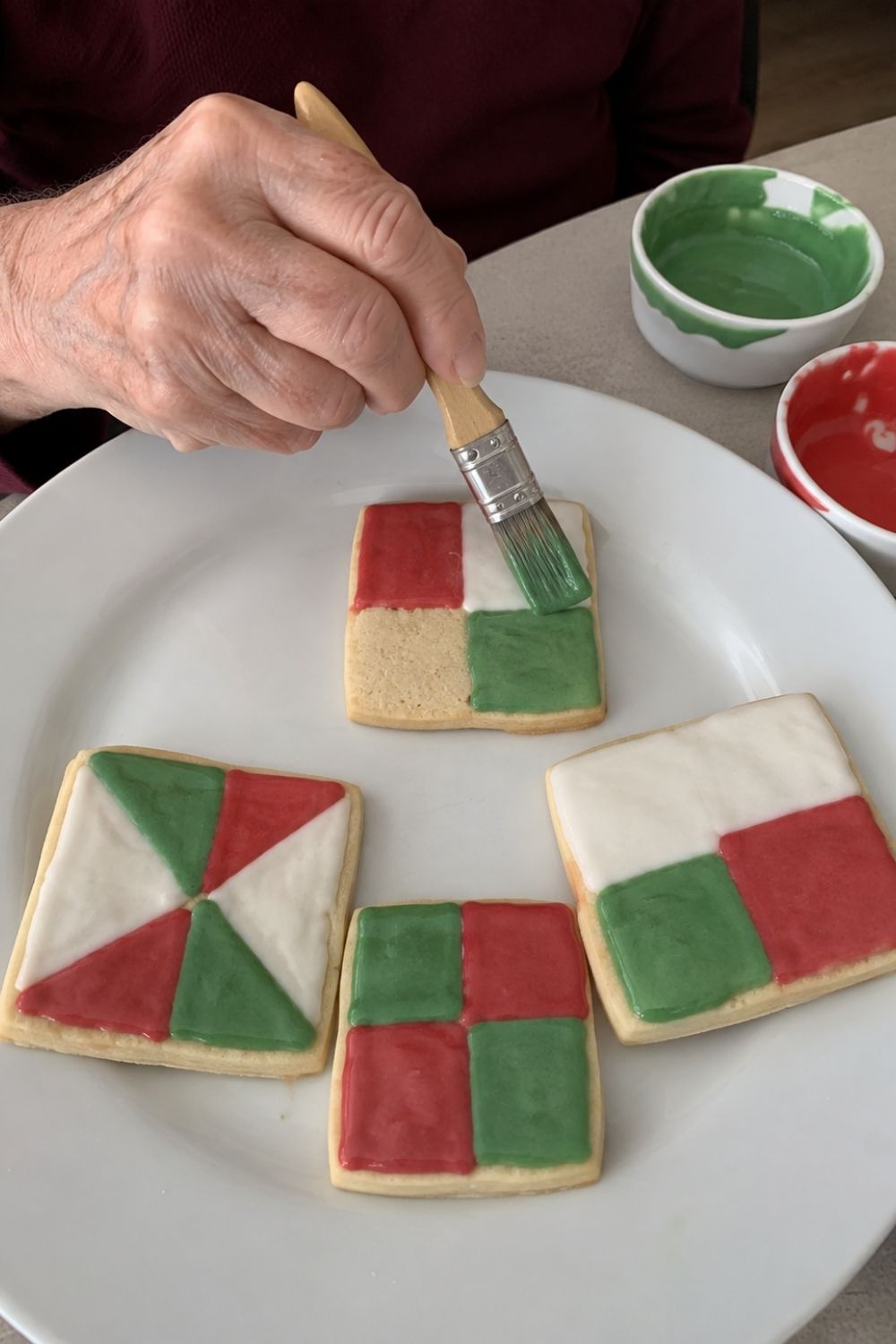
Quilt patterns often bring stories with them. Someone remembers a grandmother’s bedspread. Someone else remembers cutting fabric squares at the kitchen table. Suddenly one cookie has opened the whole room.
What you’ll need: square cookies, white icing, red and green icing, wide food-safe brushes, and sanding sugar.
Divide the cookie into four broad sections with white icing lines. Fill two opposite squares with red and the others with green, or let each person choose her own pattern. Add a small white dot in the center.
Do not ask residents to make identical geometric edges. This is a patchwork cookie, not an entrance exam.
If the conversation becomes richer than the decorating, let it. The memory-first approach in this free memory book activity for seniors works for exactly the same reason: familiar objects give stories somewhere to begin.
7. Vintage Ornament Cookies

Round ornament cookies give residents room to recreate the colors they remember from childhood trees—silver glass baubles, bright red bulbs, or the one fragile ornament nobody was allowed to touch.
What you’ll need: round cookies, colored icing, metallic sanding sugar, large sprinkles, and a small rectangle of wafer or soft candy for the cap.
Cover the cookie in one icing color. Add one broad stripe, a row of dots, or a sprinkle-dipped lower half. Place the small cap at the top while the icing is wet.
Set out photographs of vintage ornaments if the group benefits from visual prompts. Avoid asking, “What did Christmas look like when you were young?” That question is huge. Ask, “Which color ornament did your family use most?” Small questions bring back specific rooms.
8. Church-Window Mosaic Cookies

This design looks detailed, but the method is simply placing several patches of colored icing inside a dark border. No two windows should match.
What you’ll need: rectangular cookies with rounded tops, white base icing, red, blue, green and gold icing, plus chocolate icing in a wide-tip bottle.
Spread a thin white base over the cookie. Add five or six colored icing patches, leaving small spaces between them. Trace a few broad chocolate lines through the gaps to suggest window leading.
Use only three colors for residents who prefer fewer choices. If piping the border is difficult, the host can prepare the chocolate outline before the session and leave all the color decisions to participants.
For groups that enjoy faith-centered seasonal activities, these scripture card-making ideas for seniors offer a separate non-food event without competing with this cookie post.
9. Bethlehem Star Cookies With One Gold Center

This cookie is simple enough to feel calm. A white star gets one gold center and a few lines radiating outward. That is it.
What you’ll need: star-shaped cookies, white icing, gold sanding sugar, edible gold stars, and wide food-safe brushes.
Brush or spread white icing over the star. Add a small circle of gold sugar in the middle, then drag the tip of a spoon lightly from the center toward each point.
The design works beautifully for church groups because it carries meaning without turning the activity into a long lesson. Read Matthew 2:10 if appropriate, then let the decorating continue.
One clear focal point makes this among the most accessible christmas cookie decorating for seniors designs for people who find busy patterns visually confusing.
10. Holly-and-Berry Thumbprint Cookies

No holly-shaped piping tip is required. Two broad green thumbprints and three red dots create the entire design.
What you’ll need: round cookies, green icing on shallow plates, red icing in bottles, food-safe gloves if preferred, and wipes.
Spread a small amount of green icing onto a clean gloved thumb or a rounded silicone stamp. Press twice at an angle to form two leaves. Add three red dots where the leaves meet.
Participants who do not want icing on their hands can use the back of a teaspoon for the leaf shapes. It gives the same soft oval print.
This project is quick enough to use during a shorter activity session. For more ideas designed around different ability levels, see these fall activities for assisted living residents; the seasonal theme differs, but the participation principles remain useful.
11. Partner-Decorated Mitten Cookies

This cookie is deliberately made by two people. One person chooses and spreads the base color. The other adds the cuff and pattern. Then they switch roles on the next cookie.
What you’ll need: mitten-shaped cookies, two or three icing colors, soft sprinkles, coconut or sanding sugar for the cuff, and silicone spreaders.
Cover the mitten in one color. Add a white cuff, then finish with three large dots, one zigzag, or a sprinkle dip. Keep the design broad.
Partner work creates conversation without demanding it. Someone has to ask, “Red or green?” and “Dots or stripes?” Those tiny exchanges are often more natural than an organized sharing circle.
This is the edible version of the pairing method used in these Thanksgiving gratitude crafts that help residents share.
12. Soft Marshmallow Polar Bear Cookies

The polar bear face uses pieces large enough to pick up easily. It is cheerful without looking like a children’s classroom project.
What you’ll need: round cookies, white icing, one large soft marshmallow cut in half, mini chocolate chips, and chocolate icing.
Cover the cookie with white icing. Place the marshmallow half near the center as the muzzle, add two chocolate-chip eyes, and dot a chocolate nose onto the marshmallow.
Skip hard candies and firm sugar pearls. If marshmallow texture is not appropriate for a participant, pipe one broad white icing circle for the muzzle instead.
A divided cookie-decorating tray with easy-grip tools helps keep the larger toppings visible and separated. Choose a tray that sits flat rather than one that spins.
13. Chocolate-Dipped Reindeer Faces

This one begins with dipping, so half the decoration happens in a single motion. A red nose and two eyes do the rest.
What you’ll need: round or oval cookies, melted chocolate in shallow bowls, red icing, chocolate chips, and soft pretzel pieces if suitable.
Dip one end of the cookie into chocolate and place it flat. Add two chocolate-chip eyes and one large red icing nose. Soft pretzel pieces can become antlers, but they are optional and may be too firm for some participants.
If dipping feels unsteady, place the cookie on a plate and paint the chocolate over the top third with a pastry brush. The result looks the same once decorated.
For another low-cost activity using familiar everyday materials, these recycled crafts for seniors show how good preparation matters more than expensive supplies.
14. Christmas Stocking Name Cookies

A name turns a cookie into a small gift. These work especially well when residents decorate for one another, visiting family members, staff, or grandchildren.
What you’ll need: stocking-shaped cookies, red icing, white icing, alphabet sprinkles or icing pens, and small food-safe boxes.
Spread red icing over the stocking and add a broad white cuff. Write a first name across the cuff, or let the host prepare name strips on edible wafer paper for residents to place.
Keep names large and short. Initials work when the full word would become cramped.
Let each person decide whether to eat or gift the cookie. Seniors are not automatically the recipients of Christmas generosity; they should also get the pleasure of making something for somebody else.
For thoughtful packaging ideas, use the same dignity-first approach found in these DIY Thanksgiving gift baskets for elderly neighbors.

The final idea turns individual cookies into one group display. Each participant decorates one tree, star, snowball, or mitten, then adds it to a large tray lined with white parchment.
What you’ll need: assorted cookie shapes, icing, soft toppings, a large flat serving board, parchment paper, and small name cards.
Give everyone one cookie and complete it at the same pace: choose the base, add one texture, add one final detail. As cookies are finished, place them together on the board and add the maker’s first name beside each one.
Photograph the complete tray before the cookies are eaten or packaged. The picture becomes a record of the group’s work without asking anyone to create a separate keepsake.
This collaborative finish makes christmas cookie decorating for seniors feel like one shared event instead of 15 people quietly completing separate worksheets.
How to Adapt the Activity for Different Abilities
For arthritis or limited grip strength
Use wide-tip bottles, short silicone spreaders, food-safe brushes, and icing bowls. Fill bottles only halfway so they remain light, and place a damp nonslip mat under every plate.
Those small adjustments turn christmas cookie decorating for seniors from a hand-strength challenge into an activity people can actually enjoy.
The tool-selection principles in these bead crafts for seniors with different hand abilities can help you think about grip, visibility, and reach before the session.
For low vision
Use dark plates under pale cookies and white plates under chocolate cookies. Offer strong color contrast, keep toppings separated, and describe their position like a clock: “The red icing is at two o’clock.”
Avoid transparent bowls. Clear toppings in clear containers disappear on a busy table.
For dementia or memory loss
Show one step at a time. Put only the materials needed for that step on the table and remove empty containers before adding more choices.
Do not correct harmless decorating decisions. A green snowman and a star with six different centers are still completed Christmas cookies.
Successful christmas cookie decorating for seniors is measured by engagement and enjoyment, not by how closely every cookie matches the example.
For residents with dietary or swallowing restrictions
Follow the resident’s established care plan. Do not assume that a soft cookie, marshmallow, coconut, hard sprinkle, or thick icing is safe for everyone.
If eating is not appropriate, a resident may still choose colors, direct a helper, decorate a cookie for someone else, or participate in arranging the final tray. Participation and consumption are not the same thing.
How to Keep the Table Social Without Forcing Conversation
Open questions can feel like work. Use specific choices and memory prompts instead:
- Did your family bake sugar cookies or gingerbread?
- Were Christmas biscuits kept in a tin or left on a plate?
- Which disappeared first: the chocolate cookies or the plain ones?
- Did anybody in your family hide treats until Christmas Day?
- Which color always appeared on your childhood tree?
Ask one question, then keep decorating. Do not move around the table demanding answers.
For more ready-made conversation support, the questions to ask aging parents can help you turn one food memory into a fuller family story later.
Simple Ways to Package the Finished Cookies
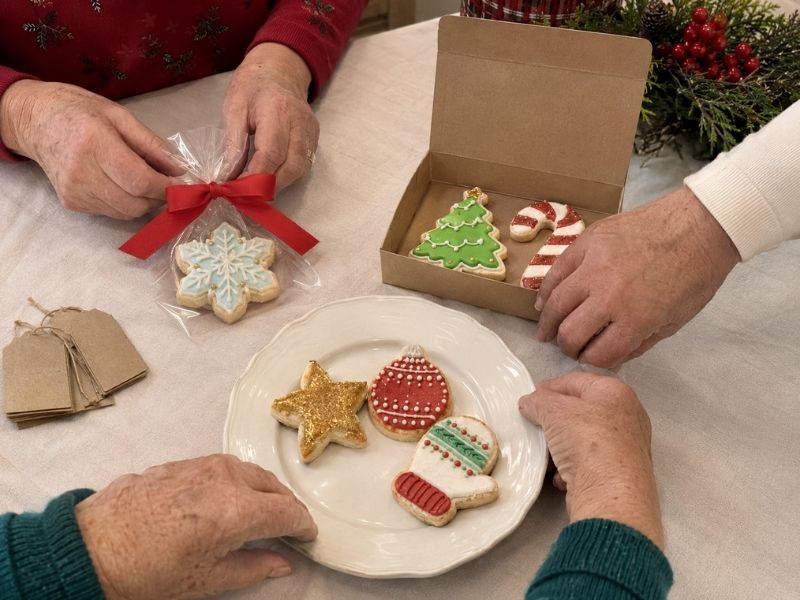
Let the icing set fully before moving anything. Then use one of these options:
- one cookie in a clear food-safe bag with a wide ribbon
- two cookies in a small paper bakery box
- three cookies on a disposable plate covered securely
- one named cookie beside a Christmas card
- a mixed box created by the whole table for staff or visitors
Label allergens and include the decorating date. Do not send a cookie to an unknown recipient without ingredient information.
If families are preparing small seasonal gifts, these meaningful crafts to make for friends offer more presentation ideas without turning one decorated cookie into a large basket of clutter.
FAQs About Christmas Cookie Decorating for Seniors
Large round, square, tree and star cookies are easiest because they provide a broad, stable surface. Sprinkle-dipped snowballs, melted snowmen and holly thumbprints require the fewest detailed movements.
Prepare two cookies per person plus 10 to 15 percent extra. Two allows everyone to try more than one technique without turning the activity into a production line.
What icing is easiest for seniors to use?
Soft icing in wide-tip squeeze bottles or shallow bowls is easier than stiff royal icing in narrow piping bags. Offer spoons, silicone spreaders and short pastry brushes as alternatives.
Plan for 45 to 75 minutes. That includes handwashing, a short demonstration, decorating two cookies, conversation, and packaging.
Offer one cookie and one step at a time, use strong color contrast, and limit the toppings on the table. Demonstrate the motion rather than giving several verbal instructions at once.
Yes, if participation is appropriate for the individual. They can decorate for another person, select toppings, direct a helper, arrange the final tray, or help choose ribbons and labels.
Use rimmed trays, one plate per person, shallow topping containers, wipes at every table, and a separate finished-cookie station. Fill icing bottles only halfway to reduce spills and hand fatigue.
The Cookie Is Not the Most Important Part
A cookie will be eaten, gifted, or wrapped up for later. That is what cookies do.
What stays is the woman who remembered her mother’s biscuit tin. The resident who decorated one green star, decided she liked it, and asked for another. The two tablemates who spent ten minutes debating whether a reindeer really needed antlers.
That is the real value of christmas cookie decorating for seniors. It gives people something easy to make while the better part happens around it.
Choose three or four designs for your table, not all 15. Prepare the icing before anyone arrives. Keep the choices clear, the toppings soft, and the conversation unforced.
Then take the picture before somebody eats the red-nosed reindeer.
Save this post to your senior Christmas activities board and send it to the person planning December’s calendar.