This post contains affiliate links. This means I may earn a small commission if you purchase through my links at no extra cost to you.
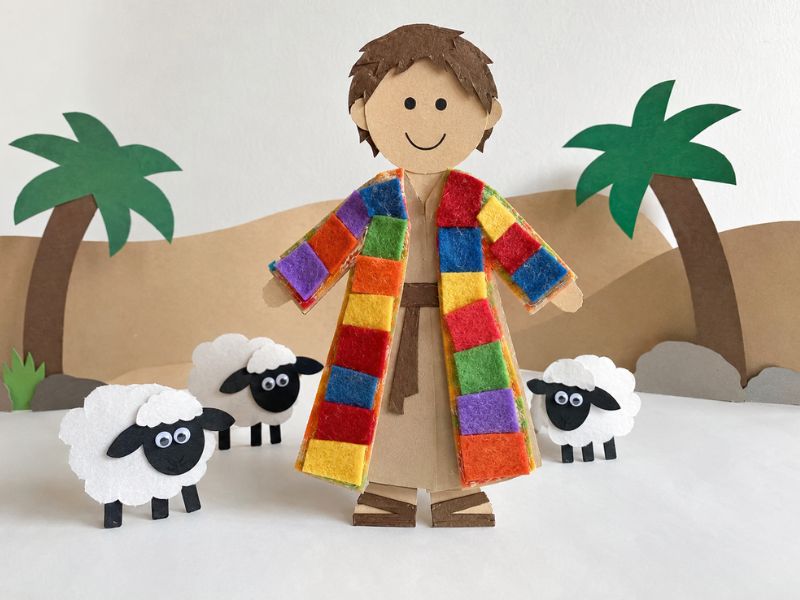
Forgiveness took twenty years to arrive. These joseph and his coat of many colors crafts for kids show why it mattered.
Picture the coat first: not a rainbow of patchwork colors, but something closer to a long, sleeved, floor-length robe, the kind worn by someone who didn’t have to work with their hands.
That’s likely closer to what Jacob actually gave Joseph, and it’s already a problem before anyone even gets jealous. A robe like that told everyone, including ten grown brothers doing physical labor in the fields, exactly where they stood in their father’s eyes.
That’s the part of this story that gets lost the moment “coat of many colors” becomes shorthand for a costume.
The real story isn’t about fabric. It’s about a family that broke apart over favoritism, dreams, and a decision to sell their own brother rather than deal with him honestly, and then, years later, had to face what forgiveness actually costs when the person they wronged holds all the power over them.
Nineteen moments make up that arc, from a father’s favorite to a brother’s confession to a reunion nobody saw coming.
The crafts below follow them in order, so what a kid builds isn’t just a coat.
It’s the whole weight of what it means to be wronged, and what it means to actually forgive the people who did it.
Bring another inspiring Bible story to life with Jonah and the Whale Crafts for Kids That Make the Story Come Alive With Wonder, featuring hands-on projects that teach obedience, God’s mercy, and second chances.
Joseph and His Coat of Many Colors Crafts for Kids
1. The Coat Itself (Ketonet Passim)
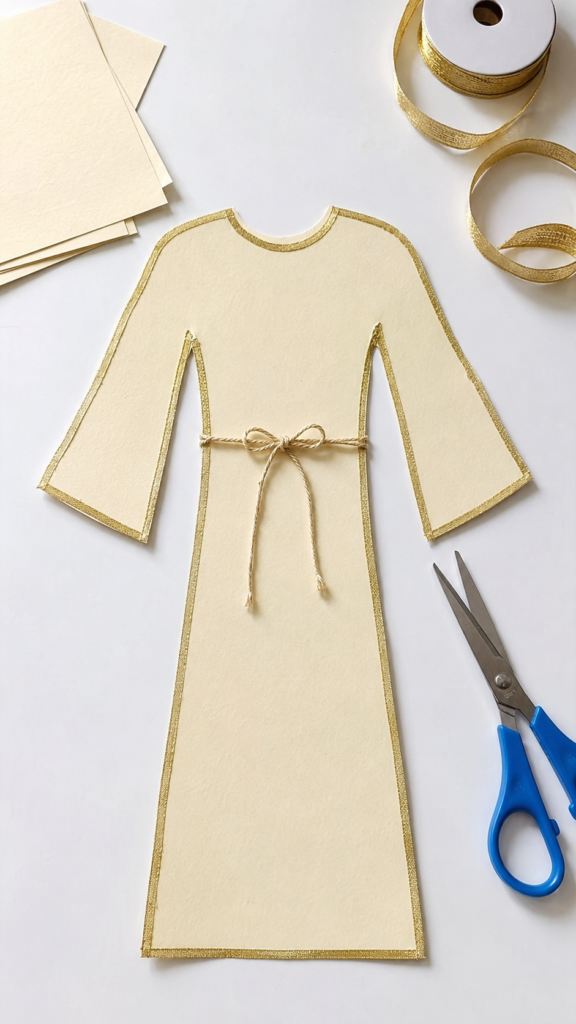
The coat is called a ketonet passim in Genesis, and scholars have gone back and forth on those two words for a long time.
Ketonet just means tunic, a basic garment. Passim is the harder word. It doesn’t mean “colorful”, that translation came later, through the King James Version and centuries of art and children’s books built on top of it.
What passim more likely describes is length and sleeves: a robe that reached the ankles and wrists, rather than the shorter, sleeveless tunic a working man would wear to actually do physical labor.
That distinction matters more than it sounds like it should. A long robe with sleeves wasn’t practical. You couldn’t tend sheep in it, haul water in it, or do the daily work Joseph’s brothers were out doing every day.
So when Jacob put that robe on Joseph specifically, he wasn’t just giving a gift. He was telling everyone, without saying a word, that Joseph didn’t need to work the way the others did.
It was the kind of garment worn by someone being set apart, maybe even being groomed for authority over the rest.
That’s the real weight behind the coat, and it’s worth saying plainly to a kid: this wasn’t a nice present that got jealous brothers upset over nothing.
It was a father publicly announcing a favorite, in a culture where birth order and duty usually decided who mattered most. Joseph was the second-youngest of twelve.
By every normal expectation, he should have been near the bottom of that list. The robe put him at the top instead, in front of everyone.
You’ll need:
- Plain white or cream fabric, or a long strip of cream-colored paper for a paper version
- Fabric markers or crayons
- Scissors
- Yarn or ribbon (for a simple tie or trim)
Steps:
- Cut the fabric or paper into a long, simple robe shape, ankle-length, with long sleeves, no decoration yet.
- Before adding any color, ask the kid what they notice: it’s plain, not rainbow-colored, just long and covering the hands and feet.
- Talk through what that length and those sleeves would have meant, a robe built for someone who wasn’t expected to do physical work.
- Let them add a simple trim or border along the edges, kept minimal, to represent status rather than decoration for decoration’s sake.
- Tie it closed with the yarn or ribbon, and ask: if you were one of Joseph’s brothers, working outside every day, and you saw this robe on your younger brother, what would you feel watching him wear it?
Reinforce the importance of faith through He Prayed Anyway — Daniel and the Lions Den Crafts for Kids Who Need to Know Courage Is Real, where creative activities make this Bible story unforgettable
2. A Father’s Favorite
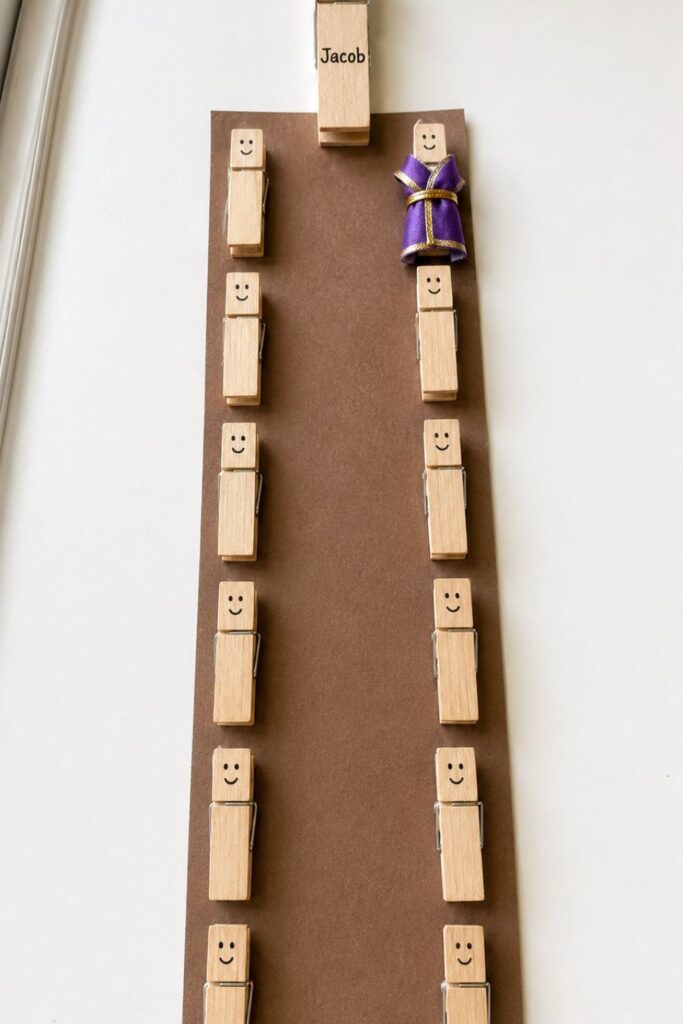
Jacob’s favoritism didn’t start with the robe. The robe was just the moment it became visible to everyone else.
Genesis is direct about the reason behind it: Joseph was the son of Jacob’s old age, born late in his father’s life, and he was also the son of Rachel, the wife Jacob had loved most and had worked years to marry.
Of the twelve sons, Joseph carried both of those things at once, and Jacob didn’t hide which son that made him prefer.
That kind of favoritism rarely stays contained to one gesture. It shows up in smaller ways first: who gets asked along, who gets listened to, whose opinion carries weight at the table.
By the time the robe appears in the story, it isn’t introducing favoritism into the family. It’s confirming what the brothers had likely felt for years, finally made impossible to overlook or explain away.
It’s worth being honest with a kid about this part, even though it isn’t flattering to Jacob. He was a father who loved deeply, but not equally, and that imbalance did real damage long before anyone sold anyone into slavery.
Forgiveness, later in the story, doesn’t just have to cover what the brothers did. It has to reckon with what started the whole thing in the first place.
You’ll need:
- A long strip of paper or cardstock (for the table)
- 12 small figures, clothespins, or paper cutouts (to represent Jacob’s sons)
- One small piece of fabric or colored paper (to mark Joseph)
- Glue or tape
Steps:
- Lay out the strip of paper as a long table and set up all 12 figures along it, spaced evenly.
- Leave 11 figures plain, and dress or mark only the Joseph figure with the small piece of fabric or color, setting him apart from the rest.
- Have the kid place the Joseph figure closest to where “Jacob” would sit, while the other 11 are spread further down the table.
- Talk through what it would feel like to be one of the brothers seated at the far end, watching one brother consistently placed closest to their father.
- Ask the kid: was Jacob wrong to love Joseph, or wrong in how openly he showed it over the other eleven? Let them sit with the difference between the two.
Continue exploring Bible stories with 15 Noah’s Ark Crafts for Kids Your Sunday School Class Will Actually Be Excited to Make, filled with engaging projects children will remember.
3. The Sheaves Dream
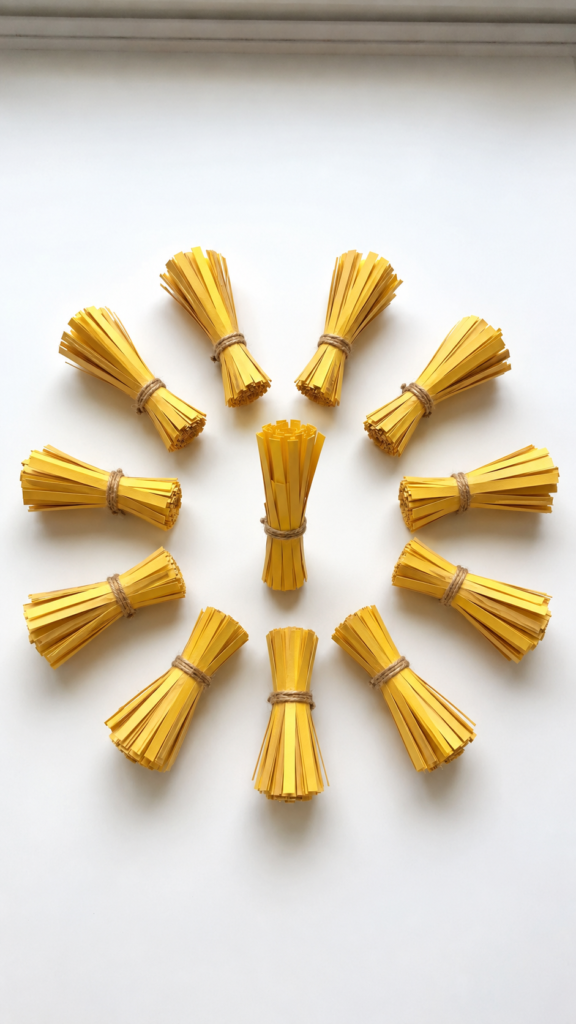
Joseph had two dreams, and he made the mistake of telling both of them to the people they were about.
The first came while the brothers were out binding sheaves of grain in the field. In the dream, Joseph’s sheaf stood upright, and one by one, his brothers’ sheaves gathered around it and bowed down.
It wasn’t a subtle image. Sheaves don’t bow on their own; the dream was plainly about the brothers themselves, bending to Joseph’s authority.
And Joseph, seventeen years old at the time, told them the dream in plain language, without softening it or waiting to see if it needed saying at all.
Genesis says his brothers hated him even more for it, and asked him outright: “Do you intend to reign over us?” It wasn’t a question. It was an accusation.
What makes this beat worth slowing down on with a kid isn’t just the dream itself, but Joseph’s part in it. He wasn’t only the favored son anymore.
He was a teenager who repeated a vision of his own future authority to the very people it put beneath him, without seeming to consider how that would land.
Favoritism from Jacob was one thing the brothers had to absorb. This was Joseph adding to it himself.
You’ll need:
- Dried wheat, straw, or yellow construction paper cut into thin strips (to represent sheaves)
- Twine or string
- 12 small paper or fabric bundles, one set slightly taller than the rest
Steps:
- Bundle the straw or paper strips into 12 small sheaves, tying each with twine.
- Set one sheaf upright in the center, and arrange the other 11 around it.
- Have the kid tip the 11 outer sheaves so they lean toward the center one, like they’re bowing.
- Ask them to imagine hearing this dream described to them if they were one of the brothers, and what they’d think Joseph meant by telling it.
- Talk through the difference between having a dream and choosing to announce it to the people it’s about.
Inspire bravery with 15 David and Goliath Bible Crafts for Kids That Teach Courage and Faith, using creative activities to reinforce one of the Bible’s best-known lessons.
4. The Sun, Moon, and Eleven Stars

If the first dream left any room for doubt, the second one didn’t. This time, Joseph dreamed of the sun, the moon, and eleven stars all bowing down to him.
The symbolism wasn’t subtle to anyone listening. Eleven stars meant eleven brothers. The sun and moon meant his father and mother.
Joseph told this one to his brothers and his father together, and this time even Jacob, who had shown Joseph favor at every turn, pushed back.
He asked Joseph directly whether he expected his whole family, mother included, to bow down before him. It’s a small but telling detail: the one dream Jacob had let slide without much comment was the sheaves.
This one, aimed at himself and not just the brothers, he rebuked on the spot.
Genesis notes that the brothers were jealous, but that Jacob kept the matter in mind, turning it over rather than dismissing it outright.
That’s worth pointing out to a kid: even a father who played favorites recognized when something had gone too far. The dream wasn’t rejected because it upset people.
It was rebuked because a father, in that moment, drew a line his son had crossed.
You’ll need:
- Black or dark blue construction paper (for the night sky)
- Yellow paper or a yellow circle sticker (for the sun)
- White or gray paper (for the moon)
- 11 small star stickers or star cutouts
Steps:
- Cut out or attach the sun, moon, and 11 stars onto the dark background, arranged loosely across the sky.
- Have the kid tilt or lower each shape toward one corner, as if everything in the sky is bowing toward a single point.
- Ask them who each shape stands for: the sun and moon as parents, the stars as the eleven brothers.
- Talk through why this dream, unlike the first, got a direct rebuke from Jacob, and what that tells them about a parent noticing when something’s gone too far.
- Ask the kid: why might Joseph have shared a dream like this out loud, instead of keeping it to himself?
Make science fun with 12 Skeleton Crafts That Teach Body Parts While Kids Craft, where creative activities help children learn about the human body through play.
5. Brothers Who Couldn’t Speak a Kind Word
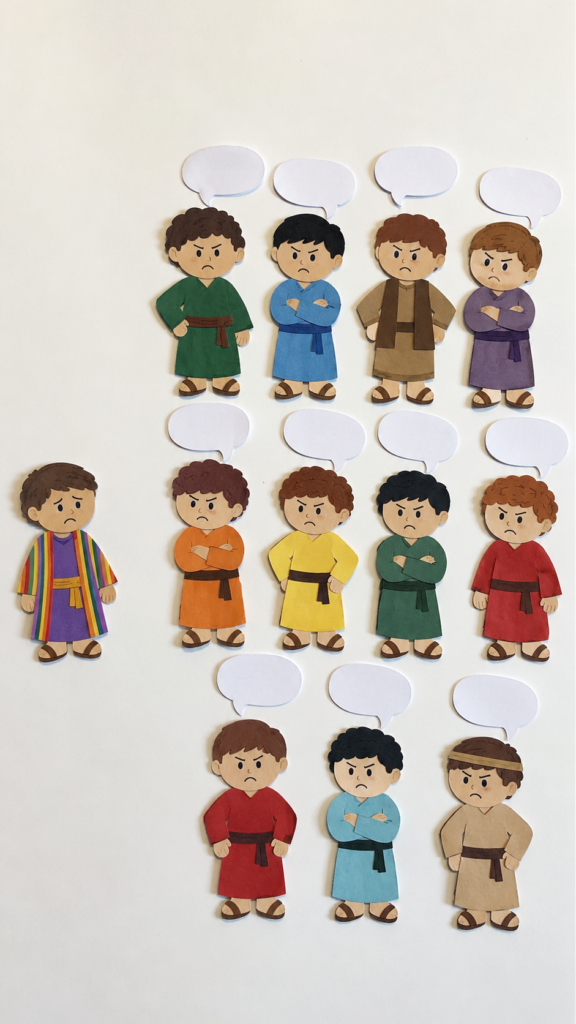
By this point in the story, resentment had stopped being something the brothers carried quietly.
Genesis says plainly that they couldn’t speak a kind word to Joseph, not occasionally, not when they were in a bad mood, but consistently, as a settled fact about how they related to him.
That’s a specific and heavy detail, worth not skimming past. This wasn’t sibling rivalry that flared up and passed.
It was resentment that had fully hardened, built from years of visible favoritism, a robe that announced it publicly, and two dreams that suggested Joseph expected to rule over all of them one day.
Whatever affection had once existed between these brothers had been worn down to almost nothing.
This is the point in the story worth naming honestly with a kid: hatred like this doesn’t usually appear out of nowhere. It builds, slowly, out of things that go unaddressed for too long.
Jacob’s favoritism, left unchecked for years, had grown into something his sons could no longer contain, and it was about to turn into action.
You’ll need:
- 11 small paper figures or cutouts (for the brothers)
- 1 separate figure (for Joseph)
- Small speech bubble cutouts, left blank
Steps:
- Arrange the 11 brother figures in a loose group, with Joseph standing apart from them.
- Hand the kid the blank speech bubbles and ask them to leave them empty, taping one near each brother figure.
- Talk through what it means that the brothers, in the story, had nothing kind left to say, not even one word among eleven of them.
- Ask the kid what they think changed for the brothers between feeling jealous and feeling nothing but resentment.
- Set this scene aside without resolving it, and tell the kid the next part of the story is where that resentment turns into a decision.
Celebrate fall with 10 Corn Husk Crafts for Kids Without a Trip to Michaels, using simple natural materials to create beautiful seasonal decorations.
6. Reuben’s Quiet Plan
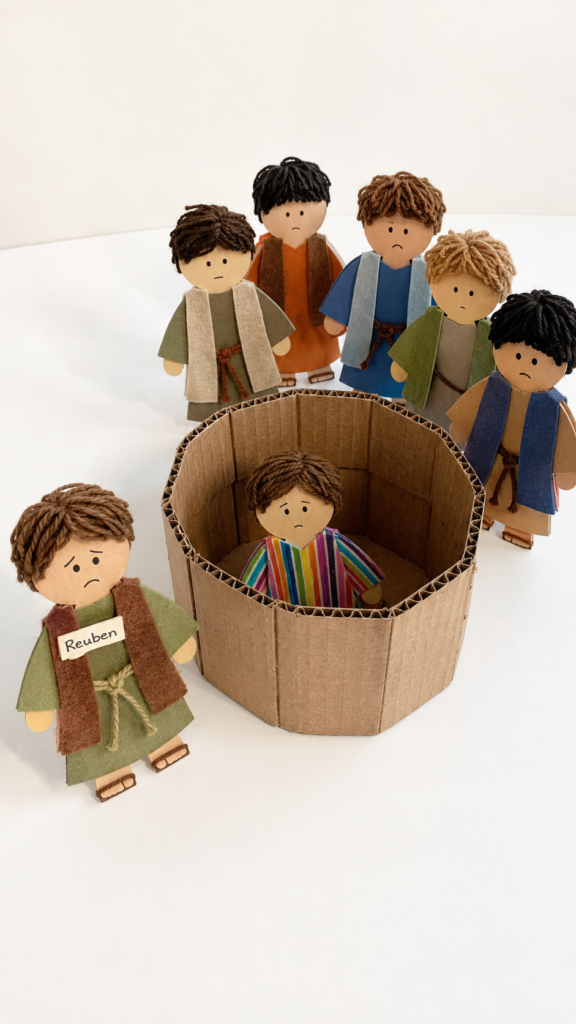
By the time the brothers saw Joseph coming out to check on them in the fields, the plan wasn’t jealousy anymore. It was murder.
Genesis says they saw him from a distance and started plotting to kill him before he even arrived, calling him “this dreamer” among themselves, mocking the very dreams that had made them hate him.
Reuben, the oldest, did something the others didn’t expect.
He didn’t argue that killing Joseph was wrong outright, at least not out loud. Instead, he suggested throwing him into a pit instead, planning quietly to come back later and pull Joseph out to return him to Jacob.
Genesis is direct about his motive: he wanted to rescue Joseph, not just delay the inevitable.
It’s a detail worth including in any joseph and his coat of many colors crafts for kids collection, because it complicates the story in a good way. Not every brother wanted Joseph dead.
Reuben’s plan was quiet, imperfect, and it ultimately failed, since he wasn’t there when the others acted. But it shows that even inside a family capable of this much cruelty, someone was still trying to do less harm than the rest.
You’ll need:
- A shoebox or small bowl (for the pit)
- A small figure to represent Joseph
- 11 figures for the brothers
- A small separate marker or sticky note for Reuben
Steps:
- Set the shoebox or bowl in the center as the pit, and place the Joseph figure inside it.
- Arrange the 11 brother figures around the pit, with Reuben marked separately from the group.
- Have the kid move the Reuben figure slightly apart, whispering (literally, if they want) his plan to come back later.
- Ask the kid what it means that Reuben didn’t openly refuse the others, but tried to work around them instead.
- Talk through whether a quiet effort to do less harm still counts as doing the right thing, even when it doesn’t fully succeed.
Welcome apple season with 20 Apple Crafts Kids Will Beg to Repeat, packed with easy, colorful projects for home, school, or homeschool.
7. Sold for Twenty Pieces of Silver

While Reuben was away, a caravan of traders passed by, heading to Egypt. Judah, another brother, suggested selling Joseph instead of leaving him to die in the pit.
His reasoning wasn’t kindness. It was practical: what profit was there in killing their own brother and covering it up, when they could sell him and be rid of him just the same?
The brothers pulled Joseph out of the pit and sold him to the traders for twenty pieces of silver.
When Reuben returned and found the pit empty, Genesis says he tore his clothes in grief, having missed his chance to pull Joseph out himself. Joseph, meanwhile, was gone, sold into slavery, on his way to a country he’d never asked to see.
This is a hard beat to sit with, but it belongs in the story without softening. Joseph didn’t get kidnapped by a stranger. He was sold by his own brothers, for a price, while at least one of them tried and failed to stop it.
Any honest set of joseph and his coat of many colors crafts for kids has to include this moment plainly, because everything Joseph does later with forgiveness has to reckon with exactly this.
You’ll need:
- 20 coins, buttons, or coin cutouts
- A small figure for Joseph
- A toy camel or a simple caravan drawing
- A small pouch or cloth
Steps:
- Count out 20 coins or buttons with the kid, one at a time, so the number feels concrete rather than abstract.
- Have them place the Joseph figure with the caravan, and the coins into the pouch on the brothers’ side.
- Ask the kid to hold both images at once: Joseph walking away with strangers, and his brothers holding a small pouch of silver.
- Talk through Judah’s reasoning, that selling Joseph seemed better to them than killing him, and ask if that’s the same as doing the right thing.
- Set the coins aside and ask what the kid thinks the brothers were feeling as they watched the caravan leave.
Add extra excitement to Halloween with 10 Glow-in-the-Dark Halloween Crafts Kids Will Actually Want to Repeat, featuring spooky crafts that shine after dark.
8. The Blood on the Coat

The brothers still had to explain Joseph’s absence to their father. So they took the robe Jacob had given him, the same one that had marked Joseph as the favorite from the beginning, and dipped it in the blood of a goat they had killed.
They brought it back to Jacob and let him draw the conclusion himself: that a wild animal had torn Joseph apart.
Jacob’s grief, described in Genesis, wasn’t brief. He tore his own clothes, wore sackcloth, and refused every attempt at comfort from his other children, saying he would mourn until he joined Joseph in the grave.
The very item that had once announced Joseph’s favor was now being used to convince his father Joseph was dead.
It’s worth pointing this out plainly: the coat shows up three times in this part of the story, as a gift, as a provocation, and now as a weapon in a lie. Each time it means something different, and each time it does real damage.
That arc alone is enough reason the coat belongs at the center of any joseph and his coat of many colors crafts for kids project, not as decoration, but as the thread tying the whole story together.
You’ll need:
- The same robe or coat craft from section 1
- Red paint, red marker, or red fabric dye (diluted, for safety)
- A small bowl of water (to represent washing or staining)
Steps:
- Bring back the plain robe made in section 1, and set it in front of the kid again.
- Have them add red marks or diluted red paint to the fabric, treating it carefully, not gleefully, as something being used to deceive.
- Ask them to name what the coat has meant so far: a gift, then a source of jealousy, and now evidence in a lie.
- Talk through how Jacob must have felt seeing it, and why grief like his doesn’t get resolved quickly.
- Set the robe aside deliberately, and tell the kid it won’t reappear again until much later in the story.
Spark imagination with 12 Mushroom Crafts for Kids You’ll Wish You’d Found Sooner, a collection of whimsical woodland-inspired projects children will love.
9. Trusted in Potiphar’s House

Joseph arrived in Egypt as a slave, sold again to Potiphar, an official in Pharaoh’s court. Genesis doesn’t dwell on Joseph’s despair here, though it would have been reasonable for him to have plenty.
Instead, it says the Lord was with Joseph, and that Potiphar noticed it, enough to put Joseph in charge of everything in his household.
That’s a detail worth drawing out for a kid: Joseph didn’t earn Potiphar’s trust through some dramatic act. He earned it the slow way, through consistent honesty and reliability in ordinary daily responsibilities, in a house where he had every reason to feel like giving up.
Genesis says Potiphar trusted Joseph so completely that he stopped concerning himself with anything except the food he ate.
It’s a quiet turning point, easy to skip past in favor of the more dramatic scenes around it, but it matters. Joseph’s character didn’t change once he became powerful later.
It was already there, being built in a house where nobody owed him anything, long before anyone in Egypt knew his name.
You’ll need:
- A small dollhouse, box, or drawing of a household
- Small labeled items (food, tools, ledgers, keys) made from paper
- A figure for Joseph, a figure for Potiphar
Steps:
- Set up the small household scene with several labeled items scattered around.
- Have the kid hand each item to the Joseph figure, one at a time, narrating that Potiphar is placing more responsibility in his hands.
- Ask them what it would take to trust someone with everything you own, the way Potiphar trusted Joseph.
- Talk through the idea that Joseph didn’t do anything flashy to earn this. He was just steady, day after day.
- Set the scene up as fully “trusted,” and tell the kid the next part of the story is where that trust gets tested in a way Joseph didn’t choose.
Capture the beauty of autumn with 18 Handprint Fall Deer Crafts Kids Will Love Making, turning tiny handprints into memorable seasonal keepsakes.
10. Falsely Accused
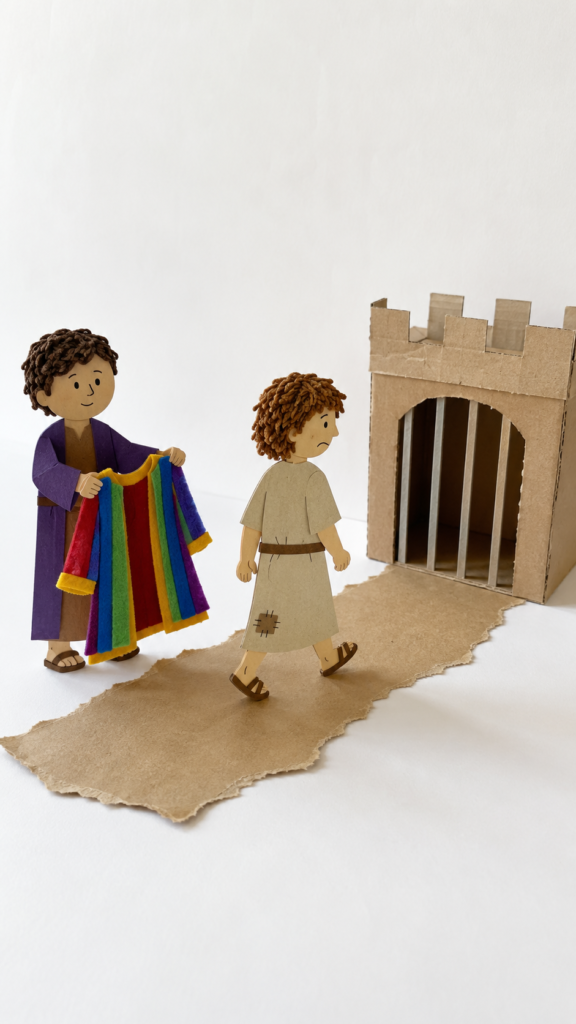
Potiphar’s wife noticed Joseph too, but not in the way Potiphar had.
Genesis describes her repeatedly trying to get Joseph to sleep with her, and Joseph refusing every time, telling her plainly that doing so would be a sin against God and a betrayal of the trust Potiphar had placed in him.
One day, she caught him alone, grabbed his cloak, and he ran, leaving the garment in her hand.
She used it as evidence, claiming Joseph had tried to attack her, and Potiphar had him thrown into prison. Joseph did nothing wrong here. He refused temptation consistently, kept his integrity intact, and was punished for it anyway.
This is worth sitting with honestly, especially with an older kid: doing the right thing doesn’t always protect you from consequences.
Joseph went from trusted head of a household to a prisoner, not because he failed, but because someone lied about him after he refused to do wrong.
That’s a harder lesson than most Bible crafts are willing to teach, but it’s true to the story, and it sets up exactly why Joseph’s character in prison matters so much next.
You’ll need:
- A small piece of fabric (to represent the cloak left behind)
- A figure for Joseph, a figure for Potiphar’s wife
- A small “prison” box or drawing
Steps:
- Have the kid act out Joseph pulling away, leaving the small piece of fabric behind in the other figure’s hand.
- Move the Joseph figure into the prison box, away from the household scene built in section 9.
- Ask the kid how it feels to imagine being blamed for something you refused to do, and having no one believe you.
- Talk through the difference between what’s fair and what actually happens, and how Joseph responds to that unfairness next.
- Leave the scene set up this way, with Joseph in prison, and tell the kid this is where two other men’s dreams are about to change everything.
Recycle everyday supplies with 23 Cute Paper Cup Crafts for Kids for Year-Round Creativity, featuring fun projects for every season..
11. Integrity in Prison
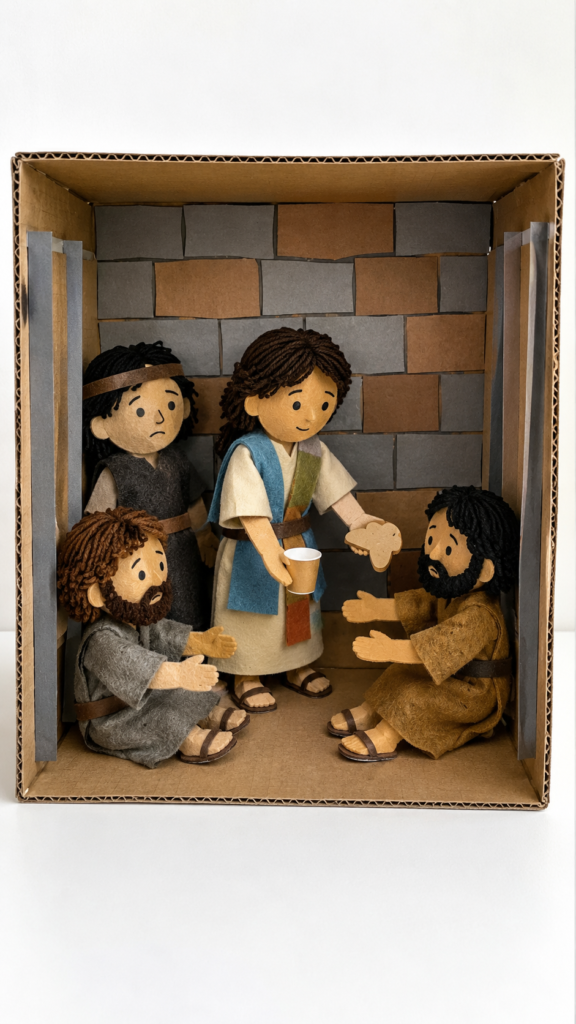
Joseph didn’t disappear into bitterness once he was locked up. Genesis says the Lord was with him there too, and that the prison warden, much like Potiphar before him, noticed something in Joseph worth trusting.
Before long, Joseph was overseeing the other prisoners, with the warden paying no attention to anything under Joseph’s care because he trusted it completely.
That’s a striking detail to slow down on with a kid: Joseph had every reason, by this point, to stop trying.
He’d been sold by his own brothers, falsely accused after doing the right thing, and thrown into prison for a crime he refused to commit. Nothing about his situation was fair. And yet the same steadiness that had defined him in Potiphar’s house showed up again here, in a place with far less reason to reward it.
This is the version of Joseph worth naming clearly: not someone whose good character appeared once he had power, but someone who held onto it in the one place it seemed to matter least.
Whatever happens later, with dreams and famine and reunions, starts from this quiet consistency in a cell he didn’t deserve to be in.
Steady in a Place That Owed Him Nothing
You’ll need:
- A small box or drawing to represent the prison
- Several small figures (for other prisoners)
- A figure for Joseph
- A small ledger or list, made from paper
Steps:
- Set up the prison scene with several prisoner figures scattered inside.
- Place the Joseph figure among them, then hand him the small paper ledger, as if he’s been given responsibility for the others.
- Ask the kid what it means that Joseph was given trust here, in a place where he had no reason left to expect anything good.
- Talk through the idea that character isn’t really tested when things are going well. It’s tested in a place like this one.
- Set the scene aside, and tell the kid two other men are about to arrive in this same prison, each carrying a dream Joseph will need to explain.
Keep craft time simple and colorful with 19 Easy Pipe Cleaner Crafts for Kids That Boost Creativity, offering projects that strengthen fine motor skills while encouraging imagination.
12. The Cupbearer’s Dream
Two of Pharaoh’s officials, his cupbearer and his baker, were thrown into the same prison after offending the king.
One morning, Joseph noticed both of them looking troubled, and asked why. Each had dreamed a dream the night before, with no one to explain what it meant.
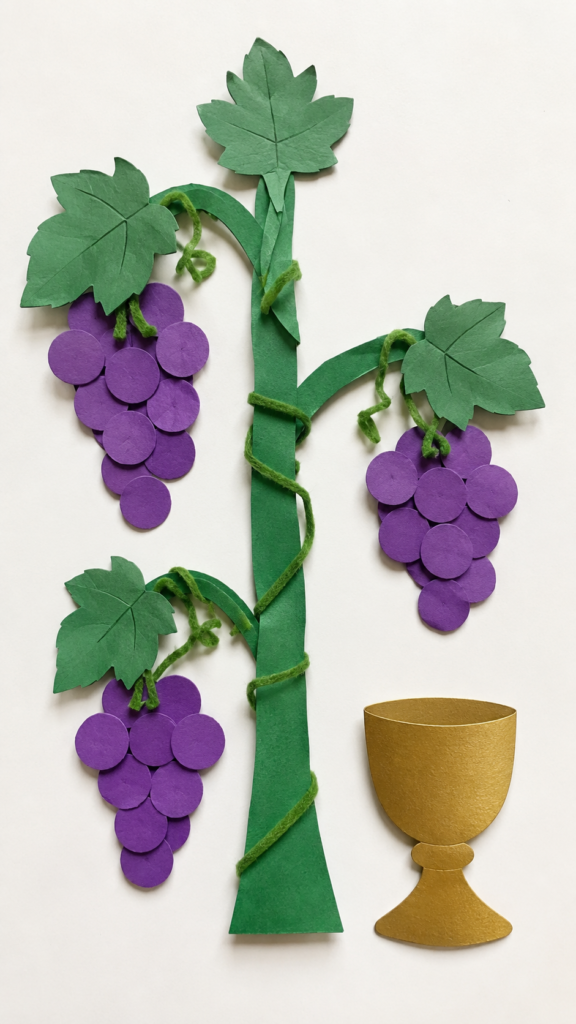
The cupbearer went first. He described a vine with three branches, budding, blossoming, and producing ripe grapes, all in the space of the dream.
He took the grapes, pressed them into Pharaoh’s cup, and placed it in Pharaoh’s hand.
Joseph told him plainly what it meant: the three branches were three days, and within three days, Pharaoh would restore him to his position as cupbearer.
Joseph asked for only one thing in return, that the cupbearer remember him once he was back in Pharaoh’s favor, and mention him to Pharaoh to help get him out of prison.
It’s a small, human request, worth noting with a kid: even while helping someone else, Joseph was still hoping, still trying to find his own way out of a situation he didn’t deserve to be in.
You’ll need:
- Green pipe cleaners or paper strips (for the vine and branches)
- Small purple pom-poms or paper circles (for grapes)
- A small cup shape cut from paper
Steps:
- Twist or shape the pipe cleaners into a vine with three separate branches.
- Attach the grape pom-poms or paper circles to each branch.
- Have the kid “press” the grapes into the small paper cup, then hand the cup to a figure representing Pharaoh.
- Talk through Joseph’s interpretation: three branches meaning three days, and restoration at the end of them.
- Ask the kid what they think Joseph was hoping for when he asked the cupbearer to remember him later.
Turn beach treasures into keepsakes with 19 Beautiful Seashell Crafts for Big Kids That Feel Beachy and Creative, perfect for older children who enjoy detailed craft projects.
13. The Baker’s Dream
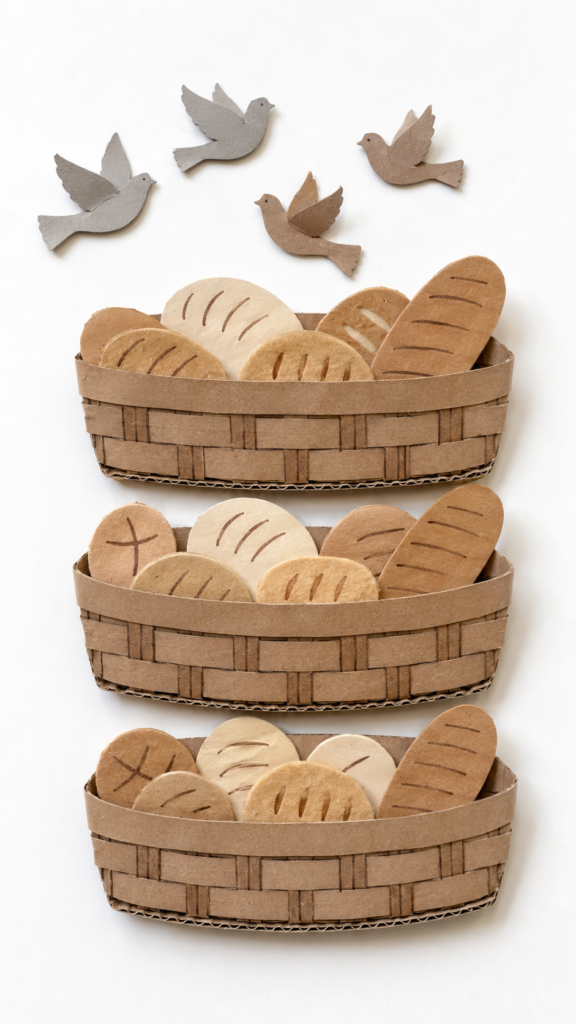
Encouraged by how well the cupbearer’s dream had gone, the baker told Joseph his own. In it, he carried three baskets stacked on his head.
The top basket held baked goods made for Pharaoh, and birds came down and ate out of that basket, right off his head, while he was powerless to stop them.
Joseph’s answer this time was not good news, and he didn’t soften it.
The three baskets, he said, were three days as well, but within three days Pharaoh would have the baker executed, and birds would eat his flesh.
It’s a detail rarely included in retellings of this story, likely because it’s grim and doesn’t resolve happily, but it’s exactly what the text says, and leaving it out flattens what Joseph was actually doing in that prison.
Joseph wasn’t simply handing out comforting words to anyone who asked. He interpreted both dreams honestly, even when one of them carried news no one wanted to hear.
That matters for understanding who Joseph was becoming: someone entrusted with the truth, even the hard parts of it, and willing to say it plainly rather than manage people’s feelings about what was coming.
You’ll need:
- 3 small basket shapes, cut from brown paper or woven from paper strips
- Small bread shapes cut from tan or brown paper
- A few small bird cutouts or stickers
Steps:
- Stack the three baskets, placing the bread shapes in the top one.
- Have the kid place the bird cutouts on or near the top basket, “eating” from it.
- Ask them what they think it felt like for the baker to hear this interpretation, so different from what the cupbearer was told.
- Talk through why Joseph gave the honest answer instead of a kinder, false one.
- Set both the cupbearer’s and baker’s crafts side by side, and ask the kid to notice how differently their two stories end, even though both men asked Joseph the exact same kind of question.
Create adorable handmade projects with 15 Easy Popsicle Stick Crafts for Kids That Turn Out So Cute, using inexpensive materials found in almost every home.
14. Pharaoh’s Two Dreams
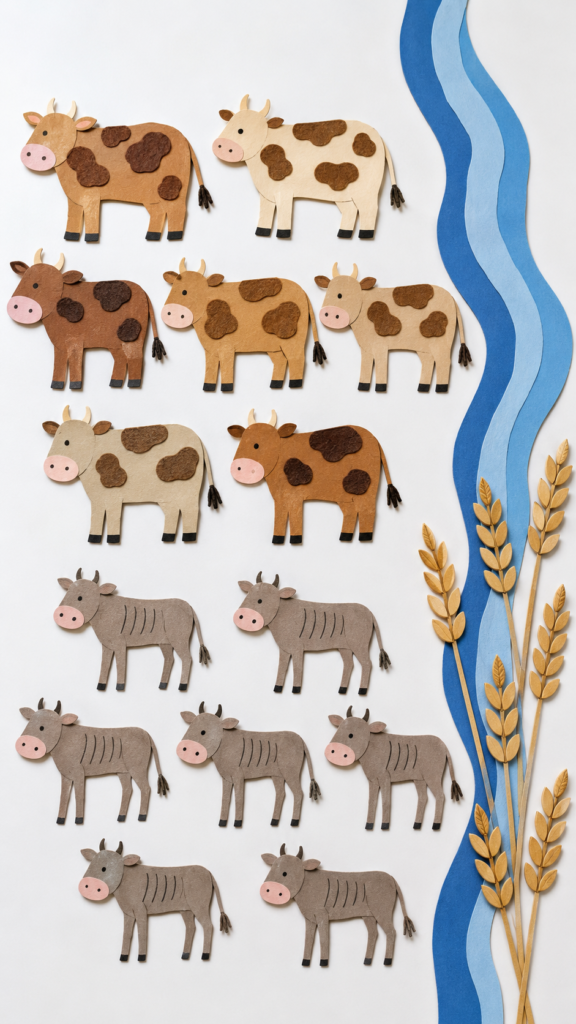
Two full years passed after the cupbearer was restored, and true to how these things tend to go, he forgot Joseph completely, at least for a while. Then Pharaoh himself began having dreams no one in his court could explain.
In the first, seven healthy, well-fed cows came up out of the Nile, followed by seven sickly, thin cows that ate the healthy ones without gaining any weight from it.
In the second dream, seven plump, full ears of grain grew on a single stalk, then seven thin, scorched ears sprang up and swallowed the good ones whole. Pharaoh woke up troubled both times, and none of his magicians or wise men could tell him what either dream meant.
That’s when the cupbearer finally remembered Joseph, and mentioned him to Pharaoh. Joseph was brought out of prison, shaved, given new clothes, and stood in front of the most powerful man in Egypt.
He was honest from the very first sentence: he couldn’t interpret dreams himself, but God could give Pharaoh the answer he needed.
Any accurate account of joseph and his coat of many colors crafts for kids has to include this moment, because it’s where the story stops being about Joseph surviving and starts being about Joseph being prepared for something much larger.
You’ll need:
- 14 small cow cutouts (7 plump, 7 thin) or use different colors to distinguish them
- 14 small ear-of-grain shapes (7 full, 7 withered)
- A blue strip of paper or fabric (for the Nile)
Steps:
- Lay the blue strip down as the river, and have the kid line up the 7 healthy cows coming out of it first.
- Follow with the 7 thin cows, and act out them “swallowing” the healthy ones without changing in appearance.
- Repeat the same pattern with the grain, full ears first, then the thin ones overtaking them.
- Ask the kid why they think nobody in Pharaoh’s court could explain these dreams, and what it might have felt like to have no answer for something that troubling.
- Talk through how Joseph’s honesty, telling Pharaoh plainly that the answer wasn’t his own to give, set him apart before he even said what the dreams meant.
Brighten the afternoon with 10 Fun Butterfly Crafts for Kids That Will Keep Little Hands Busy All Afternoon, featuring colorful butterfly projects children will enjoy making and displaying.
15. From Prisoner to Second-in-Command
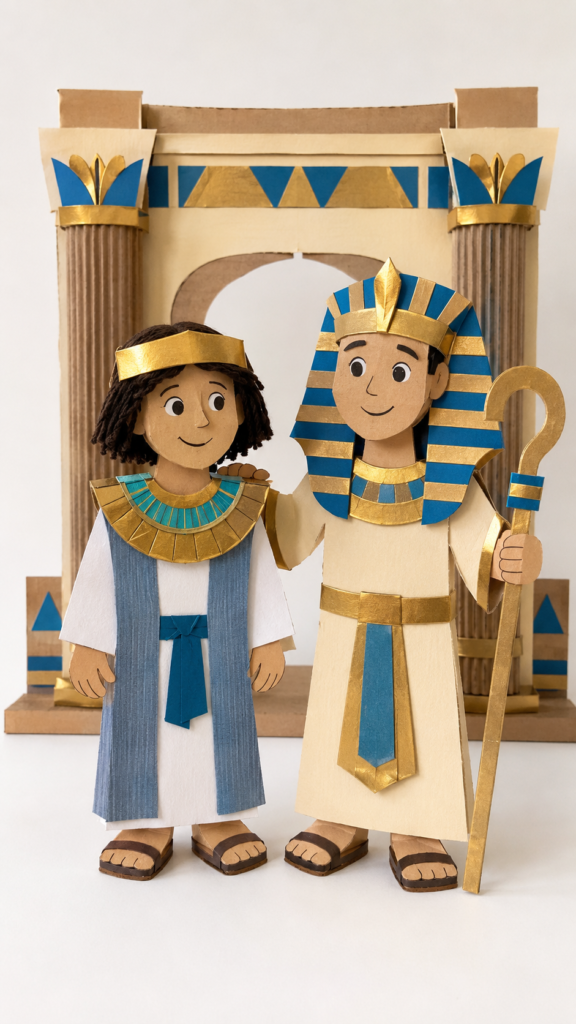
Joseph explained both dreams as one message: seven years of great abundance across Egypt, followed by seven years of severe famine so harsh it would erase all memory of the good years before it.
He didn’t stop at the interpretation. He gave Pharaoh a plan, appointing wise officials to collect and store a portion of the grain during the plentiful years, so there would be enough saved to survive the famine after.
Pharaoh’s response was immediate and total. He put Joseph himself in charge of the entire plan, second in command over all of Egypt, answering to no one but Pharaoh. A man who had been a prisoner that same day was now overseeing the country’s food supply for the next fourteen years.
It’s worth pointing out to a kid how fast this turn happens in the text, because it can read like luck if you’re not paying attention. It wasn’t luck.
Joseph had spent years being reliable in situations nobody was watching closely, in Potiphar’s house and then in prison, and when a moment finally called for someone trustworthy at scale, he was already the kind of person who could be trusted with it.
Any thorough joseph and his coat of many colors crafts for kids project should slow down here, because this is where everything Joseph built quietly earlier finally gets used.
You’ll need:
- A large box or bin (to represent Egypt’s storehouses)
- Dried beans, rice, or paper “grain” pieces
- A figure for Joseph, a figure for Pharaoh
Steps:
- Have the kid fill the box steadily over several rounds, representing each of the seven plentiful years, adding a handful each time.
- Once full, set the box aside and explain that this stored grain is what the whole country, and eventually Joseph’s own family, will depend on later.
- Ask the kid why storing up during the good years, instead of using everything right away, made the difference between survival and disaster.
- Talk through how quickly Joseph’s circumstances changed, and what he’d already built in himself before that change happened.
- Leave the storehouse full and set aside, and tell the kid this grain is exactly what brings Joseph’s brothers to Egypt next.
Turn ordinary rocks into colorful masterpieces with 10 Creative Rock Painting Ideas for Kids That Look Like They Took Hours, offering designs that are easier than they look.
16. Brothers in Egypt, Unrecognized

The famine Joseph predicted didn’t stay confined to Egypt.
It reached Canaan too, where Jacob and his remaining sons were living, and food ran short enough that Jacob sent ten of his sons to Egypt to buy grain, keeping only Benjamin, Joseph’s younger full brother, back home with him.
The brothers arrived and bowed before the Egyptian official in charge of distributing grain, not recognizing that the man in front of them was Joseph.
It had been roughly twenty years since they’d sold him. He looked different, spoke through an interpreter, and held a position none of them could have imagined him reaching. Joseph recognized them immediately. They had no idea who he was.
This moment deserves real attention in any joseph and his coat of many colors crafts for kids collection, because it’s the exact fulfillment of Joseph’s two childhood dreams, the sheaves and the stars, playing out decades later in a way none of them could have expected.
The brothers who once refused to speak a kind word to him were now bowing to him without knowing it.
You’ll need:
- 10 small figures (for the brothers who traveled)
- 1 separate figure, dressed differently (for Joseph, now an Egyptian official)
- A small pile of grain or beans (to represent what they’ve come to buy)
Steps:
- Set up the 10 brother figures approaching the Joseph figure, who should look distinctly different from how he was dressed in earlier sections.
- Have the kid bow the 10 figures down in front of him, just as Genesis describes.
- Ask the kid to hold two facts at once: Joseph knows exactly who they are, and they have no idea who he is.
- Talk through the sheaves and stars dreams from sections 3 and 4, and ask the kid to notice how directly this moment matches what those dreams showed years earlier.
- Leave the scene as a bow, unresolved, and tell the kid Joseph is about to decide what to do with the power he now holds over the very brothers who sold him.
Encourage curiosity about nature through Weather Crafts for Kids That Turn Curiosity Into Gentle Creativity, combining simple science with hands-on creativity.
17. The Silver Cup and Judah’s Offer

Joseph didn’t reveal himself right away. Instead, he tested his brothers, first accusing them of being spies, then demanding they bring Benjamin, the one brother left behind in Canaan, on their next trip before he’d sell them any more grain.
When they finally returned with Benjamin, Joseph had his personal silver cup hidden in the sack of grain Benjamin was carrying, then sent his steward after them, accusing them of theft.
The brothers, certain they were innocent, offered to have whoever was found with the cup put to death, and the rest of them made slaves.
When the cup turned up in Benjamin’s sack exactly where Joseph had placed it, they tore their clothes in grief and returned to face him, expecting the worst for their youngest brother.
That’s when Judah, the same brother who had once suggested selling Joseph for silver, stepped forward and offered himself in Benjamin’s place.
He described their father’s grief in detail, how Jacob had already lost one son he believed dead and would not survive losing Benjamin too, and asked to remain as a slave himself rather than let Benjamin suffer that punishment.
It’s a striking reversal worth naming plainly: the brother who once had no trouble giving Joseph up now refused to let a different brother be taken at all.
You’ll need:
- A small silver cup or spoon (or a cup shape cut from foil or silver paper)
- A grain sack made from cloth or paper
- Figures for Judah, Benjamin, and Joseph
Steps:
- Hide the small cup inside the grain sack before the kid sees where it’s placed.
- Have the kid “discover” the cup when the sack is searched, and react as the brothers might have.
- Move the Judah figure forward, in front of Joseph, offering to take Benjamin’s place.
- Ask the kid to compare this Judah to the one from section 7, who suggested selling Joseph for silver, and talk through what’s changed in him.
- Ask the kid why Joseph might have set up this exact test, of all the ways he could have handled seeing his brothers again.
Celebrate flowers with 6 Simple Flower Crafts for Kids That Encourage Creativity Over Perfection, where children can focus on creating instead of getting everything just right.
18. Joseph Reveals Himself
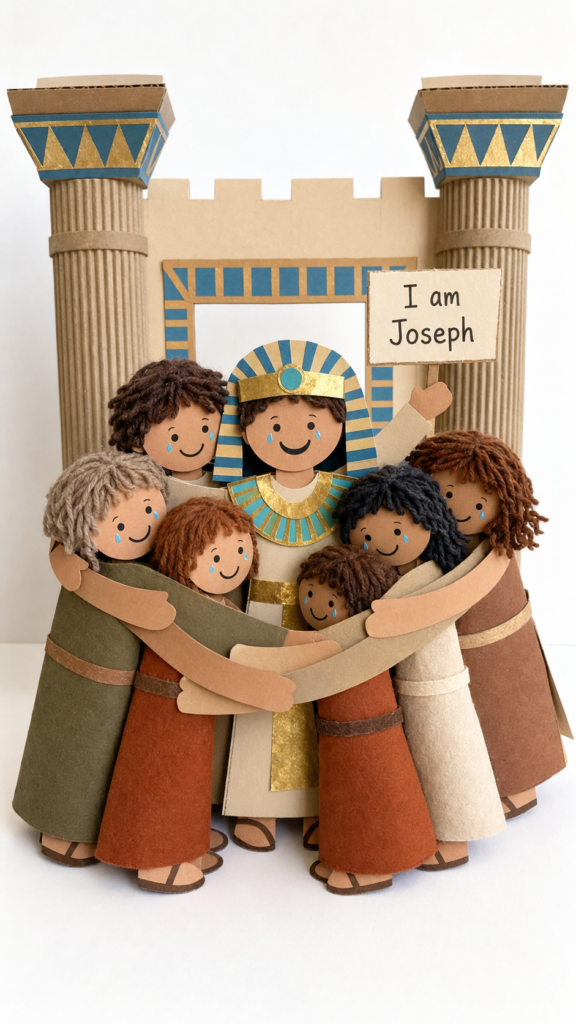
Judah’s offer was the moment Joseph couldn’t hold back any longer.
Genesis says he ordered every Egyptian attendant out of the room, then wept so loudly that the Egyptians outside heard him, and word of it reached all the way to Pharaoh’s own house.
Once he and his brothers were alone, he said the words they never expected to hear from an Egyptian official: “I am Joseph. Is my father still alive?”
The brothers were too stunned to answer him. Joseph had to ask them to come closer, and when he told them plainly who he was, the same brother they had sold twenty years earlier, they were left too shaken and afraid to speak at all.
What Joseph said next is the center of the whole story: that although they had intended harm against him, God had used it for good, to preserve the lives of many people, including their own.
That single line carries the weight of everything that came before it, the favoritism, the dreams, the pit, the silver, the false accusation, the prison, all of it. Joseph didn’t pretend none of it happened, and he didn’t minimize what they’d done.
He named it plainly, and forgave them anyway, choosing to see a larger purpose in it rather than holding the harm against them for the rest of his life.
You’ll need:
- A private, enclosed space (a blanket fort, a box, or a curtained-off corner)
- Figures for Joseph and the brothers
- A small card or paper with the line “I am Joseph” written on it
Steps:
- Set up the enclosed space and have the kid move the Joseph figure inside it, alone at first, as if sending everyone else away.
- Bring the brother figures in one at a time, and have the kid hold up the “I am Joseph” card at the moment of reveal.
- Ask the kid to imagine the silence in that room, the brothers too shocked to respond right away.
- Talk through Joseph’s exact words about what was meant for harm being used for good, and ask the kid what they think it took for him to actually mean that.
- Ask the kid: is forgiveness the same as saying what happened didn’t matter, or is it something else? Let them sit with the question rather than answering it for them.
Build creativity and confidence through Farm Animal Crafts for Kids: Building Confidence and Creativity Beyond the Tutorial, featuring fun farm-themed projects that encourage imaginative learning.
19. Reunited in Goshen
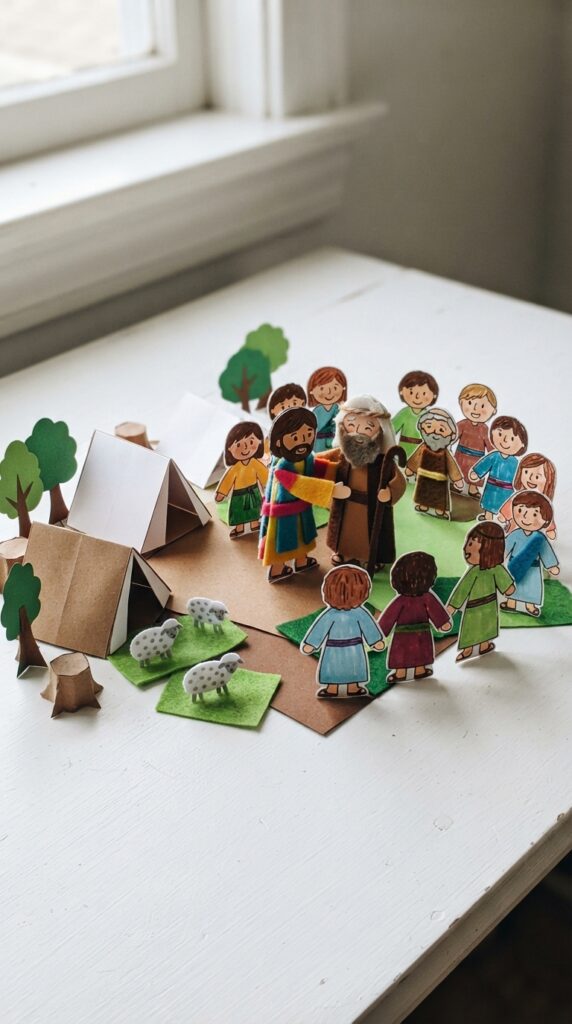
Joseph told his brothers to hurry back to Canaan and bring Jacob to Egypt, along with everyone in the family, since five years of the famine still remained.
Pharaoh himself backed the invitation, offering the family the best land in Egypt to settle on, a region called Goshen, well suited for their flocks and herds.
When Jacob heard that Joseph was still alive, Genesis says he could hardly believe it at first. Once he did, he said the only thing left worth saying: that he would go see his son before he died.
The journey to Egypt, and the reunion between Jacob and Joseph when it finally happened, is described simply but heavily, Joseph falling on his father’s neck and weeping for a long time, a father seeing again the son he had mourned as dead for over twenty years.
The family that had once broken itself apart over a robe, two dreams, and a decision to sell their own brother was whole again, settled together in Goshen, alive because of a plan Joseph had built years earlier in a country none of them had chosen to be part of.
It’s the ending worth landing on clearly: not a clean, easy resolution, but reconciliation that only became possible because someone chose to forgive rather than settle the score he’d earned the right to settle.
You’ll need:
- A simple map or drawing showing Canaan and Egypt, with Goshen marked
- All 12 brother figures, plus a figure for Jacob
- Small props (sheep, tents, or flocks) to represent settling the land
Steps:
- Have the kid move all 12 brother figures, plus Jacob, along the map from Canaan into Goshen.
- Set up the small flock props around the family once they’ve “arrived,” showing them settled rather than still traveling.
- Bring the Jacob and Joseph figures together for the reunion, and let the kid act out the embrace described in the story.
- Ask the kid to think back to section 2, Jacob’s favoritism, and section 5, the brothers who couldn’t speak a kind word, and talk through how far this family has come from where it started.
- Ask the kid the same question the whole story has been building toward: what does it take for a broken family to actually become whole again, not by forgetting what happened, but by choosing to move past it?
Before you leave, ensure to read: 20 Bible Character Halloween Costumes for Kids — Easy DIY Ideas for Trunk or Treat
Conclusion
Joseph had every reason to hold on to his anger. His brothers betrayed him, and twenty years later, he finally had the power to punish them.
Instead, he chose forgiveness.
That’s the lesson children can carry with them long after the craft is finished—more than Joseph’s colorful coat, his dreams, or any activity in this collection. His story shows that forgiveness takes strength and can bring healing even after deep hurt.
Try a few of these crafts with your children, then pay attention to the questions they ask afterward. Those conversations often become the most meaningful part of the lesson.